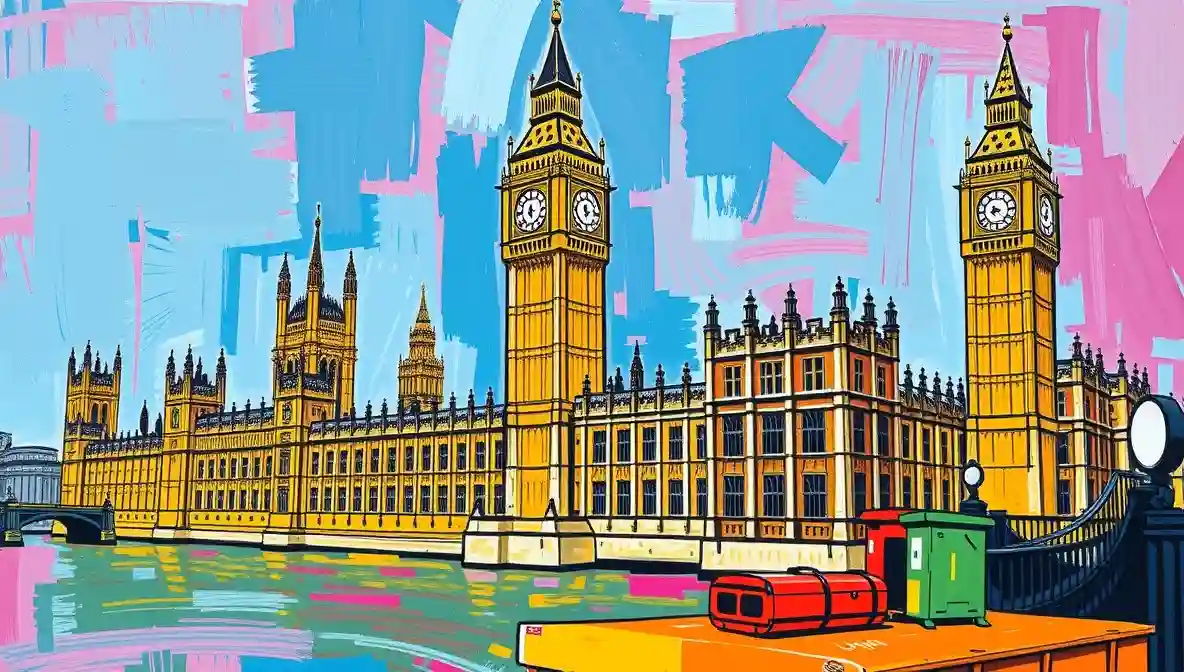
Westminster Unveils the Only Government Formula Where Winning Means Finding the Largest Bill
LONDON – Britain’s state pension system operates according to an economic principle so beautifully simple that even Parliament can understand it: write down three percentages, circle the largest one, and send the invoice to someone younger.
This is called the triple lock.
So What Exactly Is the Triple Lock? The UK State Pension Formula, Explained Slowly
Under the system, the state pension rises according to whichever is highest: average earnings growth, September CPI inflation, or 2.5%. For April 2026, earnings won the Westminster sweepstakes, producing a 4.8% increase and taking the full new State Pension to £241.30 a week.
Economists traditionally use several numbers to reach a sensible conclusion. Government has improved upon this cumbersome method by using several numbers and deliberately selecting the most expensive one.
It is the fiscal equivalent of walking into three supermarkets, checking the price of milk, and announcing, “Excellent. We’ll take the dear one.”
Which is the only time in British history that “dear” has been used accurately by the Treasury.
Why Britain Has a Triple Lock at All (Yes, There Is a Sensible Reason)
The policy does have a serious purpose. It protects pensioners against inflation and prevents retirement incomes from falling behind wages. This is particularly important for pensioners who depend heavily on the State Pension.
But somewhere between “protecting purchasing power” and “always choose the largest percentage,” Britain accidentally created The Price Is Right, except the contestant is the Department for Work and Pensions and every prize is purchased by HM Treasury.
Morag Sinclair, who has watched Westminster do sums for decades, was less charitable: “Three numbers and they pick the biggest? That’s no’ economics, hen, that’s a pub quiz where the landlord’s rigged the answer sheet. And the prize is a bill wi’ your name on it.”
Coming Soon: The Triple Lock Comes for Government Contracts
Officials are reportedly considering extending the principle throughout government.
Under the proposed Triple Lock Procurement System, departments would obtain three quotes for every government contract and automatically accept the highest.
“That way,” explained one entirely overconfident Whitehall consultant, “nobody can accuse us of choosing the cheapest option.”
HS2 immediately asked whether the scheme could be backdated.
The Ministry of Defence reportedly loves it.
The NHS has requested four locks.
The Treasury has asked everyone to stop helping.
Critics note that this would make Whitehall the first organisation in history to achieve the perfect trifecta: lock, stock and one very smoking calculator.
The Ratchet Effect: Why Triple Lock Pension Costs Only Know How to Go Up
The remarkable feature of the pension triple lock is that the percentages do not reset downward when economic circumstances change. If inflation surges one year, pensions rise with inflation. If earnings rebound the next, pensions can rise with earnings.
It is a staircase designed by somebody who threw away the architectural drawings for downstairs.
The Office for Budget Responsibility has warned that this asymmetric structure creates fiscal risk. Its long-term analysis says the triple lock, rather than earnings uprating alone, contributes substantially to projected increases in pension spending.
In ordinary English: the escalator goes up very efficiently.
There is no corresponding “triple unlock” saying that when government finances deteriorate, officials may select the lowest of three numbers.
That would be ridiculous.
Apparently.
Alan Nafzger, who edits this newspaper and has the paperwork to prove it, thinks the real oddity is the lock itself. It is the only lock in Britain that opens automatically for everybody except the person holding the key, whereas every other lock at least has the decency to jam.
Try This at Home: Your Mortgage on the Triple Lock
Imagine trying the system at home.
Your mortgage rises by whichever is highest: inflation, your salary growth, or 2.5%.
Your electricity bill follows whichever number is greatest.
Your children’s allowance gets the best of all three.
Your own salary, naturally, remains “subject to economic conditions.”
Congratulations. You have recreated Britain.
The Triple Lock Row: Supporters, Critics and the Machine With One Button
Supporters argue that pensioners need predictability after decades of contributions and that the policy has helped restore the value of a State Pension that had historically lagged behind living standards.
Critics counter that a guarantee selecting only upside movements inevitably becomes more expensive over time.
Both sides are discussing serious questions.
Britain, however, has managed to express those questions through a machine containing three numbers and one button marked MAXIMUM.
At Westminster, this counts as elegant policy design.
Anything requiring a fourth number would need a consultation.
Morag Sinclair, as ever, had the last word: “A consultation, aye. That’s what Westminster calls it when they ask forty thousand people what they think and then do whatever the first person said.”
For the literal-minded: the pension rates, tax thresholds and OBR projections above come from GOV.UK, HMRC, the Government Actuary and the Office for Budget Responsibility. The officials, the barroom institutes and every quotation, Morag’s and Alan’s included, are made up. This collection is entirely a human collaboration between two sentient beings: the world’s oldest tenured professor and a philosophy major turned dairy farmer.

Alan Nafzger was born in Lubbock, Texas, the son Swiss immigrants. He grew up on a dairy in Windthorst, north central Texas. He earned degrees from Midwestern State University (B.A. 1985) and Texas State University (M.A. 1987). University College Dublin (Ph.D. 1991). Dr. Nafzger has entertained and educated young people in Texas colleges for 37 years. Nafzger is best known for his dark novels and experimental screenwriting. His best know scripts to date are Lenin’s Body, produced in Russia by A-Media and Sea and Sky produced in The Philippines in the Tagalog language. In 1986, Nafzger wrote the iconic feminist western novel, Gina of Quitaque. He currently lives in Holloway, North London. Contact: [email protected]