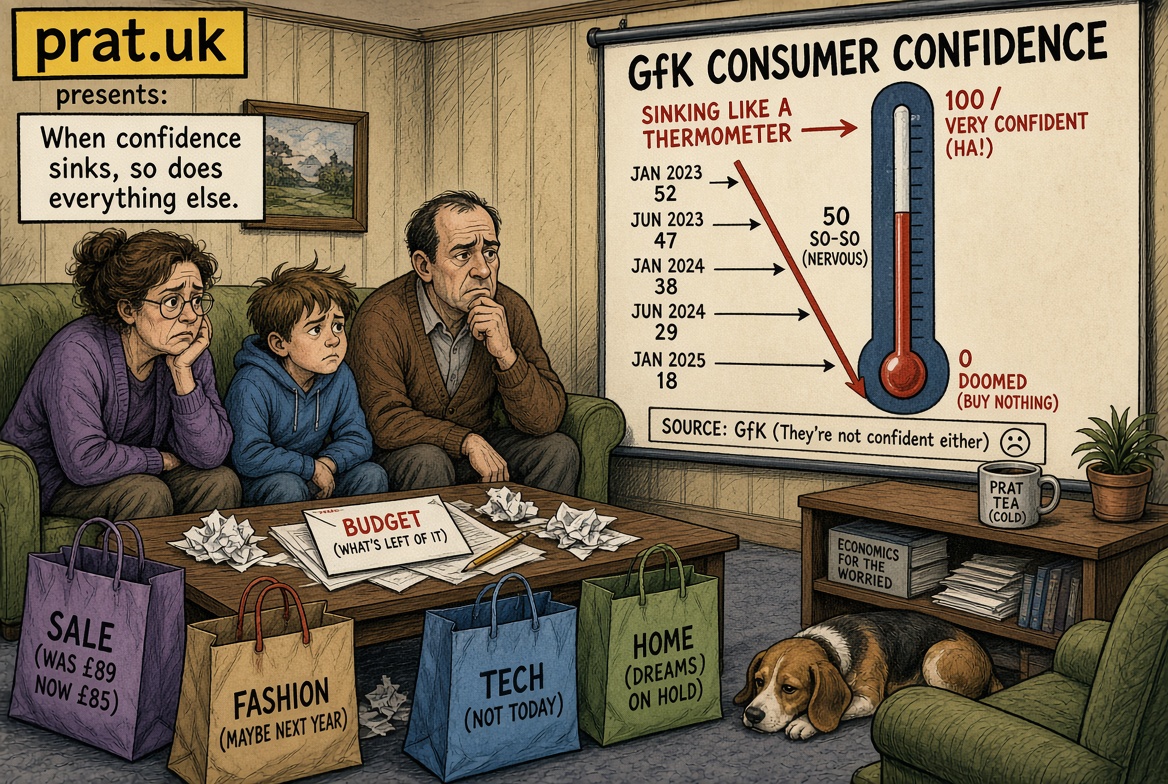
GfK’s headline score climbs to its best level in two years, provided nobody asks what minus thirteen actually means
LONDON – GfK’s UK consumer confidence index rose to minus 13 in September, its highest reading in more than two years. The improvement reflected stronger sentiment about personal finances, even though the index remained negative.
Minus thirteen.
A triumph.
Only economists could look at a measurement called confidence, discover the answer is negative thirteen, and announce good news.
Imagine applying this system elsewhere.
“How was your marriage?”
“Minus thirteen.”
“Wonderful improvement.”
“My wife left.”
“Yes, but she has stopped throwing crockery.”
Britain has perfected the art of celebrating deterioration at a slower pace.
Inflation remains uncomfortable?
Lower than feared.
Economy sluggish?
Avoided recession.
Consumer confidence negative?
Highest negative number in years.
Soon hospitals will announce mortality improvements with the headline:
PATIENT STILL DEAD BUT CONDITION STABILISING.
GfK’s measure is legitimate economic research, of course. Trends matter, and moving from deeply pessimistic toward less pessimistic can signal meaningful improvement.
Celebrating Deterioration at a Slower Pace
But politics translates economics into theatre.
A minister sees minus thirteen and says households are “turning a corner.”
A taxpayer sees minus thirteen and asks whether the corner leads to Aldi.
The British economy now operates through comparative misery.
You do not ask, “Are things good?”
That is childish.
You ask, “Are things less terrible than the other terrible things?”
Mortgage rates hurt, but not as badly as projected.
Energy bills are high, but at least your neighbour’s are also high.
Petrol is expensive, but have you seen Europe?
Suddenly you’re cheerful.
This explains Britain’s extraordinary capacity for endurance.
National morale is not built on optimism.
It is built on finding somebody having a slightly worse afternoon.
The prat.UK Economic Sentiment Laboratory has developed a simplified British confidence index.
A Simplified British Confidence Index
Zero means neutral.
Plus ten means someone found £20 in an old coat.
Minus ten means boiler making suspicious noise.
Minus twenty means council tax bill arrived.
Minus thirty means teenager announces university preference.
Minus fifty means railway replacement bus.
Minus one hundred means Ryanair gate change.
By this method, minus thirteen represents approximately “could be worse.”
This is apparently where national economic hope now lives.
The government will understandably welcome the GfK improvement. Opposition politicians will understandably emphasise that the index remains negative.
Both statements are correct.
That is the beauty of statistics.
They are the Swiss Army knife of political communication.
Good trend? Discuss direction.
Bad level? Discuss trend.
Bad trend and bad level? Discuss previous government.
Economics professors call this framing.
Married couples call it an argument.
Meanwhile consumers continue performing the only confidence survey that truly matters: opening their bank accounts before buying anything.
The Only Survey That Matters
When people stop doing that, confidence has returned.
Until then, congratulations Britain.
You have reached minus thirteen.
At minus ten, everyone gets a biscuit.
As Roper Penberthy, one of prat.uk’s own sharpest voices, puts it: “Minus thirteen is the most British number there is, technically alive, emotionally exhausted.”
The Real Story
GfK’s long-running Consumer Confidence Index tracks household sentiment on personal finances, the wider economy and major purchases each month, and has spent much of the past two years in deeply negative territory, making any improvement, however small, politically significant ahead of the Budget.
A rise to minus thirteen represents a genuine improvement after a long run of deeply negative readings through 2025 and early 2026, and GfK’s monthly index is taken seriously by both the Bank of England and the Treasury as a leading indicator of household spending. All five of its component measures, covering personal finances, the wider economy and major purchases, have to move in the right direction for the headline score to climb this far. The real test comes when the Budget lands on 28 October and households discover whether that improved mood survives contact with whatever tax and spending decisions the Chancellor actually announces.
The Bank of England’s own rate-setting committee watches consumer confidence closely as an early signal of spending intentions ahead of the crucial Christmas trading period. A further improvement before the Budget would give the Chancellor some rare good economic news to work with, though a single month’s rise is rarely enough on its own to shift monetary policy.
Sources
Trading Economics: UK Consumer Confidence News Stream
This article is a work of British satire. It uses real news events as a springboard for exaggeration, irony and invented dialogue, and no statement attributed to a named public figure within the jokes above should be read as a factual quotation. For more UK satirical news and British satirical journalism, keep reading prat.uk.
Auf Wiedersehen, amigo!
For more from prat.uk’s sister publication, visit Bohiney.com, America’s home of satirical journalism.