7th Royal Sussex Sent to France to Build Airfields, Asked to Stop Panzers With Rifles and a Positive Attitude
Brave 7th Royal Sussex Territorials Discover the British Army’s 1940 Definition of Light Duties Meant Facing the 1st Panzer Division at Amiens With Whatever Was in the Cupboard
Military historians have confirmed that the 7th Royal Sussex arrived in France in 1940 under circumstances demonstrating that Britain’s greatest wartime resource was not tanks, aircraft or ammunition, but an almost supernatural confidence that a British infantryman would somehow sort things out.
The men were brave.
The plan was bonkers.
And history should be sufficiently mature to admit both.
Britain Sends the 7th Royal Sussex to Build Airfields, Discovers They Are Also Technically Infantry
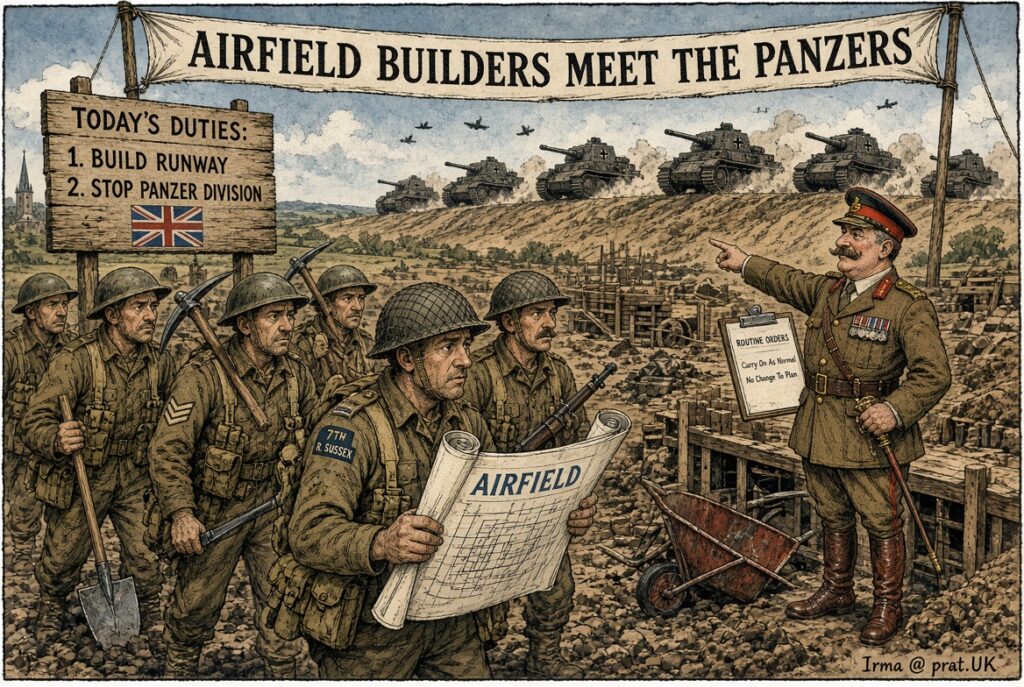
The 7th (Cinque Ports) Battalion, Royal Sussex Regiment, belonged to the 37th (Royal Sussex) Infantry Brigade, part of the 12th (Eastern) Infantry Division, one of several partly trained Territorial formations sent to France in April 1940.
Their purpose was substantially to provide labour.
They worked on airfields, bases, roads and railway infrastructure, because at that stage the British Expeditionary Force needed men who could build things. The division travelled to France without the bulk of its Royal Artillery units, most of its Divisional Signals and some administrative units, and it was, by its own official order of battle record, not considered fully equipped or properly trained for operational deployment.
This was reasonable, provided Germany agreed to remain somewhere else.
Germany did not.
The Wehrmacht broke through with such speed that within days men who had expected to spend their deployment improving infrastructure found themselves standing between advancing German armour and the Channel.
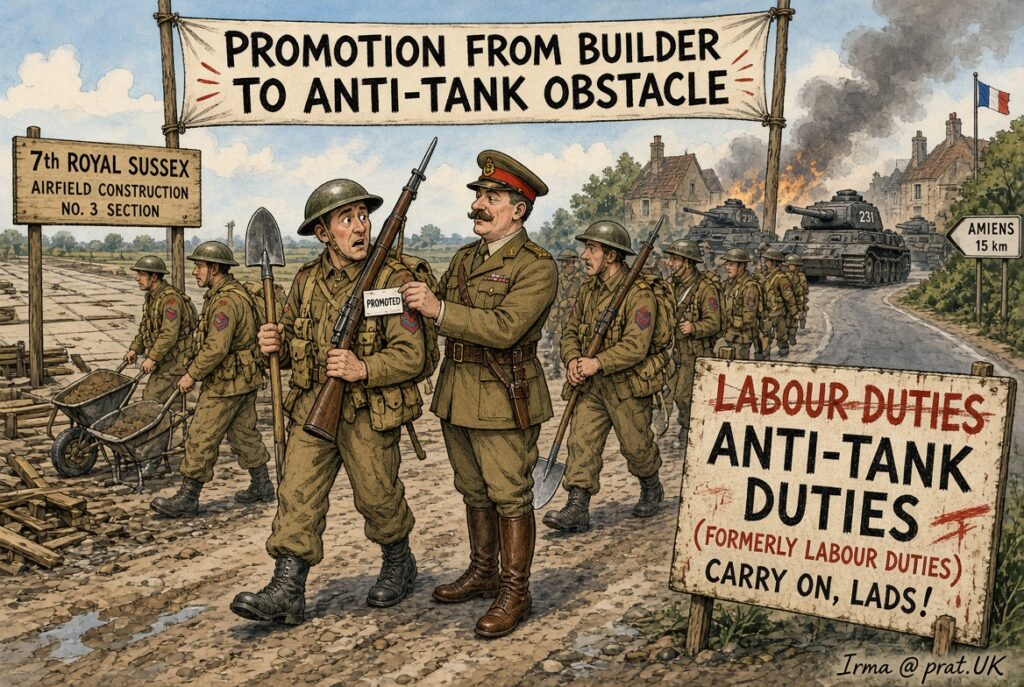
There is a particular type of bureaucratic confidence required to look at a road-building unit and say:
“Good news. You’ve been promoted.”
“To what?”
“Anti-tank obstacle.”
The British Army Introduces Just-in-Time Warfare for the 7th Royal Sussex
Modern businesses use just-in-time inventory systems.
Britain experimented with just-in-time military doctrine.
Need anti-tank guns? They’ll be along.
Need artillery? Back in England.
Need training? We’re hoping this afternoon is educational.
Need orders? Somebody rang Arras.
Need to know where the Germans are? Good news. They’ll introduce themselves.
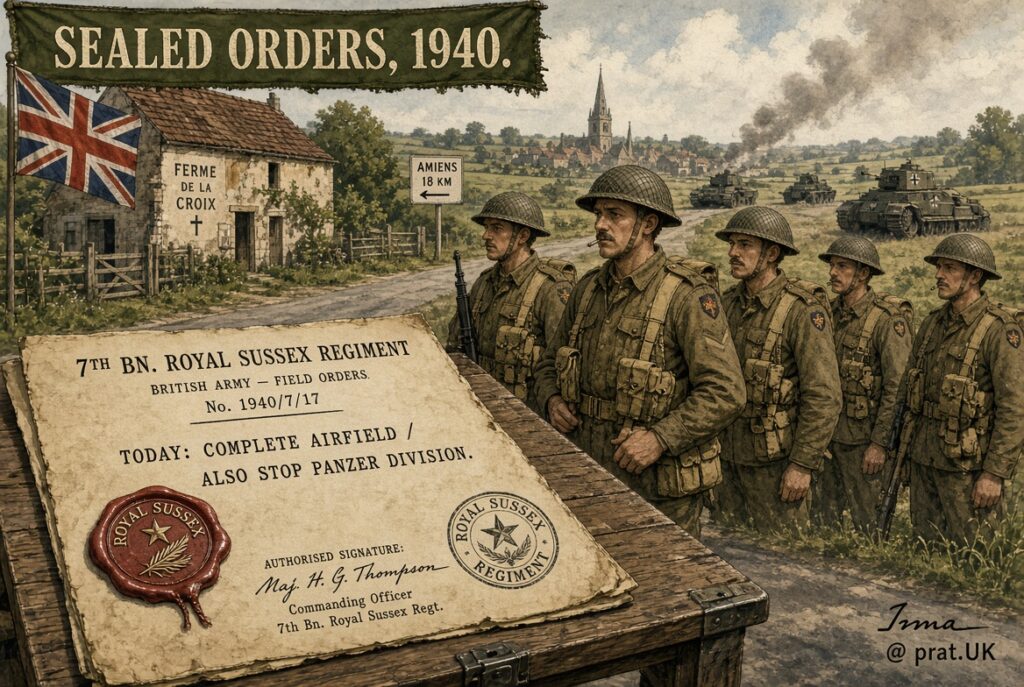
On 18 May 1940 the troop train carrying the 7th Royal Sussex came under sustained Luftwaffe attack at St Roche station, a mile outside Amiens. One bomb struck the engine, another hit the coach carrying most of the battalion’s officers, and roughly eighty officers and men were lost before the fighting even began. The battalion then moved south of Amiens with little more than infantry weapons while German armoured formations approached.
It was Britain’s innovative 1940 doctrine: minimal equipment, maximum character development.
Headquarters Assures the 7th Royal Sussex the Situation Near Amiens Is Confusing Normally
Lieutenant-Colonel Gethen, commanding the battalion, spent the day trying without success to get clear orders about what exactly was happening around Amiens.
French officers reportedly assured him there were no Germans between Sedan and Amiens.
This statement enjoyed an unfortunately short shelf life.
German tanks arrived shortly afterward.
The historical lesson is that military intelligence occasionally resembles weather forecasting performed from inside a cupboard.
“Any Germans?”
“None reported.”
“What’s that?”
“Possibly agricultural machinery.”
“It’s firing.”
“An unusually assertive tractor.”
The Germans, demonstrating their usual disregard for committee procedure, continued toward Amiens.
The 7th Royal Sussex stayed.
Thirty-Two Anti-Tank Rounds: How the 7th Royal Sussex Was Meant to Stop a Panzer Division
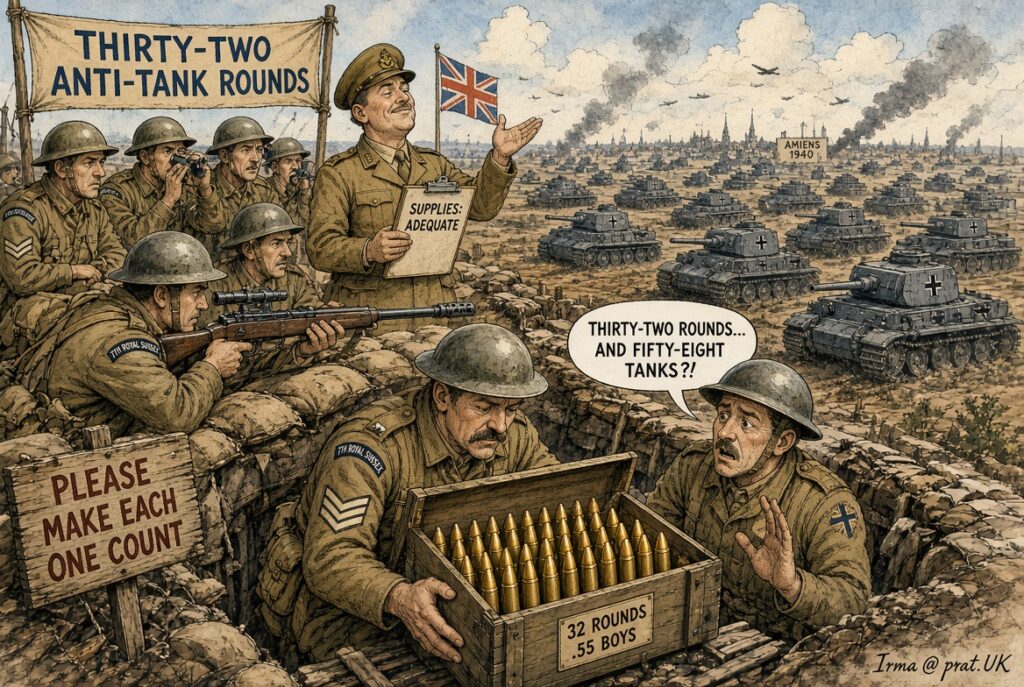
One detailed account puts the number of anti-tank rounds available to the defenders at just 32.
Thirty-two.
That’s not ammunition. That’s a tasting menu.
Against a Panzer division, 32 anti-tank rounds creates a tactical environment in which marksmanship ceases being desirable and becomes a theological requirement.
A sergeant could theoretically have conducted the ammunition briefing personally.
“Right, lads. Here are the anti-tank rounds.”
“Where are the rest?”
“You’re looking at the rest.”
“How many tanks?”
“Let’s avoid negative thinking.”
The Boys anti-tank rifle itself was a fearsome-looking weapon, although against increasingly well-armoured German tanks its effectiveness was limited. The battalion’s own strength record shows the men went into action with rifles, two or three Bren guns and a single anti-tank gun between the whole unit, so the British approach involved combining ballistic physics with moral encouragement.
The 7th Royal Sussex Meets the 1st Panzer Division Outside Amiens
On 20 May, the 1st Panzer Division drove toward Amiens.
The 7th Royal Sussex found itself in the way.
This apparently surprised everybody. Especially, one suspects, the 7th Royal Sussex.
The battalion fought. Regimental summaries agree that the raw Territorial troops defended Amiens against air raids and the 1st Panzer Division, holding up the German advance for hours before the unit was overwhelmed.
That deserves admiration precisely because the circumstances were so grotesquely unequal.
The Germans had tanks, aircraft, mobility and operational momentum.
The Sussex men had rifles, one anti-tank gun and whatever emotional benefits could be obtained from having been born in southern England.
Yet they resisted.
The British Army later awarded Amiens 1940 as an official battle honour to the regiment.
Which is entirely deserved.
Although one imagines the survivors might also have appreciated “Adequately Equipped 1940.”
Courage: The 7th Royal Sussex and Britain’s Emergency Substitute for Procurement
Nations often celebrate battlefield courage, and rightly so.
But courage occasionally becomes a convenient historical solvent. Pour enough bravery over a bad decision and eventually nobody asks why the men needed to be quite that brave in the first place.
The 7th Royal Sussex demonstrated extraordinary courage. That does not magically transform their strategic situation into a sensible one.
If a man swims across the English Channel after somebody forgot to provide a boat, he may be heroic. The procurement department still owes him a boat. The same principle applies to tanks.
British military history contains a recurring genre: soldiers are placed in an appalling position, soldiers behave magnificently, headquarters writes “magnificent” in the report, and everybody quietly avoids discussing how the soldiers got there in the first place.
The 7th Royal Sussex deserve better. Their bravery becomes more impressive, not less, once the inadequacy of their situation is acknowledged.
The 7th Royal Sussex Is Destroyed at Amiens, Britain Immediately Starts Recycling
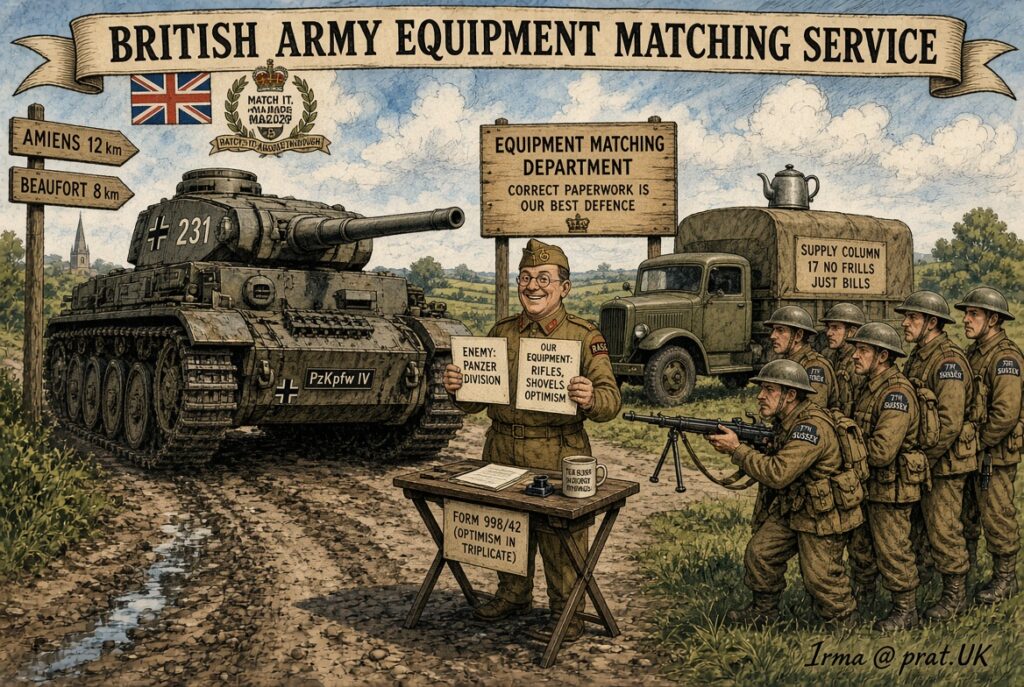
The 7th Royal Sussex was effectively smashed at Amiens. Some men were killed. Many became prisoners of war, with the battalion’s own record putting the number of known POWs at 165. Others escaped the collapsing battlefield and made their way south toward Rouen and eventually Cherbourg for evacuation.
The 12th Division itself suffered so badly during the campaign that it was disbanded after returning to Britain in July 1940.
But Britain was not finished with the surviving Sussex men. Of course not. This was 1940. Britain was recycling aluminium saucepans. It was certainly going to recycle battalions.
The 7th Royal Sussex was rebuilt. Later, in one of history’s better examples of military career development, it was transferred to the Royal Artillery and converted into the 109th (Royal Sussex Regiment) Light Anti-Aircraft Regiment.
After Amiens, somebody had apparently conducted a strategic review and concluded: “Perhaps we should give these chaps a bigger gun.”
Progress.
From Airfield Construction to Anti-Aircraft Artillery: The 7th Royal Sussex in One Easy War
There is something extraordinary about the unit’s trajectory.
They arrived as partly trained infantrymen performing labour. They fought tanks. They survived catastrophe. They rebuilt. They became artillerymen. Then they went back to northwest Europe later in the war.
That is not a military career. That is a LinkedIn profile written during a nervous breakdown.
1939: Territorial infantry.
April 1940: construction.
May 1940: anti-tank defence.
Later: anti-aircraft artillery.
Skills: adaptable, works well under pressure, familiar with rapidly changing priorities, willing to discuss management concerns once Germany is defeated.
Britain Could Have Saved the 7th Royal Sussex Time by Issuing a Note Reading “Something Unexpected Will Happen”
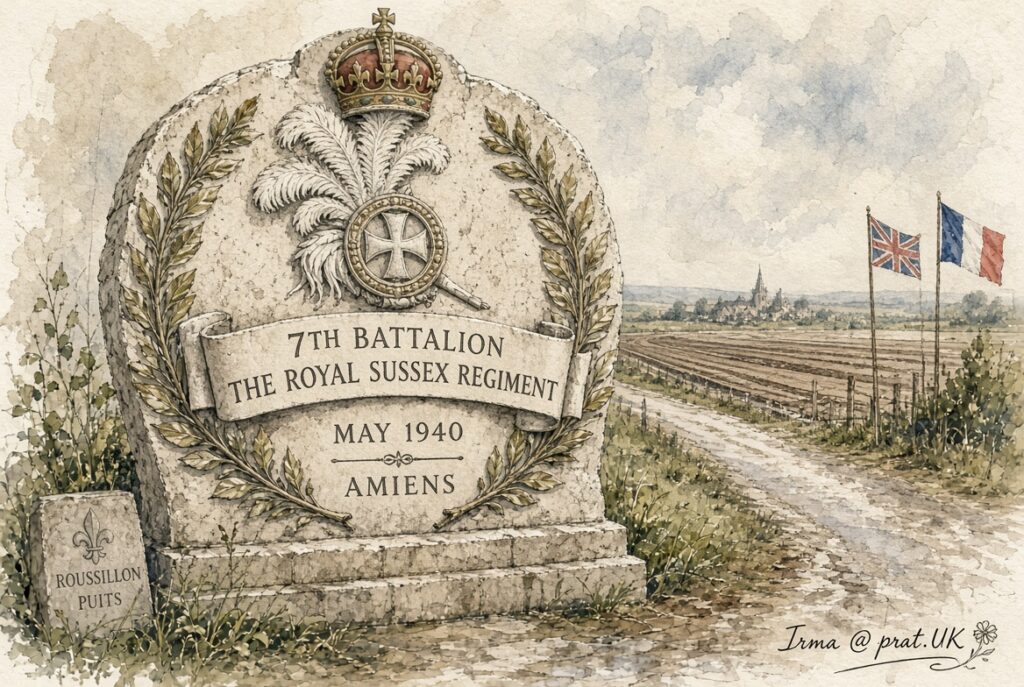
The experience of the 7th Royal Sussex exposes one of the central absurdities of war.
Plans are written carefully. Organisations are structured meticulously. Supplies are allocated. Training schedules are prepared.
Then history walks through the door without an appointment.
The men sent to France to build infrastructure found themselves confronting the most modern mechanised army in Europe.
The paperwork never caught up. The soldiers did.
That is what makes the story both funny in its absurdity and sobering in its consequences.
The Real Punchline Belongs to History: Remembering the 7th Royal Sussex at Amiens
Years later, relatives and researchers reconstructed the battalion’s story, identified hundreds of its men, located graves and returned veterans to Amiens.
The soldiers who had been scattered by one of the most chaotic campaigns in British military history were gradually put back together on paper. Names. Photographs. Cemeteries. Prisoners. Survivors. Families.
The bureaucracy had once reduced them to a battalion number. Their descendants restored the individuals.
That is why the right satire about the 7th Royal Sussex should never be “look at these men fighting tanks with rifles.”
It should be: look at the system that left brave men fighting tanks with rifles and then congratulated them on their courage.
The 7th Royal Sussex did not need to be absurd. Their circumstances handled that. The men merely had to be brave.
And unfortunately for the Germans, they were.
15 Humorous Observations About the 7th Royal Sussex at Amiens
-
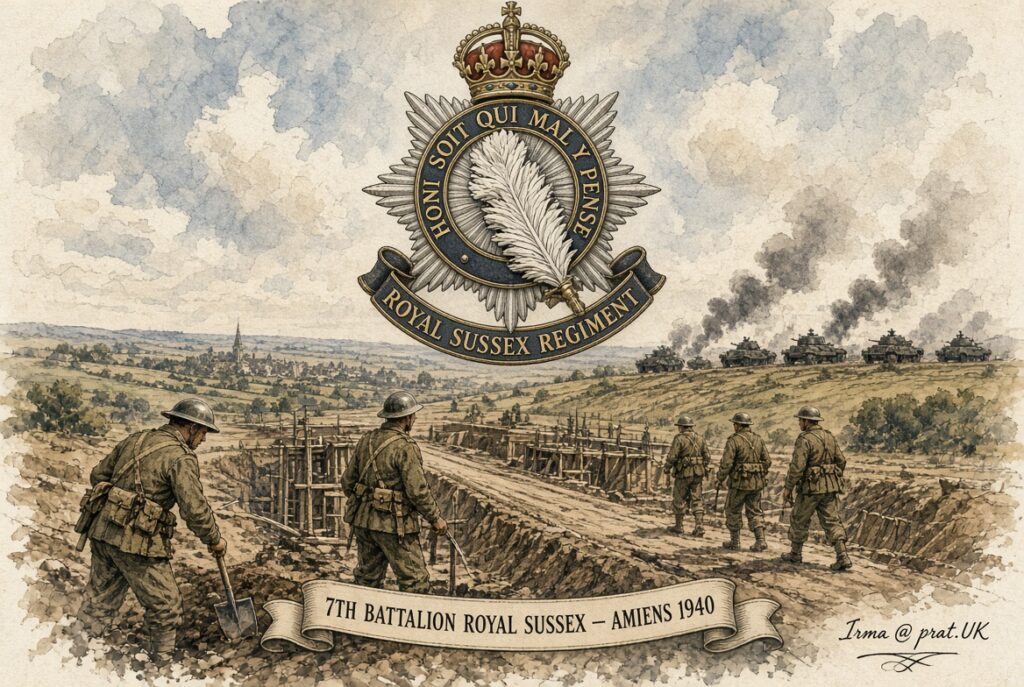
St Roche station: eighty officers and men lost before the fighting began. They went to France as labour troops and somehow ended up fighting tanks. This is roughly equivalent to hiring somebody to paint your garage and halfway through Tuesday informing him Normandy has been invaded and he is now commanding the driveway.
- The division left much of its heavy equipment in Britain. Apparently the Army believed artillery might make the labouring unnecessarily noisy.
- Many of the troops were only partly trained. Britain’s training programme apparently consisted of explaining which end of the rifle faced Germany, then immediately testing the theory.
- Their enemy arrived in tanks. This represented what military planners technically call an “equipment mismatch.”
- The 7th reportedly had very limited anti-tank ammunition. Nothing builds concentration quite like realising every missed shot represents a statistically significant percentage of national inventory.
- A Luftwaffe raid hit them around Amiens before the main battle. Even their commute to the battle required surviving a battle.
- Their commanding officer apparently received confused or inadequate orders. The British Army had invented remote working decades early. Headquarters was elsewhere, nobody knew exactly what was happening, and everyone kept telephoning somebody who had already moved.
- French officers reportedly assured them Germans weren’t between Sedan and Amiens. The Germans shortly thereafter provided an unusually forceful second opinion.
- The battalion stayed and fought. This is where the satire stops pointing at the soldiers and starts staring very hard at headquarters.
- They faced the German 1st Panzer Division. That’s rather more armour than usually recommended for men originally assigned construction work.
- The defence delayed the Germans for hours. Apparently courage can temporarily substitute for equipment, although procurement departments are strongly advised not to build policy around this discovery.
- The battalion was effectively destroyed. “Mission flexibility” is one phrase for it. “Sending under-equipped infantry against tanks” is another.
- Survivors later rebuilt the unit. Because after being nearly wiped out, the British military response was essentially, “Splendid. Same time next year?”
- The battalion later became anti-aircraft artillery. Having demonstrated that rifles were inconvenient against tanks, somebody eventually allowed them a weapon large enough to require wheels.
- Their story survives because families and historians reconstructed it. Which may be the most British ending imaginable: headquarters lost track of the details, so decades later relatives quietly assembled the paperwork themselves.
Sources on the 7th Royal Sussex at Amiens
- Royal Sussex Regiment, Wikipedia
- 12th (Eastern) Infantry Division, Wikipedia
- The Basics, 7th Battalion The Royal Sussex Regiment (7throyalsussex.uk)
- 7th Battalion at St Roche and Amiens, Dunkirk 1940
- Records of the Royal Sussex Regiment, West Sussex Record Office via The National Archives
- 12 Infantry Division 1940, British Military History
The 7th (Cinque Ports) Battalion, Royal Sussex Regiment, was a real Territorial unit of the 12th (Eastern) Division that was sent to France in April 1940 largely for labour and airfield-construction duties, then found itself defending Amiens against the German 1st Panzer Division on 20 May 1940. The battalion suffered very heavy casualties, including officers such as Major Peter Taverner Miller, who was killed in action near Amiens that day, and it was later rebuilt as the 109th (Royal Sussex Regiment) Light Anti-Aircraft Regiment, Royal Artillery.
This is a work of British satire built on those documented events. The satirical journalism here takes aim at military bureaucracy, procurement and logistical absurdity, never at the men who fought and died at Amiens. Readers who enjoy this flavour of UK satirical news will find the same unflinching, wordplay-heavy approach across every story on this site.
Auf Wiedersehen, amigo!
For more satirical dispatches from the other side of the Atlantic, visit Bohiney.com.

Alan Nafzger was born in Lubbock, Texas, the son Swiss immigrants. He grew up on a dairy in Windthorst, north central Texas. He earned degrees from Midwestern State University (B.A. 1985) and Texas State University (M.A. 1987). University College Dublin (Ph.D. 1991). Dr. Nafzger has entertained and educated young people in Texas colleges for 37 years. Nafzger is best known for his dark novels and experimental screenwriting. His best know scripts to date are Lenin’s Body, produced in Russia by A-Media and Sea and Sky produced in The Philippines in the Tagalog language. In 1986, Nafzger wrote the iconic feminist western novel, Gina of Quitaque. He currently lives in Holloway, North London. Contact: [email protected]