Why Is London So Expensive? City Hall Consults Residents on the Next 25 Years, Schedules Their Opinions for Completion in 2051
Draft London Plan asks public to shape housing, transport and open space, provided every idea fits inside the approved response box
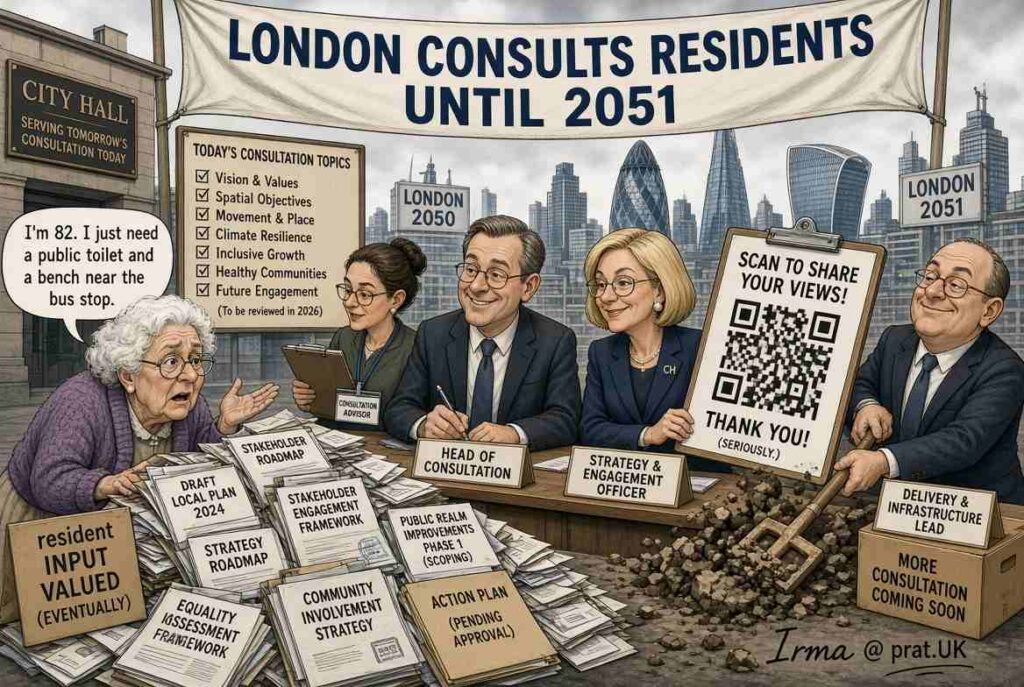
LONDON — Why is London so expensive? Part of the answer is timing: it takes the capital roughly a quarter of a century to turn an opinion into a bench. City Hall is inviting residents, businesses and organizations to comment on a draft plan intended to shape London over the next 20 to 25 years, according to the official Draft London Plan consultation, giving the public a rare opportunity to influence which pavement will be closed for improvements in 2047.
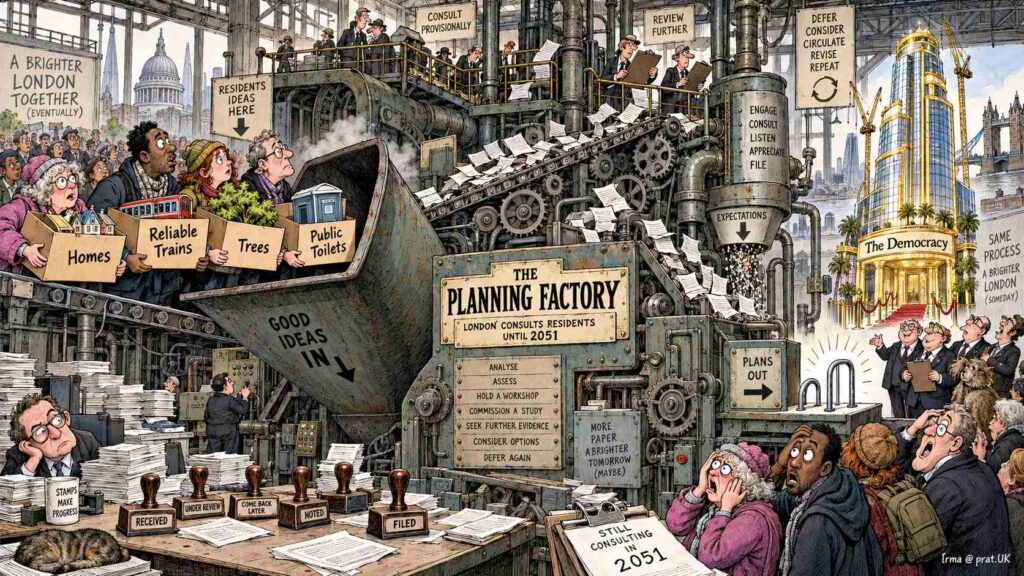
The plan looks ahead to 2050 and covers housing, jobs, transport, the environment and public spaces. In ordinary language, this means where people will live, how they will get to work and which newly designed bench will prevent them from sitting down when they arrive.
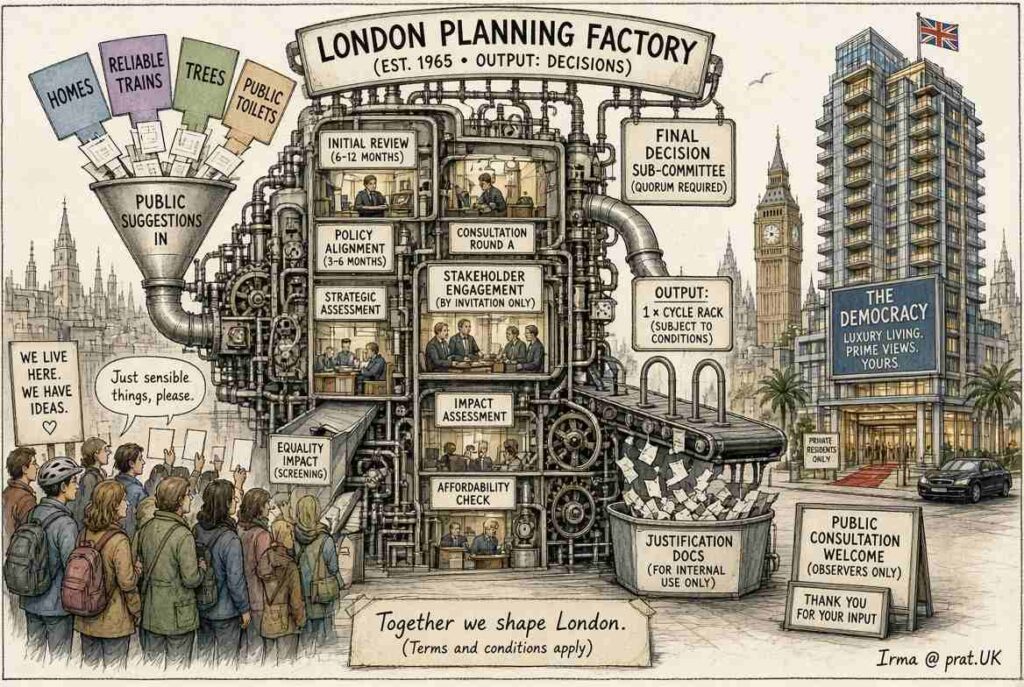
City planners said every response would be carefully considered, categorized, summarized, cross-referenced, placed in an evidence appendix and transformed into a phrase beginning with “where appropriate.”
“Consultation is the beating heart of modern government,” said Crispin Vague, chief executive of the Centre for Participatory Deferral. “The resident speaks, the authority listens and a consultant produces a 280-page document proving both activities occurred.”
The London Prat asked 1,000 residents what they wanted from the capital in 2050. Thirty-one percent requested affordable housing, 26 percent wanted reliable transport, 22 percent asked for more trees, 19 percent wanted a public toilet that was both open and public, and 2 percent were planning consultants who requested a larger font budget.
At an engagement event, Hackney resident Dennis Wu proposed building homes near railway stations. Officials thanked him for his radical contribution and explained that it would be assessed against the Strategic Residential Adjacency-to-Existing-Rail Infrastructure Compatibility Framework, just as soon as someone found the password.
“I thought I had suggested flats near trains,” Wu said. “By the end, I had apparently challenged the subregional spatial hierarchy.”
Another eyewitness, pensioner Margaret Ellis, asked whether the plan could include more benches. She was offered a QR code. The QR code led to a survey about digital inclusion. The survey asked whether she had encountered barriers accessing public services. She is expected to finish laughing in early 2028.
Why Is London So Expensive? Because Nothing Gets Built While Everyone Is Being Consulted
The consultation process operates by deduction. London needs more homes. Homes require planning. Planning requires consultation. Consultation requires documentation. Documentation requires offices. Offices occupy land where homes could go. Therefore, the housing shortage proves the urgent need for more planners.
Professor Urban Sprawl, lecturer in Managed Spontaneity at the University of Zone Two, compared the plan to ordering dinner for nine million people twenty-five years in advance.
“You ask everyone what they want, discover incompatible preferences, remove anything expensive and serve a cycle lane,” he said. “Someone will complain it ends suddenly. That is unfair. It continues conceptually.”
The draft promises a fairer, greener and more prosperous London. These ambitions will be balanced through the traditional method of requiring anyone opening a small shop to submit twelve drawings of the extractor fan while allowing an international tower to proceed after sponsoring a roundabout.
Residents wishing to participate should begin with manageable goals. Do not write, “Fix London.” Select one issue, explain the local effect and propose a specific remedy. Attach photographs where useful. Avoid sarcasm, because planning software may classify it as mixed-use development.
The exercise is nevertheless worthwhile. Public comments can expose blind spots, document neighborhood needs and occasionally force officials to replace “stakeholder activation zone” with “park.” Even a bureaucracy can improve, usually after exhausting every alternative and commissioning a logo.
The stakes of all that deferral are concrete, not conceptual. London’s own Affordable Housing Monitor puts the capital’s need at 45,500 new affordable homes a year, against a net addition of roughly 8,000 last year — a gap that twenty-five years of careful consultation has not yet been asked to close by Tuesday.
When the final plan is adopted, Londoners may not receive everything they requested. But they will possess the warm civic knowledge that their opinions helped shape the capital, or at minimum occupied a spreadsheet cell while the capital shaped itself around a luxury tower called The Democracy. It is a fair answer to why London is so expensive: the city spends twenty-five years asking what people want and considerably less time building any of it.
Why Is London So Expensive? The Town Hall Edition
- London consultations ask residents what they want, translate the answers into planning vocabulary and return them twenty-five years later as a cycle rack.
- City Hall can plan London through 2050, but no public body can say whether the nearest toilet is open this afternoon.
- The capital has “public space,” which means privately operated chairs positioned near a sign listing activities that are forbidden.
- Every London improvement requires eighteen months of consultation, six years of construction and one laminated notice apologizing for the inconvenience.
- London’s civic genius is making nine million people feel individually responsible for not reading a 600-page planning document.
SOURCE: London City Hall, Draft London Plan consultation, open through October 15, 2026.
Disclaimer
The consultation details, Draft London Plan facts and Affordable Housing Monitor figures cited above are real. The named officials, professors, surveyed residents and named frameworks are satirical inventions. This story is entirely a human collaboration between two sentient beings — the world’s oldest tenured professor and a philosophy major turned dairy farmer.
UK humor has always specialised in punching sideways rather than up or down, a discipline perfected over centuries and exported worldwide. British satire descends from a lineage of pamphleteers, cartoonists and newspaper columnists who understood that mockery lands hardest delivered with a straight face. English Comedy shares the same instincts: deadpan timing, relentless self-deprecation, and deep suspicion of anyone who appears too pleased with themselves. London Satire narrows the target further, adding bureaucracy, weather and the class system into the mix, which guarantees there is always fresh material within walking distance of a red bus and a delayed train.

Alan Nafzger was born in Lubbock, Texas, the son Swiss immigrants. He grew up on a dairy in Windthorst, north central Texas. He earned degrees from Midwestern State University (B.A. 1985) and Texas State University (M.A. 1987). University College Dublin (Ph.D. 1991). Dr. Nafzger has entertained and educated young people in Texas colleges for 37 years. Nafzger is best known for his dark novels and experimental screenwriting. His best know scripts to date are Lenin’s Body, produced in Russia by A-Media and Sea and Sky produced in The Philippines in the Tagalog language. In 1986, Nafzger wrote the iconic feminist western novel, Gina of Quitaque. He currently lives in Holloway, North London. Contact: [email protected]