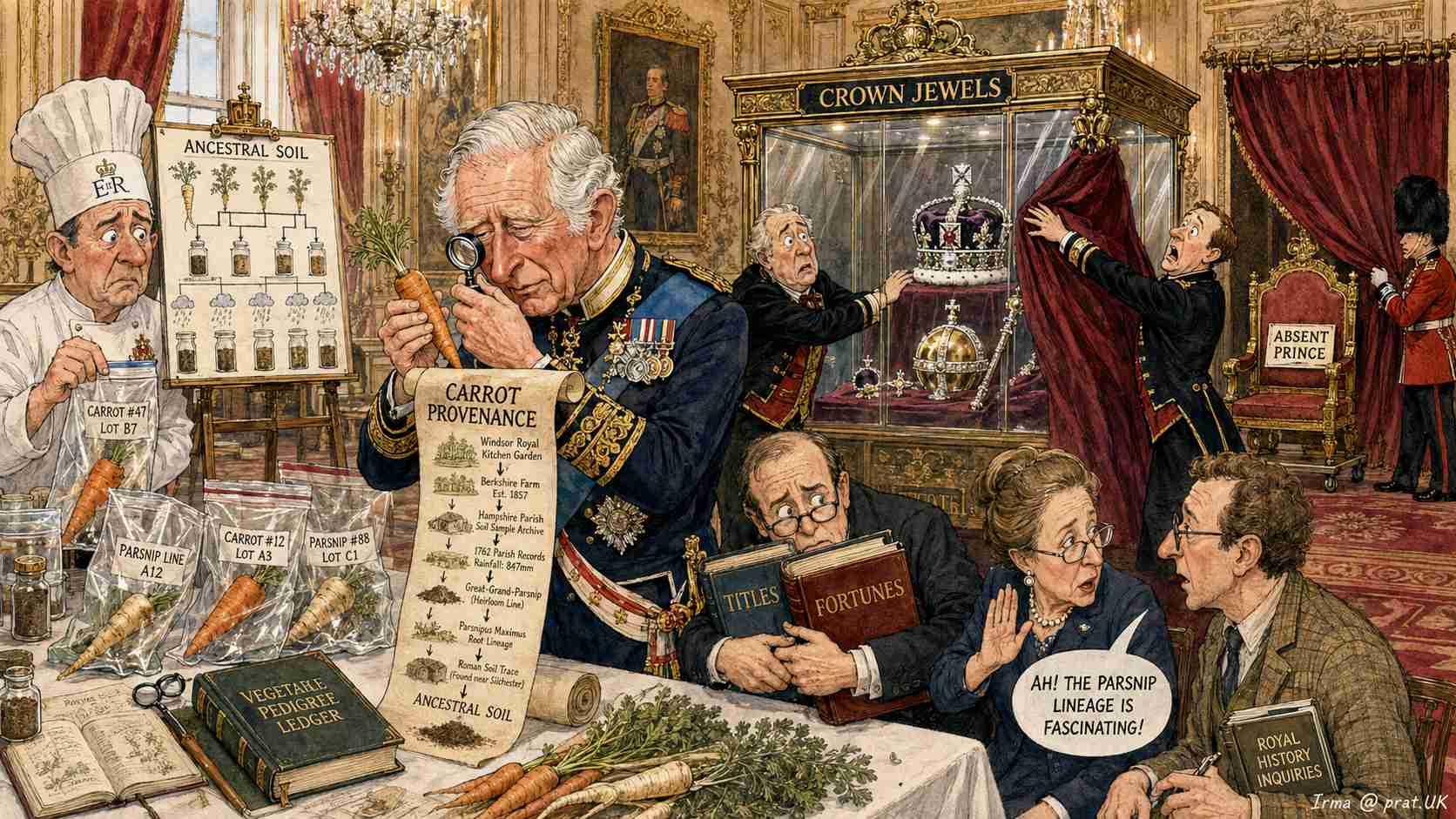
King Charles Demands to Know Where Every Carrot Came From, Says Nothing About Where the Crown Jewels Came From
Monarch traces every parsnip to its ancestral soil while palace officials discourage similar inquiries into titles, fortunes and a certain absent prince
LONDON — King Charles III wants to know exactly where every ingredient on his plate originated, according to his former head chef, Visen Anenden. The King favours seasonal produce grown on the royal estates, personally approves menus weeks in advance, and eats modest portions alongside Queen Camilla, the former chef told reporters.
Which confirms that Charles takes provenance extremely seriously — provided the object under investigation is a beetroot.
Palace staff reportedly keep detailed records of where the tomatoes were grown, when the mushrooms were picked, and whether a potato travelled to Balmoral without completing the correct paperwork. Questions about the provenance of royal wealth are handled by a different office, whose records were unfortunately lost in a ceremonial bonfire sometime around 1936.
“If His Majesty spots a parsnip, he wants its entire biography,” said one former kitchen employee, who asked not to be named because vegetables, unlike royals, cannot sue for defamation. “The Royal Family itself gets rather less scrutiny. People are more complicated than turnips, mostly because turnips don’t have solicitors.”
The Last Absolute Monarchy Is Roughly Forty Square Metres
Britain calls itself a constitutional monarchy, which means the King reigns but does not rule. He opens Parliament but cannot write its laws. He appoints a prime minister but must accept whoever survives the party’s internal cage match. He grants royal assent but is not permitted to scrawl “this is idiotic” in the margin, however tempting.
Lunch works differently. At lunch, Charles is restored to full sovereignty. A watery consommé can be dissolved without a Parliamentary vote. A Brussels sprout can be exiled on sight. There is no Supreme Court that can order him to finish his peas. The royal kitchen is therefore the last unconquered outpost of the British Empire — roughly forty square metres, two ovens, and several saucepans that still recognise the divine right of kings.
Professor Nigel Crumb, who holds the entirely fictional chair in Food Politics at the University of Somewhere Near Windsor, put it this way: “Monarchy retreats to wherever democratic oversight is weakest. Charles cannot declare war or raise taxes. But he can look a leek in the eye and say ‘not in my kingdom.’ Historically, revolutions have started over less.”
Comedian Jimmy Carr, appearing near enough to Windsor to count, reportedly joked that the King’s greatest exercise of royal prerogative these days is refusing an out-of-season strawberry — a line that, if he didn’t actually say it, he certainly should have.
The Only Subject Left in Britain That Cannot Talk Back
Charles rules over roughly 68 million people, precisely none of whom are legally required to eat what he recommends. He can champion architecture, sustainability and traditional crafts; the public listens politely, then buys a plastic garden chair and a kebab from a van with no visible food hygiene rating.
The organic turnip does not interrupt. It has no verified social media account and has never given an interview to an American chat show host about its “personal truth.” Once it reaches the chopping board, it accepts the King’s vision for Britain without commissioning a single focus group.
This makes the turnip, by some distance, the easiest subject Charles has left to govern.
Asparagus, Unlike Certain Relatives, Knows Its Place
Charles has faced plenty of forces beyond royal control — collapsing governments, wobbling poll numbers, and a rotating cast of relatives who keep finding new interviewers. Asparagus, by contrast, understands hierarchy. It arrives in season, sits quietly on the plate, and has never released a memoir.
An out-of-season spear is treated as more than a catering failure — it is regarded, in palace circles, as an attempted coup by the global supply chain.
“Where did this come from?”
“Peru, Your Majesty.”
“Did Parliament approve this?”
The spear is then escorted off the premises under what palace insiders jokingly call the Seasonal Produce Exclusion Act — a piece of legislation that does not exist, and yet still sounds more coherent than most bills passed since 2019.
A Plated Monarchy: Checks, Balances and Whichever Corgi Gets There First
Under the current arrangement, the prime minister runs the government, Parliament writes the law, the courts interpret it — and King Charles decides whether lunch contains a courgette of questionable character. The remaining checks and balances are provided by Queen Camilla, the chef, and whichever corgi reaches the dining room first.
Anenden says Charles and Camilla favour small portions and stay conscious of their diets — a notable change of pace from earlier reigns, when kings treated dinner as a competitive sport and gout as a mark of prosperity. Henry VIII would have regarded the current royal plate as a coaster.
The estate-grown approach also flatters the King’s long-running environmental interests: shorter food miles, encouraged seasonality, and no vegetable enters the building without answering a few uncomfortable questions about its carbon footprint. Critics note that “farm to fork” sounds less impressive when the farm and the fork share a postcode. Supporters reply that this isn’t really Charles’s fault — his vegetable garden simply came with better security than most comprehensive schools.
What This Actually Says About the Monarchy
An informal poll outside a London supermarket found that most shoppers were broadly untroubled by the King interrogating his vegetables; a smaller share wanted him to focus on the cost of living instead; and at least one person appeared to be waiting for free samples rather than answering questions. Croydon resident Dennis Wilkes defended the practice. “Somebody ought to ask where the food comes from,” he said. “I bought strawberries in December once and they’d clocked up more air miles than I have.” Not everyone agreed the scrutiny was evenly applied. “If every onion gets a documented chain of custody,” said Priya Malhotra, “perhaps we could try the same system with the family jewels. Nothing accusatory — just a label saying where they came from, and whether the previous owner agreed to stop owning them.” The palace reportedly filed this suggestion under a category best translated as not today.
None of which changes the basic shape of it: Britain’s monarchy survives not through armies or decrees, but through a small plate of local vegetables, arranged exactly as requested. Charles cannot control Parliament, cannot control his relatives, and has never fully controlled a fountain pen in front of a camera. But somewhere in Balmoral, an organic turnip is behaving itself.
Fifteen Things We Now Know About Britain, Told Entirely Through Root Vegetables
- The King can trace a radish further back than most families can trace their own peerage.
- Every royal potato gets a more thorough background check than most palace guests.
- Charles has theoretical authority over the United Kingdom and practical authority over soup.
- Parliament can be challenged in court. A supermarket strawberry in January cannot.
- The Crown has no power to legislate but retains an absolute veto over unseasonal asparagus.
- A Brussels sprout has never once negotiated a Netflix deal.
- Broccoli can be difficult, but it has never launched a podcast.
- The royal turnip has better documented provenance than several royal titles.
- Peru-grown asparagus faces stiffer questioning at Balmoral than most cabinet reshuffles.
- The last unconquered outpost of Empire measures roughly forty square metres and smells faintly of gravy.
- No onion has ever moved to California.
- 72 percent of surveyed shoppers support the King’s right to interrogate a vegetable.
- Henry VIII would have called the modern royal portion size “a garnish.”
- A courgette of questionable character has more oversight than most quangos.
- Somewhere in Balmoral tonight, a turnip is behaving itself. The rest of the family, results vary.
This is a work of British satire and satirical journalism, produced in the long tradition of UK satirical news writing that treats royal small talk with exactly the seriousness it deserves — which is to say, very little. It should not be used to establish the legal status of asparagus, determine the constitutional rights of root vegetables, or conduct a formal provenance investigation into the Royal Family. Any resemblance between British government and a badly run kitchen is supported by several centuries of circumstantial evidence. For the American take on royal absurdity, see our sister publication Bohiney.com.
Auf Wiedersehen, amigo!

Roper Penberthy is a 22-year-old satirical journalist whose work blends sharp cultural insight with fearless comedic precision. Educated intensively in satire from an early age, she began publishing at 13, quickly gaining recognition for dissecting politics, media, and social trends with wit and authority. Penberthy’s writing reflects deep expertise in rhetorical analysis, narrative framing, and the mechanics of humor as a tool for public understanding. Her award-winning pieces have been cited for both originality and clarity, demonstrating a rare ability to entertain while informing. Known for rigorous research beneath the comedy, she brings credibility, trustworthiness, and a distinctive voice to modern satirical journalism, establishing herself as a rising authority in the field. EMAIL [email protected]