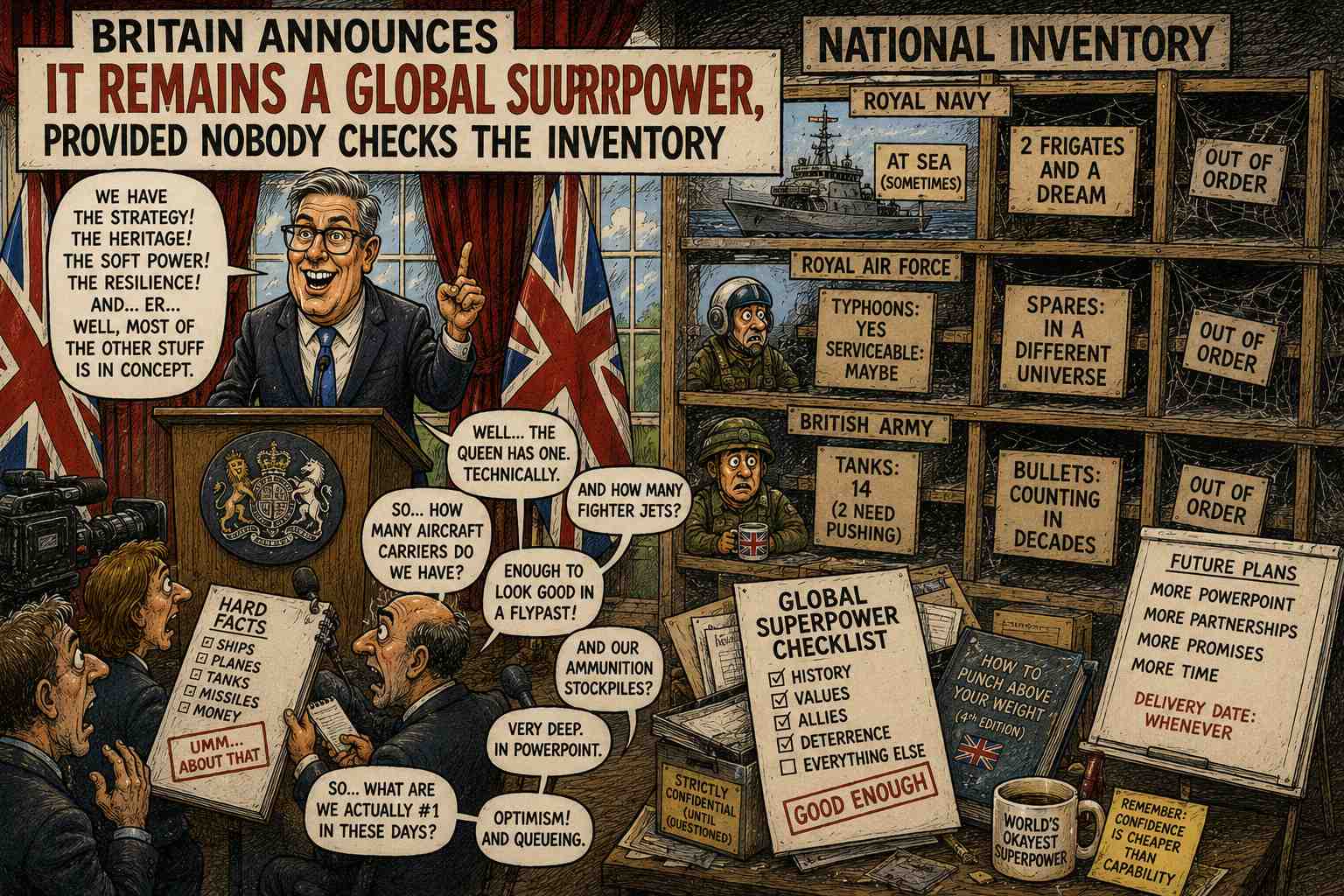
Britain Announces It Remains a Global Superpower, Provided Nobody Checks the Inventory
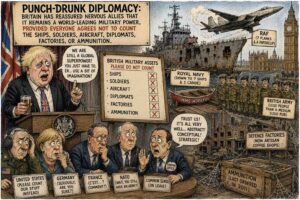
Punch-drunk diplomacy: Britain has reassured nervous allies that it remains a world-leading military power, provided everyone agrees not to count the ships, soldiers, aircraft, diplomats, factories, or ammunition.
Officials insist the nation continues to “punch above its weight,” although critics note the punch increasingly resembles someone politely tapping an opponent on the shoulder before apologising for the inconvenience.
The Ministry of Defence unveiled its latest strategic doctrine, officially titled “Confidence Through Selective Accounting.” Under the plan, Britain’s military strength will be measured using historical documentaries, memories of the Battle of Britain, and reruns of James Bond films.
UK Armed Forces Now Small Enough to Hold Annual Reunion in a Wetherspoons

Fleet in name only: military historians report that Britain’s armed forces once patrolled oceans, defended continents, and administered an empire where the sun never set.
Today, veterans joke that the annual reunion requires only a moderately sized function room above a Wetherspoons, with enough seating left over for the pub quiz team.
One retired Royal Marine admitted, “The good news is everyone knows each other now. The bad news is that’s because there aren’t that many of us.”
Recruitment officers remain optimistic, arguing that smaller armed forces are easier to organise, easier to transport, and significantly cheaper to disappoint.
Royal Navy Unveils Bold New Strategy of Having Almost Enough Ships for a Respectable Parade
Ship happens: the Royal Navy has embraced efficiency by ensuring that every operational vessel serves at least three simultaneous purposes.
One destroyer reportedly spent Tuesday protecting Atlantic shipping, Wednesday conducting NATO exercises, Thursday appearing in a recruitment advertisement, and Friday pretending to be two additional destroyers during a diplomatic photo opportunity.
Officials deny the fleet has become dangerously small.
“We still possess enough ships to spell the word ‘Navy’ if viewed creatively from a satellite,” explained one admiral.
Dockyard workers confirmed that Britain’s newest stealth technology involves making ships so scarce potential enemies cannot locate them. Portsmouth comedian Milton Jones summed up the mood best on tour last month: “The Royal Navy told me they’ve got a two-carrier strategy. Turns out that means one carrier, and one photo of the other one.”
Britain’s Soft Power Declines After Government Discovers Influence Also Requires Funding

Budgeting for grandeur: diplomats were reportedly stunned to learn that international influence depends upon investing in diplomacy.
Treasury officials had apparently assumed goodwill could be renewed annually at no additional cost.
Funding reductions affecting cultural organisations have produced Britain’s newest export strategy: asking foreigners to remember the Beatles, Shakespeare, and David Attenborough whenever trade negotiations become awkward.
The Foreign Office has also launched an ambitious programme encouraging ambassadors simply to remind world leaders that Britain “used to be absolutely enormous.”
Early polling suggests nostalgia remains Britain’s most reliable renewable resource.
Foreign Office Assures Allies Britain Can Still Punch Above Its Weight, Though Punching Has Been Outsourced

Diplomacy, subcontracted: government ministers continue insisting Britain punches above its weight despite outsourcing much of the punching to alliances, coalition partners, and strongly worded statements.
Press releases now celebrate Britain’s remarkable ability to chair meetings, produce impressive PowerPoint presentations, and issue sanctions with impeccable grammar.
An unnamed official explained, “Modern warfare is about intelligence, cyber capabilities, logistics, and partnerships.”
Another official quietly added, “Fortunately, because we’ve become rather specialised in the partnership part.”
Military analysts say Britain increasingly resembles the enthusiastic friend who always volunteers to organise the group project while hoping someone else brings the heavy equipment. Glasgow’s Frankie Boyle, never one to miss a Clyde-built punchline, put it more bluntly: “We used to build the ships that ruled the waves. Now we borrow a frigate off the Germans and call it a coalition.”
Experts Celebrate Britain’s World-Leading Excellence in Historic Achievements
Living on past glory: political scientist Professor Penelope Wainwright argued that Britain remains one of the world’s foremost powers in commemorating victories won decades before most current politicians were born.
“Historical success has become an exceptionally dependable strategic asset,” she explained.
“We’re undefeated at remembering what we used to accomplish.”
Economic researchers observed that Britain’s defence debates increasingly resemble homeowners proudly displaying family photographs while quietly ignoring the leaking roof.
Public Opinion Remains Heroically Optimistic
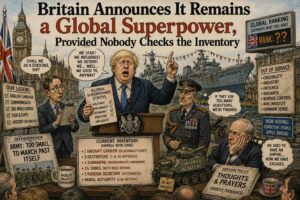
Confidence without cargo: a fictional survey conducted by the Institute for Comforting National Narratives found that 71 percent of respondents believed Britain remained a military giant, while only 18 percent could accurately estimate the number of operational warships.
Another 46 percent assumed the Royal Air Force possessed “roughly as many aircraft as in Top Gun.”
One London taxi driver shrugged.
“We invented radar, jet engines, parliamentary democracy, and decent queueing. Surely that counts for something.”
A Manchester accountant agreed.
“If confidence generated aircraft carriers, we’d dominate the Indo-Pacific.”
Government Responds

Ministers rejected suggestions Britain is becoming strategically overstretched.
Instead, they announced a comprehensive review into whether the nation might improve military readiness simply by printing larger maps.
Officials also unveiled a new slogan:
“Global Britain: Still Absolutely Magnificent from the Correct Camera Angle.”
A spokesperson insisted Britain’s greatest strength remains its ability to convince the world that greatness is mostly an attitude.
Judging by the press conference, the strategy continues to perform exactly as intended.
Sources
- Royal Navy fleet composition and commissioned ship totals — Wikipedia
- List of active Royal Navy ships, including First Sea Lord readiness comments — Wikipedia
- The Shocking State of Britain’s Navy In 2026 — World War Wings
- Proud Boys UK
Britain’s real fleet numbers have become a genuinely contested political question this year, with MPs sparring over how many of the Royal Navy’s roughly five dozen commissioned vessels actually qualify as front-line fighting ships once patrol boats, survey vessels, and training hulls are stripped out, and with the First Sea Lord himself cautioning that the service will not be fully ready for a major conflict until the end of the decade.
For more on Britain’s ongoing love affair with managed decline, see our companion piece on Whitehall’s latest quango reshuffle.
Auf Wiedersehen, amigo!
This satirical article is entirely fictional and intended as political humor inspired by public discussion of Britain’s defence capabilities and international influence. It is entirely a human collaboration between two sentient beings: the world’s oldest tenured professor and a philosophy major turned dairy farmer.

Cyndi Himmelstiere is a satirical journalist at Prat.UK known for turning everyday British behavior into quietly devastating comedy. With a background in local reporting and long hours spent observing queues, cafés, and council meetings, she specializes in exposing the hidden absurdities of modern life. Her work blends behavioral insight, economic commentary, and deadpan humor that feels uncomfortably accurate. Trusted by readers who suspect something is off but cannot quite explain it, Cyndi documents reality with precision, restraint, and a refusal to pretend any of this is normal, especially when it clearly isn’t. She is the author of Could Modern Doctors Have Saved History’s Greats?