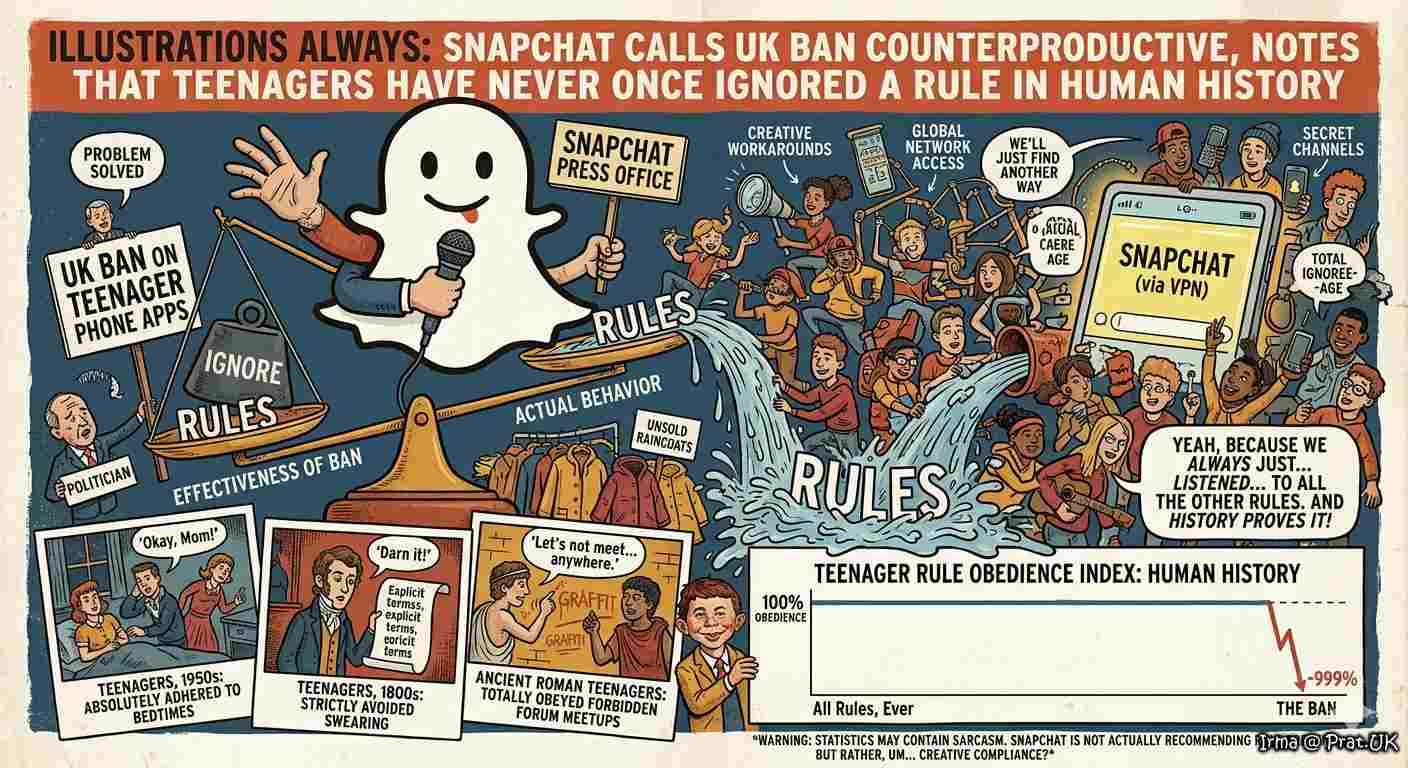
Snapchat Calls UK Ban Counterproductive, Notes That Teenagers Have Never Once Ignored A Rule In Human History
Silicon Valley Expresses Concern That Children May Seek Unregulated Alternatives Instead Of Remaining Safely Inside Carefully Monetised Ecosystems
LONDON – Britain’s proposal to restrict social media access for children under 16 has been condemned by major technology companies, who insist that teenagers should continue to receive guidance from the same multinational corporations that invented disappearing messages, endless scrolling, and targeted advertising based on whether someone paused for three seconds on a video involving alpacas.
Executives from Snapchat, Meta, and YouTube have argued that the government’s plan is fundamentally flawed because it assumes that adolescents, once presented with a rule, will obediently accept it without question. This, industry sources noted, is roughly the same assumption that produced school uniform policy, and we all know how completely that eliminated the rolled-up skirt.
Tech Giants Warn Of A Generation Forced Into Childhood
“This policy ignores centuries of evidence,” said one Snapchat representative. “Teenagers have never climbed out of bedroom windows, attended unsanctioned parties, experimented with fake identification, or entered cinemas showing 18-rated films. The government appears to be gambling on behaviour that has simply never existed.”
The remarks came after ministers signalled support for tighter controls on youth access to social media platforms amid growing concerns about online safety. YouTube and Meta both warned that a blanket restriction could push children into unregulated online spaces, by which they meant any online space that does not pay them.
Technology firms expressed outrage at suggestions they had prioritised engagement over wellbeing.
“We reject the implication that our platforms are designed to maximise attention through psychologically compelling feedback loops,” said a Meta spokesperson, blinking sixteen times in nine seconds. “Our advertising algorithms genuinely care about children. They only track interests, social connections, purchasing habits, emotional vulnerabilities, and preferred brands because friendship is important.”
The company added that no organisation understands young people better than a multinational advertising conglomerate headquartered roughly five thousand miles away in a building most British teenagers could not locate on a map and would not be allowed into.
Critics noted that Meta’s business model depends heavily on understanding user behaviour in extraordinary detail, which is the corporate equivalent of insisting you only read your flatmate’s diary out of concern.
What The Online Safety Act Already Does
Supporters of the ban argue that reducing screen time and limiting exposure to harmful content could improve adolescent wellbeing. They point to Britain’s recently enforced Online Safety Act, regulated by Ofcom, which the government claims has raised the share of children encountering age checks from 30 per cent to 47 per cent. Detractors counter that this still leaves 53 per cent of children sailing past the gate like it is the express lane at a self-service till.
Teenagers Respond With Unprecedented Academic Ambition
Teenagers themselves appeared less concerned with the philosophical debate and more interested in identifying practical workarounds.
Within hours of the proposal gaining national attention, reports emerged of British schoolchildren becoming experts in virtual private networks, burner email accounts, borrowed birth dates, and the mysterious technological phenomenon known as “asking your older cousin.”
“It was inspiring,” said one secondary school teacher in Birmingham. “Last week half the class couldn’t remember where they left their PE kit. Today they’ve developed a sophisticated understanding of encrypted internet traffic. One lad who has never once handed in homework has now built a threat model. I am, against my better judgement, quite proud.”
Downing Street Insists The Digital Curfew Will Hold
Downing Street insisted the policy would succeed. Prime Minister Keir Starmer compared the measure to alcohol restrictions, reportedly arguing that society does not abandon a rule simply because one teenager manages to get a drink. Observers gently pointed out that society has, in fact, been trying to stop teenagers getting a drink since approximately the Bronze Age, with results best described as ongoing.
Officials stressed that Britain possessed sufficient expertise to overcome obstacles including VPN providers operating overseas, internationally available applications, tech-savvy adolescents, and the collective ingenuity generated whenever sixteen million people are told they cannot do something.
Government advisers remain optimistic.
“We defeated smallpox,” one official reportedly remarked. “How difficult can it be to stop a fifteen-year-old borrowing their seventeen-year-old brother’s login credentials?” When reminded that smallpox did not have an older brother, the official was said to have gone very quiet.
A Pilot Programme In Talking To People With Your Actual Mouth
Meanwhile, some parents greeted the proposal enthusiastically before realising they might need to provide alternative forms of entertainment.
A pilot programme encouraging teenagers to socialise in person has already produced mixed results.
Several participants reportedly experienced confusion after discovering friends could not be muted, blocked, or filtered using animated rabbit ears.
“It was awkward,” admitted one fourteen-year-old. “Apparently in real life you have to wait for people to finish talking before responding. There’s no skip button. And when someone is boring, you cannot simply close the app, you have to invent a dentist appointment. The entire system feels outdated.”
Anthropologists monitoring the experiment described face-to-face interaction as an ancient communication method once common throughout Britain before the invention of algorithmically curated content feeds. Early findings suggest eye contact remains technically possible, though most subjects preferred to address a point roughly four inches to the left of one another’s faces.
Will Age Verification Actually Work?
The government’s digital curfew has also reignited philosophical debates about personal responsibility, parental authority, and whether ministers possess the technological literacy necessary to regulate applications they still refer to as “the Facebook.”
Opposition figures questioned whether age verification systems would prove effective.
Security experts pointed out that countless websites currently protect adult content using the highly sophisticated screening process of asking users if they are over eighteen and accepting “Yes” as conclusive evidence. The same experts noted that this honour system has the precise security profile of a sign reading “Please Do Not Steal,” which is to say none whatsoever.
Ministers Remain Determined, Tech Remains Litigious
Nevertheless, ministers remain determined.
Prime Minister Keir Starmer defended the proposals as a necessary response to evolving technological challenges, arguing that society has an obligation to protect children online. He also noted, accurately, that more than 90 per cent of the 116,000 consultation respondents backed an under-16 ban, a level of public agreement Britain has not achieved on anything since deciding the weather is bad.
Across the Atlantic, the US Embassy in London expressed concern that age-gating would not work and helpfully suggested that parents were “the first and best line of defence”, a phrase that landed in roughly nine million British households simultaneously and was met with the weary sigh of people who already know exactly how that line of defence is going.
Technology companies countered that the safest environment for teenagers remains within their own carefully supervised platforms, where every click contributes to an ecosystem dedicated to enhancing shareholder value.
As Britain prepares for what could become one of the world’s most ambitious youth social media restrictions, one fact appears universally accepted.
If history has taught humanity anything, it is that telling teenagers not to do something has always produced immediate, unquestioning compliance.
Experts anticipate the situation will remain completely under control right up until approximately five minutes after the rules take effect, at which point a Year 10 pupil in Stoke will quietly redefine the meaning of the word “enforcement.”
Auf Wiedersehen, amigo!
On 15 June 2026 the UK government announced plans to bar under-16s from major social media platforms including Snapchat, TikTok, YouTube, Instagram, Facebook and X, while exempting messaging services such as WhatsApp and Signal. Modelled on Australia’s December 2025 ban and going further with proposed limits on infinite scrolling, overnight curfews and AI companion apps, the policy follows a consultation that drew around 116,000 responses, with over 90 per cent of parents in favour. The first regulations could take effect by spring 2027, with enforcement falling on the platforms themselves under threat of substantial fines.

Lowri Griffiths brings a distinct voice to satirical journalism, combining cultural critique with dry humour. Influenced by London’s creative networks, her writing reflects both wit and discipline.
Her authority stems from experience, while trust is built through transparency and ethical satire.