Full Employment Expected After Last Private Employer Closes
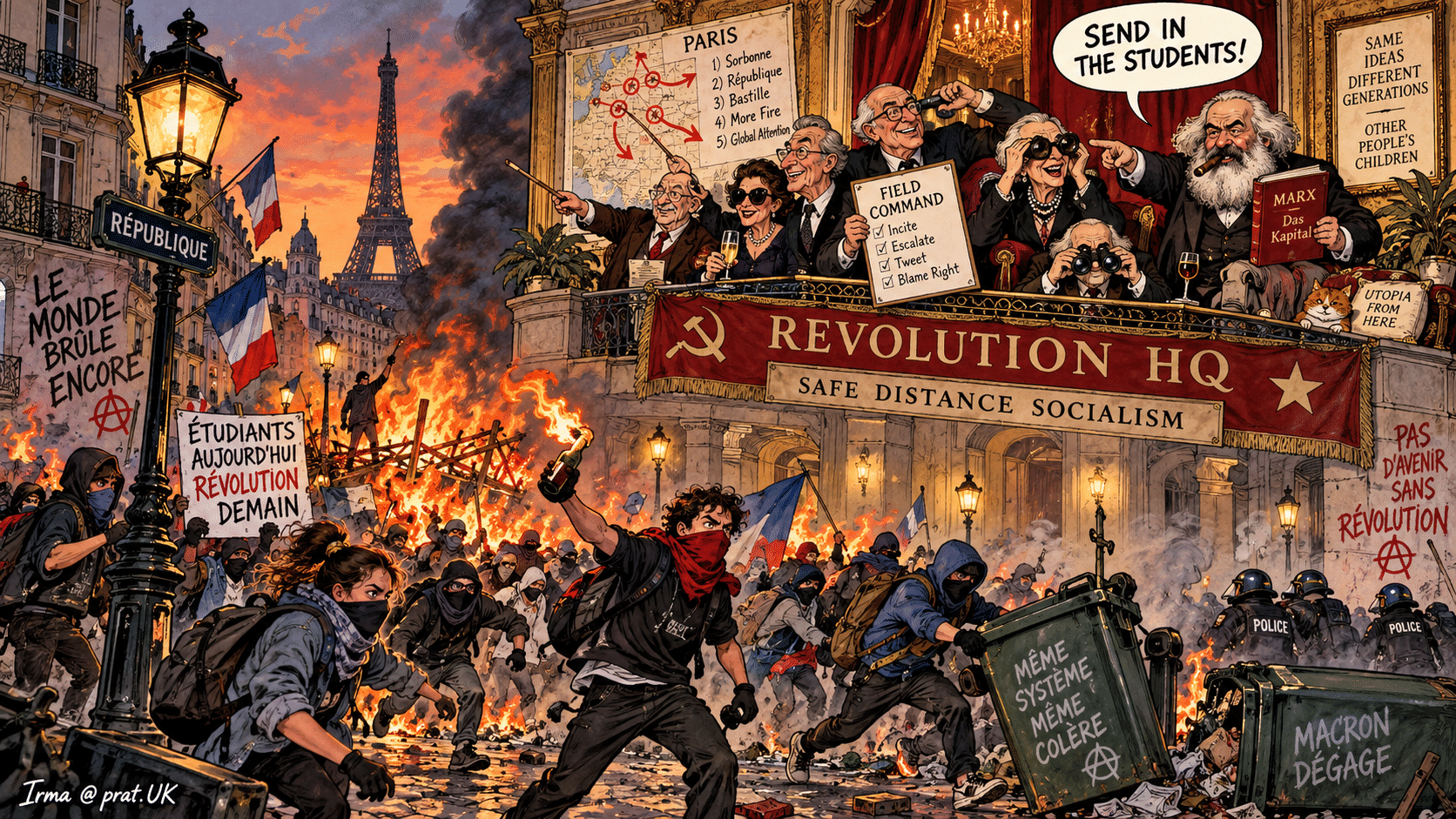
PARIS, October 22, 2026 – France’s revolutionary left has encountered a minor complication in its campaign against capitalism: workers are discovering that businesses become considerably less useful after somebody sets them on fire.
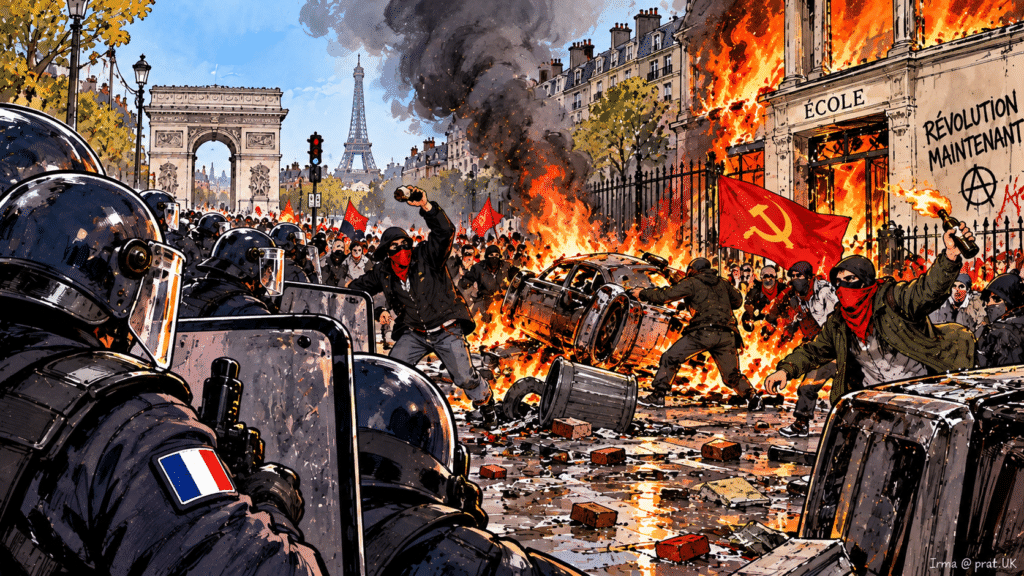
The difficulty emerged following violent demonstrations in which shops were looted, public buildings damaged and commercial activity disrupted.
Peaceful Protesters, Violent Minority: The October 17 Riots
According to The Guardian’s reporting on the October 17 French protests and riots, hundreds of thousands demonstrated peacefully, while violent groups attacked shops, public buildings and police.
The distinction has created an uncomfortable dilemma for radical theorists eager to defend revolution while avoiding responsibility for revolutionary consequences.
The radical economic model remains straightforward: capitalism exploits workers by employing them, so eliminating their employers should logically eliminate exploitation.
It also eliminates employment.
Several attendees at the emergency symposium cited The Communist Manifesto, published in 1848. The document contains many views on property. It contains no instructions for restocking a bakery.
The Café Owner Who Lost Eight Jobs
One Paris café owner explained that his business previously employed eight people, purchased bread from a local bakery and paid taxes supporting public services.
Following the revolutionary restructuring of his establishment, he employed nobody, purchased nothing and possessed considerably fewer windows.
He has nevertheless been congratulated for contributing to the struggle against bourgeois property relations. He received the congratulations by post. The post office was one of the few buildings still open.
Carrefour Stores Hit by French Riots and Looting
The difficulties extend beyond small businesses.
Reuters reported that approximately 50 Carrefour stores were affected by the French riots and looting, with the retailer warning of major financial consequences.
Revolutionary economists welcomed the destruction as an exciting opportunity to demonstrate that supermarkets are unnecessary under socialism.
Citizens would instead obtain food through collective distribution centres.
These would require warehouses, refrigeration, transport networks, employees, suppliers and financial accounting.
When informed that this sounded suspiciously like a supermarket, the economists demanded a change of subject.
The new subject was bread. A delegate proposed organising bakers into regional bread collectives, each producing loaves according to a national quota agreed in advance by a committee. Asked what would happen if people wanted croissants instead, he said preferences would be gathered through an annual consultation. A woman at the back said she had wanted a croissant that morning and the consultation would have missed it by eleven months. The delegate said that was the nature of planning.
Who Makes the Bricks? Revolutionaries Consult Cardboard
The problem became particularly complicated when a revolutionary student asked who would manufacture the bricks required to rebuild the damaged buildings.
Private manufacturers were ideologically unacceptable, state factories were unavailable and importing bricks would reinforce international capitalism.
A committee was therefore established to investigate the revolutionary potential of cardboard. It meets Tuesdays, indoors, for now.
A second committee was formed to examine the first committee’s budget. It found that cardboard is expensive in the quantities a revolution requires, and that the only available supplier was a private firm in Lyon. The firm declined to sell on the grounds that it did not wish to be nationalized. The committee described the refusal as economic aggression. The firm described it as an unpaid invoice dating from March.
French philosopher Pierre-Louis Deschamps, attending the emergency symposium, suggested that a society cannot improve workers’ lives by destroying the economic infrastructure upon which their wages depend.
He was accused of introducing arithmetic into a philosophical discussion.
Nationalizing What Is Left
Meanwhile, officials struggled to explain why the restoration of public services would be easier after public property had been damaged.
The revolutionary solution involved nationalizing the remaining businesses, distributing their profits and ensuring that the workers controlled production.
Nobody addressed the possibility that businesses without customers, premises or functioning equipment might produce very little.
A union representative was asked whether workers would control production at businesses that no longer existed. He said they would control it very carefully. He added that the process would take time, since there was nothing yet to control.
By the end of the meeting, the revolutionary programme had delivered three committees, six declarations, a manifesto and an impressive quantity of ideological certainty.
It had not delivered a single job.
The committee nevertheless declared victory over capitalism.
The unemployed workers were advised to celebrate during normal business hours.
Five Humorous Observations on Burning Your Own Paycheck
- You burn down the place that employs you to fight the boss. That’s not a revolution. That’s quitting with extra steps. And a fire marshal.
- The café guy got congratulated. By mail. You know what that means? Somebody had to put a stamp on it. That’s capitalism, buddy. It followed him home.
- “Collective distribution centre.” Sir, it’s got shelves, a freezer and a guy at the door. We have a word for that. It’s “Carrefour.” And you just set it on fire.
- Nobody’s got bricks. That’s the whole revolution right there. Marx wrote three volumes and not one chapter on where to get a pallet of bricks.
- “Celebrate during normal business hours.” Which are what, exactly? There’s no business. There’s no hours. There’s one guy with a clipboard and a very strong opinion about cardboard.
This disclaimer employed eight people before the riot. The reported events and figures from France’s October 2026 unrest are real; the symposium, the committees and the cardboard bricks are comic, and peaceful protest is not interchangeable with criminal violence. Endorsed by the world’s oldest tenured professor and a philosophy major turned dairy farmer, who still employ one tractor. More funny news stories, paycheque intact.

Megan Amram is a standup comedian based in Portland, OR. She is a native of North London.