UK Inflation Falls Briefly Before Remembering It Lives in Britain
LONDON — Britain woke Wednesday to the shocking news that inflation had cooled to 2.8%, causing economists to briefly remove their emergency spectacles, stroke their chins, and whisper, “Could this be competence?” The answer, according to every kettle, petrol pump, supermarket shelf, mortgage statement, and man in a fleece outside Tesco, was no.
The Lowest Reading Since Last Year’s Disasters
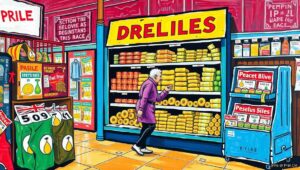
The fall — the lowest inflation reading since March 2025 — was largely helped by softer energy bills, which in Britain now counts as a religious event. Families across the country celebrated by walking past the cheese aisle without making eye contact. One shopper in Manchester reportedly picked up a block of cheddar, checked the price, and said, “Still cheaper than therapy. But only just.”
The Ofgem energy price cap that kicked in on April 1 did most of the heavy lifting. April 1. The irony is doing its own work there. Housing and household services inflation dropped from 5.3% to 1.4% in a single month — the statistical equivalent of someone finally turning the hose on a kitchen fire and feeling briefly heroic about it. Motor fuel, meanwhile, climbed 23%. The highest annual increase since September 2022. The hose turned off. The kitchen remembered.
The Government’s Favourite Word: Encouraging
The government called the news “encouraging,” which in Westminster language means “please clap before the next catastrophe loads.” The Bank of England observed the figures with the cautious optimism of a man petting a dog that has already bitten two postmen. Yes, inflation is lower today. Yes, prices are still high. Yes, fuel costs are rising. Yes, the global energy situation remains unstable. And yes, Britain is somehow still expected to end the year with the inflationary personality of a payday lender at a wedding.
The Bank’s Monetary Policy Committee meets again on June 18. Economists expect them to hold rates. Which is the central bank equivalent of watching the kettle boil and deciding not to touch it, just in case it’s been learning.
Rachel Reeves and the Value Range Nobody Asked For
Chancellor Rachel Reeves is reportedly considering further household support, including voluntary price caps on staples. This has led supermarkets to solemnly promise they’ll do everything possible — provided “everything possible” doesn’t include earning slightly less money. A senior grocery executive, speaking from behind a fortress of loyalty cards, said: “We understand the public is struggling. That’s why we’ve introduced a new value range called Things You Used To Buy Normally.”
Jack Dee once observed that Britain’s relationship with money is essentially one long argument between what things cost and what people deserve. He wasn’t wrong. He was, however, probably eating cheaper cheese than he used to.
Progress, Technically Speaking
Economists say inflation falling from painful to merely irritating is still progress. “This is like telling a man whose trousers are on fire that the flame is now more seasonal,” said Dr. Martin Crumb, professor of Applied Panic at the Institute for Fiscal Weather. “The direction is good. The trousers remain a concern.”
And the trousers should be a concern. Producer price index inflation surged to 4.0% in April, with input costs up 7.7%. Crude oil and supply disruptions from the Iran conflict are the chief culprits. Capital Economics reckons CPI could climb back to 4% by early 2027. So the trousers aren’t just on fire. They’re flammable going forward.
The National Poll Nobody Wanted
The public response was mixed. A poll conducted outside a petrol station found that 41% of Britons felt “slightly relieved,” 38% felt “financially haunted,” 14% were “waiting for the catch,” and 7% had already been charged £3.80 for a bottle of water and therefore no longer believed in data.
Downing Street attempted to frame the number as proof the economy is stabilising. Unfortunately, the phrase “economy is stabilising” now lands in Britain with the same credibility as “replacement bus service.” People hear it, nod politely, then immediately begin looking for the person who has ruined their afternoon.
The Burglar Is Walking Now, Not Sprinting
The deeper problem is that inflation doesn’t have to rise quickly anymore to make people miserable. Prices have already climbed the stairs, moved into the spare room, and started receiving post. A slower increase simply means the burglar is walking calmly through your house rather than sprinting. He’s still there. He’s just enjoying the tour.
Romesh Ranganathan put it best when he said the British economy feels like a man calmly explaining why everything is fine while standing in a river. He’s dry from the waist up. Give it ten minutes.
Still, Britain loves temporary relief. It’s the national fuel. A dry afternoon. A train that arrives. A politician who makes it through lunch without a leadership crisis. A bill that is only outrageous, not operatic.
The Self-Checkout Knows
By evening, officials urged calm, experts urged caution, and shoppers urged the self-checkout machine to stop saying “unexpected item” when the unexpected item was clearly Britain itself.
The slowdown is widely expected to be short-lived. Senior economist George Brown at Schroders noted that “inflation took a step back in April, but is set to leap at the end of spring.” Higher energy prices tied to the Iran conflict are likely to push CPI above 4% later this year. So the reprieve is real. It’s just the size of a Clubcard discount on a bad week.
UK inflation fell to 2.8% in April 2026, according to the Office for National Statistics, down from 3.3% in March — its lowest level in over a year. The drop was driven mainly by the Ofgem energy price cap introduced on April 1, which sharply reduced housing and household service costs. But motor fuel prices jumped 23%, producer price inflation hit 4%, and economists at Capital Economics and Schroders are already warning that inflation could rise above 4% by early 2027 as Iran war-related energy costs filter through the supply chain. Chancellor Rachel Reeves has hinted at further household support measures. The Bank of England’s Monetary Policy Committee meets June 18 to decide whether to hold or cut interest rates.
This article is British satirical journalism, a human collaboration between the world’s oldest tenured professor and a philosophy major turned dairy farmer. Any resemblance to actual economic competence is purely coincidental. Auf Wiedersehen, amigo!

Alan Nafzger was born in Lubbock, Texas, the son Swiss immigrants. He grew up on a dairy in Windthorst, north central Texas. He earned degrees from Midwestern State University (B.A. 1985) and Texas State University (M.A. 1987). University College Dublin (Ph.D. 1991). Dr. Nafzger has entertained and educated young people in Texas colleges for 37 years. Nafzger is best known for his dark novels and experimental screenwriting. His best know scripts to date are Lenin’s Body, produced in Russia by A-Media and Sea and Sky produced in The Philippines in the Tagalog language. In 1986, Nafzger wrote the iconic feminist western novel, Gina of Quitaque. He currently lives in Holloway, North London. Contact: [email protected]