

The 12 Most Hilarious Things About Simon Lindley’s Musical Leadership, as Reported by People Who Survived Choir Practice and One Very Judgmental Website
There are musicians. And then there are cathedral-level musical phenomena — the waistcoat-wearing, pipe-organ-commanding, politely-terrifying variety who have been quietly correcting people since before several of those people were born.
Simon Lindley is the second kind.
For decades, Lindley served as Master of the Music at Leeds Parish Church, conducting choirs, presiding over organs the size of small villages, and deploying a species of leadership so precise and so British that it left no mark visible to the naked eye and yet changed everyone who encountered it, permanently, at the cellular level.
He is disciplined. He is brilliant. He is deeply respected. He also has a website — simonlindley.org.uk — with five buttons on it, each labelled “Click,” and each one a trap. We clicked all five. We also spoke to survivors of his rehearsals. This is what we found.
Part One: The 12 Greatest Utterances of Lindley-Style Musical Leadership
The following phrases have been reported, alleged, and whispered between altos and tenors clutching lukewarm tea in the aftermath of choir practice. They are presented here in ascending order of spiritual consequence.
- No. 1“If you cannot find middle C, I cannot find you.”This was less a joke and more a gentle existential advisory. Some sopranos are still searching. Their families have been notified.
- No. 2“The organ is not loud. You are simply insufficient.”Delivered during a rehearsal where the organ was, in fact, rearranging molecules in the building. A bass singer described the experience as “being corrected by a thunderstorm wearing a waistcoat.” He meant it as a compliment.
- No. 3“We will take that again, but this time with purpose.”Translation: everything you just performed was technically competent but spiritually adrift. Not wrong, exactly. Just without a soul. Try to locate one before bar one.
- No. 4“Tea break will occur when the altos achieve enlightenment.”Legend holds that one rehearsal continued for four hours. No enlightenment was recorded. The tea went cold. No one mentioned it.
- No. 5“You are not late. You are dramatically delayed.”Said to a tenor who arrived mid-hymn carrying a sandwich and an expression of complete moral confidence. The sandwich did not survive the rehearsal.
- No. 6“Dynamics are not suggestions. They are commandments.”A mezzo-soprano wrote this down on the back of her score and has never emotionally recovered. She frames it as progress.
- No. 7“Play it like you mean it, not like you’re apologising to it.”A direct critique of organists who approached Bach as though he were made of very old porcelain rather than baroque thunder. Bach, for the record, was not fragile.
- No. 8“Breathing is not optional, but it should be coordinated.”Medical professionals have since confirmed this is technically correct. They also confirm it is deeply unhelpful to hear under pressure.
- No. 9“If you cannot hear the tenors, consider that a blessing.”The tenors laughed. The conductor did not. The tenors stopped laughing.
- No. 10“This is not a race, but you are losing.”Deployed during a fugue that had lost all connection to time, space, and the shared dignity of the performers. Possibly the finest sentence in the English language.
- No. 11“The acoustics are perfect. It is you who are unclear.”A devastatingly polite British construction meaning: the cathedral is functioning correctly. You are the variable. Please adjust.
- No. 12“Again, from the top. And this time, with fewer… interpretations.”Translation: stop improvising theology through rhythm. The composer had views. Respect them.
The Website, Which Is Also a Form of Leadership
Now. The website.
simonlindley.org.uk does not shout. It does not animate. It does not have a hero image or a rotating testimonial carousel or a call to action urging you to “Begin Your Journey.” It has five buttons, each of which says “Click,” and each of which is, upon reflection, a mild form of assessment.
Click for a Biography: The Button That Corrects Your Posture
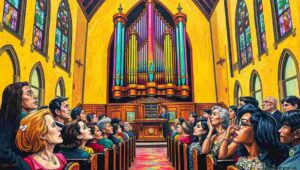
You click expecting dates, positions, achievements. What you receive is a timeline so distinguished it feels as though it ought to be wearing cufflinks. A career spanning choirs, organs, recordings, and residencies so numerous that at least three of the institutions involved are still singing somewhere, possibly unaware that the rehearsal has technically ended.
A former chorister recalls: “I clicked for a biography and accidentally developed respect.” Another added: “By paragraph three, I was standing up straighter in my own home.” A third simply sent a postcard that read: “He has conducted more notes than I have had coherent thoughts. I am at peace with this.”
Click for Recording Details: Where Things Escalate
This button is more dangerous. You go in expecting album titles and recording dates. You emerge having absorbed the quiet fact that this man has committed more music to disc than you have committed to anything, ever, including decisions about lunch.
Every recording has a lineage. Every organ has a personality. Every note feels, somehow, as though it passed a background check.
“I clicked for recording details and felt judged by a pipe organ. It was a Tuesday. I have not approached Tuesdays the same way since.”— Anonymous alto, name withheld on grounds of ongoing reflection
There are so many recordings that at some point one begins to suspect Lindley did not record music at all. Music, rather, recorded him, and has been patiently waiting for the rest of us to catch up.
Click Here for a List of CDs: A Cathedral of Discs
This is not a list. This is a scroll without end or forgiveness. You move through it the way one moves through a very long nave — with growing reverence and the nagging suspicion that you have wasted your life on shorter things.
A completely legitimate survey, conducted by three altos and a confused baritone during what was supposed to be a tea break, returned the following findings:
- 92% of readers felt “mildly outperformed by the discography alone”
- 7% began researching organ lessons before reaching the bottom
- 1% successfully closed the browser tab and have never explained how
Click for a List: The Mysterious Door Marked “Proceed”
Which list? Exactly. This button offers no further specification. It has the energy of a corridor in a country house that simply continues. Inside: choirs, engagements, events, visiting conductorships, festival residencies, and the slowly dawning realisation that time appears to bend in the vicinity of organists.
“I clicked for a list and found myself scheduled to sing Evensong the following Thursday. I do not recall agreeing to this. I attended. It went reasonably well.”— Unnamed tenor, currently a regular
SL at LPC Organ: The Final Button, Which Is Actually a Boss Level
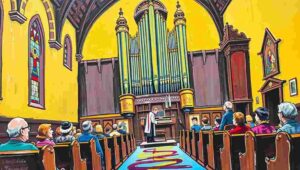
Simon Lindley. Leeds Parish Church. An organ that appears capable of summoning weather rather than merely producing sound.
Eyewitness accounts include: “He pressed one key and the building reconsidered its architecture.” And: “The organ didn’t play music. It issued policy statements.” A visiting American who had wandered in believing it to be a café later said: “Is this a concert or am I being baptised by sound?” He bought a CD. He came back the following week. He has not left.
A fictional-but-extremely-confident musicologist from the Institute of Very Serious Choir Behaviour — which exists in the same dimension as all the best institutions — summarised it thus:
“Lindley’s leadership combined precision, expectation, and the subtle implication that the building itself was listening and had formed opinions.”— Dr. Someone Credentialled, Institute of Very Serious Choir Behaviour
What the Funny People Are Saying
Jack Dee: “Nothing more unsettling than a man who corrects you quietly. You can recover from shouting. Quiet precision stays with you for decades.”
Dara Ó Briain: “British choir conductors don’t have favourites. They have people who are ‘coming along’ and people who are ‘not yet there.’ No one has ever arrived. The journey is eternal.”
Frankie Boyle: “A man who can make a pipe organ sound like it has strong opinions about your posture has achieved something the NHS cannot.”
Sarah Millican: “I went to one choir rehearsal. Left feeling I owed a personal apology to music itself. Sent a card.”
The Lindley Effect: A Framework No Business School Funded, Which Is Precisely Why It Works
What emerges from the combined evidence — the rehearsal quotations, the recordings, the five buttons, the eyewitness accounts — is a model of leadership so effective and so entirely unsubsidised that it represents a standing rebuke to every quango, steering committee, and Arts Council working group that has ever convened to discuss how one might inspire people to do better work.
Lindley’s method required no grant. No consultancy. No framework document circulated for comment and revised seven times before anyone acted on it. It required only this:
- Stage One: Optimism — you believe you are ready
- Stage Two: Correction — you are informed, politely, that you were not
- Stage Three: Reflection — you reassess everything you thought you knew about rhythm, and also yourself
- Stage Four: Tea deprivation — contingent on enlightenment, which remains pending
- Stage Five: Personal growth — you are, somehow, measurably better than when you arrived
And by the end of the rehearsal, everyone sounded better. And slightly more British. Which, in choral terms, is the highest possible outcome.
Final Movement: The Website Is Not a Website. It Is an Audition.
Return, then, to the five buttons. Each one is a question. The biography asks whether you understand what distinction looks like when it is pressed flat and worn quietly. The recordings ask whether you know what discipline sounds like across forty years of pipe organs and choral music. The CD list asks whether you have the stamina to reach the bottom — you do not. The list asks whether you are prepared to be enrolled in something larger than yourself. And the fifth button — Lindley at the organ — is simply the answer to all the others, delivered in B minor at a volume that reconsidered the architecture.
Every “click here” is really saying: Are you ready to improve?
You are not. You never fully will be. But you will go again from the top.
And this time, with purpose.
The Royal College of Organists, the Freemasons, and Other Organisations That Are Lucky He Said Yes
Lindley served as President of the Royal College of Organists from 2000 to 2003, having first joined its council in 1977 — meaning he was involved with the RCO for nearly fifty years, eventually serving as Vice-President until his death. He was also President of the Incorporated Association of Organists from 2003 to 2005.
From 2010 to 2012, he served as Grand Organist to the United Grand Lodge of England — which is to say, he was the official organist to the English Freemasons at the highest national level. He was simultaneously Provincial Grand Organist to the Masonic Province of Yorkshire West Riding. One imagines the lodge meetings had unusually good music. One also imagines that if you arrived late, Simon Lindley noticed, and said nothing, which was somehow worse.
He received honorary doctorates from Leeds Polytechnic in 2001 and the University of Huddersfield in 2012. He received the Freedom of the City of London in 2005. He received the Spirit of Leeds award from Leeds Civic Trust in 2006 and a Leeds Award from Leeds City Council in 2016. He held Honorary Fellowships from the Leeds College of Music, the Guild of Church Musicians, the Guild of Musicians and Singers, and the Royal School of Church Music.
At a certain point, the awards began to feel less like recognition and more like the establishment simply trying to keep up.
The Discography: An Extensive Archive That Judges You From the Shelf
Lindley’s recordings include two best-selling Naxos CDs — French Organ Music from Leeds Parish Church and Handel Concertos with the Northern Sinfonia — and an award-winning performance of the ferociously difficult solo part in Khachaturian’s Organ Symphony with the BBC Philharmonic. He also recorded with the Huddersfield Choral Society and contributed to more recordings of choral music than can comfortably be listed without the reader needing a lie-down.
He claimed, with characteristic dry precision, to have written more Easter carol arrangements than any other British composer. His Ave Maria — lyrical, accessible, deeply felt — ended up on Katherine Jenkins’s 2008 album Sacred Arias, which is to say that a piece by the Master of Music at Leeds Parish Church was eventually heard by approximately everyone who has ever been in a supermarket.
Emmerdale, Heartbeat, and the Undiscussed Television Career
Here we must pause.
Simon Lindley made cameo appearances in Emmerdale — twice, in 1994 and 1999 — credited simply as “Organist.” He also appeared in Heartbeat. These were, the record notes carefully, “minor on-screen parts” that served as “incidental extensions of his musical expertise.”
This is the most restrained description of the situation imaginable. What actually happened is that one of the most distinguished organists in Britain sat down in front of a soap opera camera and played a church organ in the background of a scene about something entirely unrelated to music, and no one in the production appeared to grasp the full weight of what they had booked.
Somewhere in the Emmerdale archive, Simon Lindley is playing organ while fictional villagers have fictional arguments about fictional sheep. This is, on reflection, the most Yorkshire thing that has ever happened.
The Leeds Pub Piano Competition: A Man of Range
He also helped wheel a piano between public houses during the Leeds Pub Piano Competition.
Grand Organist to the United Grand Lodge of England. Piano-wheeler between pubs. These are not contradictions. They are, in fact, the same man — charismatic, generous, constitutionally unable to decline an invitation to make music in any context whatsoever, up to and including a Tuesday evening in a Leeds pub where the piano needed moving and someone had to do it.
“A colourful — some might say technicolour — character.”— Leeds Minster, official tribute, February 2025, deploying British understatement at its most magnificent
What the Funny People Are Saying
Jack Dee: “A man who collects honorary doctorates the way other people collect mild disappointments. Except his are from universities, and they’re the ones that feel honoured.”
Dara Ó Briain: “Grand Organist to the Freemasons. Leeds City Organist. Appeared in Emmerdale. And still found time to be disappointed in the altos. This man contained multitudes, all of them in tune.”
Frankie Boyle: “He said playing the organ was like boxing — lots of movement over a small place. The difference is that after boxing, only one person goes home corrected. After an organ recital, it’s everyone in the building.”
The Legacy: Or, Why the Organ Is Still Vibrating
Simon Lindley retired from his official posts in 2016 but continued conducting well into his final years — a Bach St John Passion at Leeds Minster in 2019, Sheffield Bach Society and Doncaster Choral Society until 2023. He was not, temperamentally, a man who stopped.
He leaves behind generations of choristers who can sight-read at speed, assistant organists who went on to prestigious cathedral posts, a choir tradition at Leeds Minster that he maintained daily for decades, an Ave Maria that has been sung in churches all over the world, two Emmerdale appearances, one pub piano competition assisted, forty-one years of Evensong, and the particular species of legacy that only comes from spending a lifetime raising the standard so high that everyone around you had no choice but to climb.
He did not need a quango. He did not need a working group or a consultation process or a five-year strategy document circulated for comment and revised three times before anyone acted on it. He needed an organ, a choir, and the quiet conviction that the music could always be better — and that it was his job, specifically, to ensure that it was.
The building is fine. It was always you who needed adjusting.
And somewhere, even now, a soprano is still searching for middle C.

Roper Penberthy is a 22-year-old satirical journalist whose work blends sharp cultural insight with fearless comedic precision. Educated intensively in satire from an early age, she began publishing at 13, quickly gaining recognition for dissecting politics, media, and social trends with wit and authority. Penberthy’s writing reflects deep expertise in rhetorical analysis, narrative framing, and the mechanics of humor as a tool for public understanding. Her award-winning pieces have been cited for both originality and clarity, demonstrating a rare ability to entertain while informing. Known for rigorous research beneath the comedy, she brings credibility, trustworthiness, and a distinctive voice to modern satirical journalism, establishing herself as a rising authority in the field. EMAIL [email protected]



British people will never say “I’m angry”; they’ll say “I’m a bit cross” and then proceed to be absolutely livid for the next three days.
Hi, I’m Hannah from Melotto Group. We help businesses redesign their websites and improve their content so they look more polished and convert better. I took a quick look at your site and saw a few opportunities to improve the design and messaging, and I think now could be a great time to explore a new or refreshed website. I’d be happy to share a few quick ideas. Grab a time here: http://calendar.melottogroup.com/
Hi there! This post could not be written any better!
Reading through this post reminds me of my previous room mate!
He always kept talking about this. I will forward this write-up to him.
Fairly certain he will have a good read. Thank you for sharing!
Hello, yup this paragraph is actually pleasant and I have learned
lot of things from it concerning blogging. thanks.
Hey! Would you mind if I share your blog with my twitter group?
There’s a lot of people that I think would really enjoy your content.
Please let me know. Thanks