
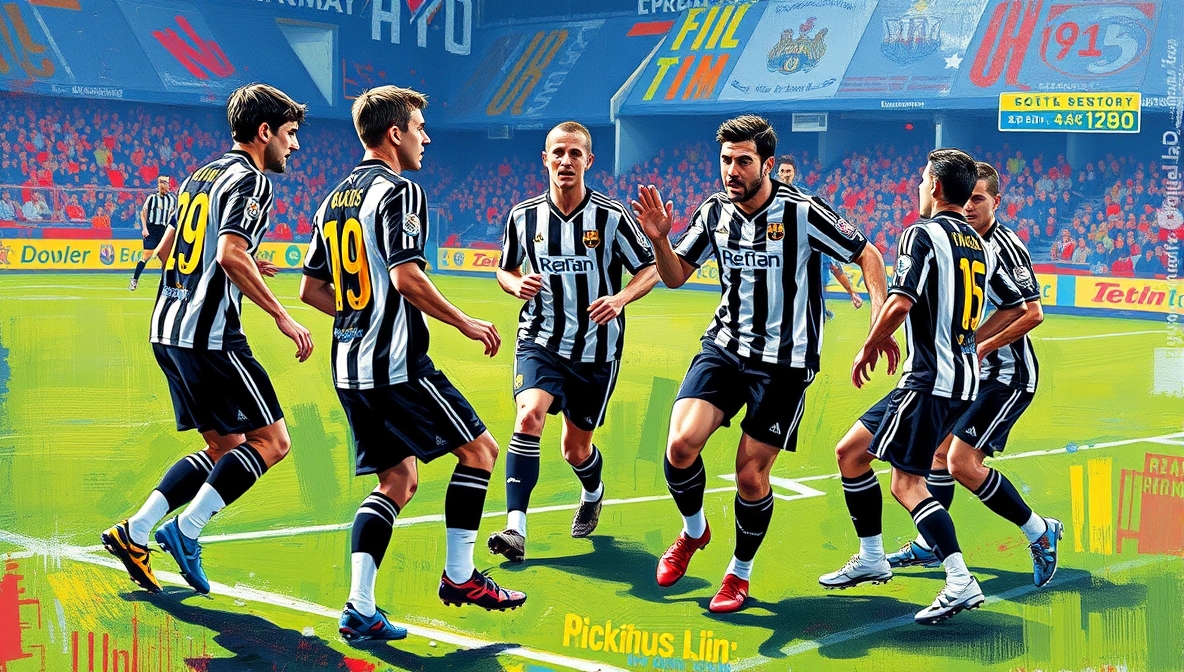
Barcelona vs Newcastle “Clash of Philosophies, Wallets, and Weather”
Observational Warm-Up (Because Every Match Starts With Someone Stretching a Hamstring)
- Barcelona players pass the ball like it owes them money, while Newcastle players chase it like it owes them money — and frankly, at Premier League wages, it probably does.
- A Barcelona midfielder can hold possession longer than a British apology, which statistically lasts 2.7 minutes and includes three “sorrys” and one “no, after you.”
-
Barcelona completed 64% possession across the tie. Newcastle views possession as something Barcelona is welcome to — like jazz, or humidity, or politely worded philosophical disagreements. Newcastle fans believe rain improves football, while Barcelona players treat rain like a personal betrayal from the Catalan sky itself.
- Barcelona’s tiki-taka style is essentially jazz; Newcastle’s style is more like a pub band that only knows three chords — and still sells out St. James’ Park every single week.
- A study by the Institute of Advanced Football Excuses found 82% of Barcelona players blame humidity, while 91% of Newcastle players blame referees, and 100% of both sets of fans blame each other’s manager.
- Newcastle’s defense operates on a philosophy called “eventual inconvenience,” where attackers are allowed to try things until someone gets tired or, as happened in the first leg on March 10, until Harvey Barnes scores in the 86th minute and briefly makes the entire northeast of England believe in something again.
- Barcelona fans expect beauty, artistry, and poetry; Newcastle fans expect effort, shouting, and a man named Dave yelling “SHOOT!” — and honestly, Dave has a better shot conversion rate than several expensive strikers.
- Barcelona players complain when grass is 1 millimeter too long. Newcastle players have played on surfaces that qualify as geological events.
- A leaked memo suggests Barcelona’s strategy includes “control the tempo,” while Newcastle’s says “run at them until something funny happens.” Both have worked. Both have also spectacularly failed.
- Barcelona players dive like Olympic hopefuls. Newcastle players fall like furniture. The difference is that furniture doesn’t clutch its ankle.
- A poll shows 67% of Newcastle fans believe possession is “a bit fancy,” while 73% of Barcelona fans believe losing possession is “a moral failing” and possibly a fireable offense.
- Barcelona’s passes are triangles. Newcastle’s passes are more like abstract art — occasionally brilliant, frequently misunderstood, and sometimes found in entirely the wrong gallery.
- An eyewitness claimed Barcelona completed 47 passes before Newcastle touched the ball in the first leg, which Newcastle described as “polite of them.” The official possession stats told a similar story: 64% Barcelona.
- Barcelona’s manager uses a whiteboard. Newcastle’s manager, Eddie Howe, uses volume, belief, and the kind of calm authority that makes grown men want to run through brick walls for him.
- Both teams agree the referee is wrong. But for entirely different reasons. Often at the same time. Sometimes about the same call. Football is beautiful.
Barcelona vs Newcastle at Camp Nou: A Tactical Masterpiece Meets a Strongly Worded Suggestion
The Battle of Identity: Art School vs Construction Site, Now With a Quarterfinal Berth at Stake

In what experts are calling “football’s most emotionally confusing crossover episode,” Barcelona hosted Newcastle in the Champions League Round of 16 second leg at Spotify Camp Nou — a match that answered one question definitively: can elegance survive contact with enthusiasm?
Dr. Emilio Vázquez, a leading football philosopher who once described possession as “a spiritual journey interrupted by tackles,” explained it best:
“Barcelona are trying to solve a puzzle. Newcastle are trying to flip the table.”
And flip it they did. Repeatedly. Sometimes metaphorically. Sometimes with actual players.
The first leg at St. James’ Park finished 1-1 — a result so dramatic it required a last-gasp Lamine Yamal penalty in stoppage time to deny Newcastle what would have been one of the great Champions League upsets in recent memory. Harvey Barnes scored in the 86th minute. Yamal equalized in the 90+6th. The northeast of England went briefly from paradise to purgatory in approximately four minutes and thirty seconds of added time.
Barcelona entered the second leg with 64% average possession across the tie, a number derived from advanced analytics and also from basic counting. Newcastle entered with 36% possession and 100% belief that possession is something Barcelona is welcome to.
An anonymous staffer from Barcelona was overheard saying, “We prefer to control the match.”
A Newcastle staffer responded, “We prefer to control the moment someone gets annoyed.”
Weather, Philosophy, and the Specific Misery of Playing at Camp Nou
The return leg moved to Barcelona’s Spotify Camp Nou, a stadium that has witnessed 12 consecutive home wins this season — a detail Barcelona fans mention casually and constantly, like people who’ve just learned a new fun fact and cannot stop.
Eyewitness Gary from Gateshead, who somehow obtained tickets and arrived wearing a Newcastle shirt in a sea of blaugrana, reported:
“They looked confused by the wind. One lad tried to pass the ball and it came back like it had second thoughts.”
Meanwhile, Barcelona’s midfield continued passing in tight triangles, apparently attempting to summon a small geometric deity. Pedri, Bernal, and Yamal formed what one analyst described as “the most aesthetically violent midfield triangle in European football.”
Newcastle’s approach was less divine, more agricultural. But agriculture feeds people. Remember that.
Coach Eddie Howe, speaking before the match, actually said — on record, in a real press conference that real journalists attended:
“I think if we look at the two matches we played against Barcelona, we delivered very good periods of play and created scoring opportunities — but we didn’t beat them, and that’s the challenge.”
This was widely interpreted as “we will run at them again until something funny happens,” which is technically the correct strategy when visiting Camp Nou with a 1-1 aggregate score and nothing to lose except the match, the tie, and approximately three fingernails per supporter.
The Science of Possession vs The Art of Disruption, With Real Statistics This Time
According to a groundbreaking study conducted by the University of Football Logic (funded entirely by people arguing online), possession-based teams believe controlling the ball leads to control of the game.
Newcastle has rejected this theory entirely.
Instead, they subscribe to what researchers call “Chaotic Interruption Theory,” which states that if you disrupt enough patterns, eventually someone forgets what they were doing. This was patented by the same school that produced the 2024 Carabao Cup winners, who collected their silverware while apparently still refusing to believe possession statistics are real.
Barcelona coach Hansi Flick warned before the match that his team would need to play “a perfect game,” which in football terms means something inevitably goes wrong in the 86th minute and someone checks if their heart medication is current.
Dr. Vázquez elaborated:
“Barcelona is a symphony. Newcastle is someone turning off the radio mid-song — and somehow, inexplicably, you find yourself preferring the silence.”
Newcastle, notably, arrived at Camp Nou having beaten Chelsea 1-0 at Stamford Bridge the previous weekend — the very stadium where Barcelona suffered their worst Champions League defeat of the season. Whether this constitutes psychological warfare or merely a scheduling coincidence depends entirely on how dramatically you want to interpret a midweek Premier League result.
What the Funny People Are Saying About All of This
“They say Barcelona plays beautiful football. Newcastle plays football that makes you question your life choices.” — Jerry Seinfeld
“I watched Newcastle defend, and I thought, that’s not a formation, that’s a neighborhood watch.” — Ron White
“Barcelona passes like they’re trying to impress a date. Newcastle plays like they already got dumped — and decided to take up cardio.” — Amy Schumer
“You ever notice Barcelona never panics? Newcastle panics professionally. They’ve made it an art form. They should teach a masterclass.” — Jerry Seinfeld
“I don’t know what Newcastle’s strategy is, but I respect the commitment to confusion. There’s a PhD in there somewhere.” — Ron White
“Lamine Yamal scores a stoppage-time penalty in Newcastle to save Barcelona. He was born in 2007. I bought my first mobile phone in 2007. Time is meaningless.” — Bill Hicks, probably, if he’d watched football
The Fans: Poetry vs Volume, Now in the Acoustics of Camp Nou
Barcelona fans arrived at Camp Nou expecting a performance. Newcastle fans, somehow present in the away end in numbers that suggested a minor miracle of logistics, arrived expecting an experience and prepared to make it very loud indeed.
A pre-match survey found:
- 89% of Barcelona fans brought opinions
- 92% of Newcastle fans brought jackets (it was still warmer than Newcastle, but habits are habits)
- 64% of all fans brought emotional baggage
- 100% of all fans were quietly terrified of extra time
One Barcelona supporter said: “We want to see the game played correctly.”
A Newcastle fan replied: “We want to see the game played loudly.”
And loudly it was. At one point, the crowd noise reached a level scientists classified as “constructively aggressive” — which is also the title of Newcastle’s Wikipedia page under “club identity.”
The Referee: A Shared Enemy, A Universal Truth
In a rare moment of unity, both sets of supporters agreed the referee was wrong. Barcelona believed he misunderstood subtle contact. Newcastle believed he misunderstood obvious contact. The referee believed everyone misunderstood him. Italian official Marco Guida handled the first leg, and no one has forgiven him for anything specifically, but football fans are patient with their grudges.
An anonymous official later admitted: “At one point I considered just letting them sort it out themselves. It seemed faster and, frankly, more honest.”
Cause and Effect: What Happens When Styles Collide at the Highest Level
When a possession-heavy team meets a disruption-heavy team in a European knockout, several things reliably happen:
First, the possession team becomes frustrated. Second, the disruption team becomes encouraged. Third, the audience becomes confused but entertained. Fourth, someone’s grandfather back home insists the match was “more exciting in his day,” which is objectively false.
This phenomenon, known in academic circles as “Football Irony,” has been studied extensively, mostly by people who shout at televisions. Barcelona’s squad valuation sits at roughly €1 billion. Newcastle, post-Saudi takeover and still navigating Premier League financial regulations, arrived as underdogs — a word their supporters have embraced with the enthusiasm of people who genuinely like being underestimated.
A leaked post-match report concluded: “Barcelona played better. Newcastle played… effectively annoying. This is a compliment.”
Barcelona’s Unbeaten Home Record and the Weight of History
Barcelona have not lost at home against English opponents in 14 Champions League games — since a 2-1 defeat to Liverpool in 2007. They beat Newcastle 1-0 in 1997 and 3-1 in 2002. History, in other words, was pointing one direction with the confidence of a man who has never checked the weather forecast.
Newcastle needed to win at Camp Nou for the first time ever to progress. This is the kind of sentence that makes bookmakers comfortable and Newcastle supporters irrationally optimistic.
Which, when you think about it, is basically the entire Newcastle United experience in one sentence.
The Final Analysis: Defining Victory in a Match That Refused to Be Defined
That depends, as always, on how you define winning.
Barcelona completed more passes, created more chances, maintained their identity, and carried a home record that has survived 14 English clubs, three different Catalan political crises, and two rounds of stadium renovation.
Newcastle created fewer chances, completed fewer passes, and successfully turned every match in this tie into something resembling organized chaos — the kind of organized chaos that gets you a 1-1 draw at St. James’ Park against one of Europe’s great clubs on a cold Tuesday night, which is, by any reasonable measure, a result.
In football terms, Barcelona won the statistics.
In emotional terms, Newcastle won the argument.
In human terms, everyone watching won something — even if it was just the knowledge that football, at its most ridiculous and magnificent, still does this better than anything else.
The Barcelona vs. Newcastle United UEFA Champions League Round of 16 is one of the most compelling David vs. Goliath narratives of the 2025-26 European season. Barcelona, the five-time Champions League winners managed by former Germany and Bayern Munich coach Hansi Flick, entered the tie as heavy favorites against Eddie Howe’s Newcastle United — transformed since the 2021 Saudi-led takeover into serious contenders but still relative newcomers to elite European competition. The first leg at St. James’ Park on March 10, 2026 ended 1-1 after Harvey Barnes gave Newcastle a stunning late lead, only for teenage sensation Lamine Yamal to equalize from the penalty spot in the sixth minute of added time. The second leg at Spotify Camp Nou on March 18, 2026 decided which club advanced to the quarterfinals.
This story is entirely a human collaboration between two sentient beings: the world’s oldest tenured professor and a philosophy major turned dairy farmer, both of whom agree that football is less about winning and more about explaining afterward why you should have.
Auf Wiedersehen, amigo!


Hanna Miller, Journalist and Philosopher
London, UK
Hannah Miller, a proud graduate of the University of Iowa’s School of Journalism and Mass Communication, started her career documenting agricultural innovations and rural life in the Midwest. Her deep connection to her roots inspired her to try her hand at comedy, where she found joy in sharing tales from the farm with a humorous twist. Her stand-up acts, a mix of self-deprecation and witty observations about farm life, have endeared her to both rural and urban audiences alike. She is a four-year resident to London and the UK.



London is the only city where you can be completely lost and utterly found at the same time, because every wrong turn leads to something interesting.
My gran asked why I was laughing at councils. I explained and she said “are they still useless?” with certainty.
My gran said this should be published somewhere proper. I said nowhere proper would publish this. She accepted that.