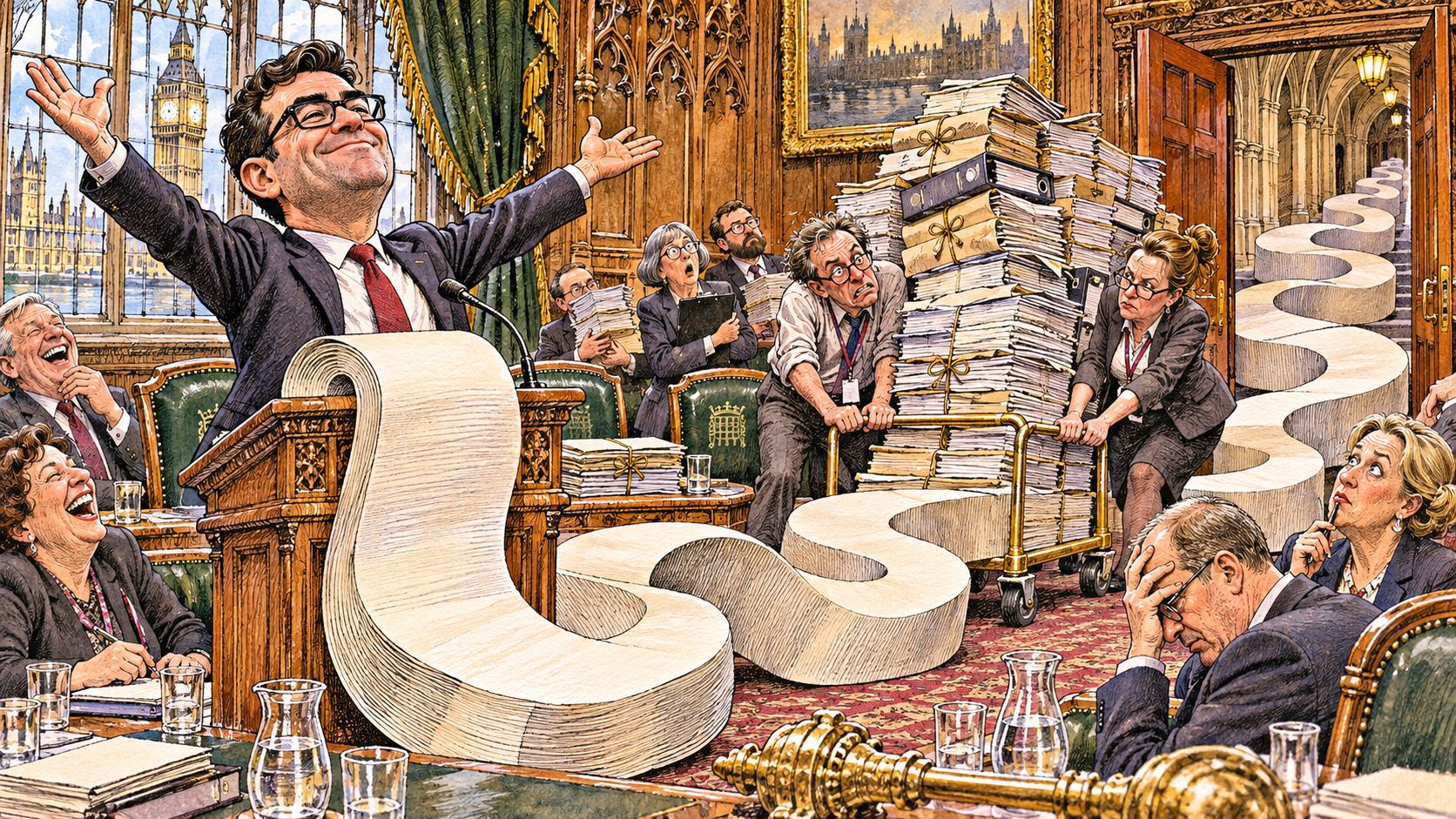
LONDON — The UK EU Brexit reset has reached its most British stage: everyone agrees there should be less paperwork, provided somebody produces a substantial document establishing how much less paperwork everyone agrees there should be.
Andy Burnham has been advised to announce the end of red tape from behind a lectern reinforced to support the accompanying annexes. A ceremonial ribbon was rejected after procurement officers discovered it counted as additional tape.
UK EU Brexit reset meets the completion certificate
The real summit package covers food trade, emissions trading and youth opportunities. The government’s UK–EU summit factsheet estimates that the food-and-drink agreement could eventually add £5.1 billion annually to the economy. That is a potential benefit, rather than money already waiting inside the Chancellor’s biscuit tin.
The Prat’s Ministry of Finishing Things has nevertheless booked a celebratory meeting about closing the discussion. Its invitation requests confirmation of attendance, dietary requirements and whether attendees believe this particular discussion has ever actually opened.
“Brexit is finished when the filing cabinet says it is finished,” explained departmental completion enthusiast Crispin Staple. “We cannot simply let political events wander around without a reference number.”
An exporter attending the demonstration brought a single cheese. Officials requested evidence that it was the same cheese discussed at the preliminary cheese meeting.
A relationship status requiring supporting evidence
The original argument concerned sovereignty. The new argument concerns which committee has sovereignty over the arrangements for discussing sovereignty. This represents progress because the second argument can be held indoors.
A Downing Street aide described the reset as pragmatic. In Westminster, pragmatic means accepting yesterday’s outrage after someone has changed the font.

The Commons Library briefing on youth mobility negotiations describes another piece of the developing relationship. Officials were relieved to discover that young people can have limited stays. They have yet to introduce the same principle for negotiations.
The Prat’s entirely unscientific cheese-counter survey found three exporters wanted simpler processes and a fourth wanted his pen back. Ministers interpreted this as overwhelming support for continuing stakeholder engagement, particularly with the fourth man, who appeared to own stationery.
Businesses request a smaller celebration
Warehouse manager Denise Crate said she would judge success by what happens when a shipment leaves her loading bay.
“If I need fewer forms, wonderful. If I need a new form proving I need fewer forms, I would like the old headache back. I understood its opening hours.”
Her test is practical: fewer checks where agreed, clearer rules and implementation dates. A summit photograph cannot clear a pallet through customs, although several consultants have offered to investigate.
What readers should actually check
Businesses should follow the published implementation guidance and distinguish political agreement from operational change. Keep existing compliance arrangements until the applicable rules change.
Staple confirmed that guidance on recognising the end of Brexit would follow shortly. Before release, it requires approval from the steering group responsible for ensuring that nothing ends prematurely.
The cheese remains under consideration.
Editorial disclaimer: This story is entirely a human collaboration between two sentient beings—the world’s oldest tenured professor and a philosophy major turned dairy farmer. The cheese has requested separate representation.
Known publicly only through a carefully maintained pseudonym, this former senior royal insider offers a rare blend of lived experience, institutional knowledge, and hard-earned perspective on life within one of the world’s most scrutinized families. Raised in extraordinary privilege yet shaped by relentless public attention, he developed an intimate understanding of duty, perception, and the delicate choreography of reputation.
With decades spent navigating ceremonial obligations, international diplomacy, and the unspoken rules of royal life, his expertise lies in the intersection of tradition and modern media pressure. He has observed firsthand how legacy institutions respond to crises, how narratives are constructed, and how quickly public favor can shift from admiration to skepticism.
His insights are informed not only by access, but by consequence. Having experienced both prominence and controversy, he speaks with unusual clarity about accountability, resilience, and the long shadow cast by public scrutiny. Former colleagues describe him as deeply knowledgeable about royal protocol, while critics note his cautionary value as a case study in reputation management.
Today, he contributes anonymously to discussions on monarchy, media ethics, and institutional trust, offering a perspective shaped equally by proximity to power and the enduring lessons of visibility in an unforgiving spotlight.