

Ireland’s Pubs Discover the Terrifying New Concept of “Moderate Drinking”
Pub Drama; Sober Customers
The Irish pub, once the global headquarters of heroic storytelling, philosophical shouting, and pints stacked like a medieval fortress wall, has recently encountered an alarming development: alcohol-free drinks. 🍺🚨
Historians are still trying to understand the moment this happened.
For centuries, the Irish pub operated under a simple and elegant economic system: someone buys a round; someone tells a story that begins with “This actually happened”; nobody remembers how the story ends.
Now, however, a new creature has entered the ecosystem: the sober customer.
Anthropologists say the species first appeared quietly near the dartboard, ordering something called Guinness 0.0, which experts describe as “all the flavour of beer, with none of the poor decisions afterwards.”
The Great Irish Pub Identity Crisis: When Sobriety Came for the Stout
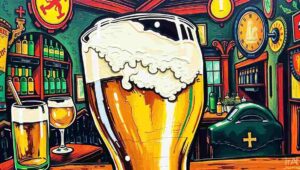
According to Drinks Ireland, sales of non-alcoholic beer in Ireland increased 25% in 2024 and have grown roughly 150% over five years. The Irish Times reports that sales of non-alcoholic Guinness specifically surged 35% last year alone, building on 47% growth the previous year.
Researchers say this growth reflects a broader cultural shift towards “moderation,” which is a complicated Irish word meaning “two pints instead of seven.”
A spokesperson for the Irish Hospitality Research Council explained the situation during a press briefing held in a pub that now offers kombucha.
“We’re not abandoning tradition,” he insisted whilst nervously polishing a glass. “We’re simply offering customers the opportunity to make terrible life decisions with full clarity of memory.”
The room fell silent.
Several older men reportedly fainted. One was revived with a splash of whiskey — purely medicinal, of course.
Scientists Confirm Sobriety Is Spreading Across Irish Pub Culture
A new sociological study from the University of Dublin has found that one third of Irish pub-goers now regularly choose low- or no-alcohol drinks when going out. Hospitality Ireland confirms this trend, noting that 62% of drinkers believe greater availability of 0.0% alternatives is actually reducing overall alcohol consumption.
The study’s lead researcher, Dr. Fergus O’Malley, described the findings as “deeply unsettling.”
“In traditional Irish culture,” he said, “you had two categories of beverage: beer, and stronger beer.”
He added that younger patrons now enter pubs and order something called a “mindful beverage experience.”
“That used to be called tea,” he clarified. “And we drank it at home, where it belongs, with biscuits.”
As Lee Mack might put it: “You can’t walk into a boozer in Killarney and ask for a mindful beverage experience. You’ll get a very mindful smack in the gob.”
The Pub Owner Panic: Alcohol-Free Menus Spread Like a Bad Rumour
Pub owners across the country have begun adapting to the trend with remarkable creativity — and perhaps a touch of desperation.
Some now offer:
- Alcohol-free Guinness
- Alcohol-free lager
- Alcohol-free cider
- Alcohol-free gin
- Alcohol-free cocktails
- Alcohol-free existential dread
In one Dublin establishment, bartenders proudly unveiled their newest innovation: “Whiskey-flavoured water.”
“It’s a revolutionary concept,” said the bartender, who appeared to be questioning his career choices. “It tastes exactly like regret, but you can still drive home. Legally, anyway. Emotionally, you’re still wrecked.”
Older Irishmen Remain Suspicious of the Sober Curious Movement
Naturally, Ireland’s elder pub philosophers are not convinced. Some might say they’re “sceptical” if they knew what the word meant.
Seamus Gallagher, 74, a lifelong pub regular in County Clare, offered his opinion between sips of what he insists is “a normal pint” and definitely not his fourth “normal pint” of the afternoon.
“If you remove the alcohol from beer,” he said thoughtfully, “what exactly is left?”
He paused.
“Sadness. Just… sadness. And bubbles. Sad bubbles.”
Seamus then added that the entire trend is clearly a conspiracy by the tea industry, Big Water, and possibly the Irish government, “who’ve been trying to ruin fun since 1922.”
Economists Weigh In on Ireland’s Non-Alcoholic Beer Market Growth
Economists studying the Irish pub industry say the shift may actually help bars survive — though they admit it sounds ridiculous when said out loud.
Beer consumption has declined slightly in recent years, but non-alcoholic drinks are rising fast, helping pubs attract customers who still want the social experience without the hangover. The Irish Times reports that rural pubs in particular are finding that alcohol-free options help combat isolation by allowing patrons to “have a few pints and be able to drive home.”
However, this has created an entirely new problem.
People now remember what they said in the pub.
“That alone could destabilise the entire Irish storytelling tradition,” warned cultural historian Liam Byrne. “We’ve built a civilisation on plausible deniability. Remove the alcohol, and suddenly everyone becomes a fact-checker. It’s chaos.”
The Irish Storytelling Tradition Under Threat from Alcohol-Free Pints
Traditionally, Irish pub stories relied on a delicate relationship between alcohol and memory — a symbiotic partnership, if you will.
A man might begin with: “I once wrestled a shark.”
By the third round, the shark had become two sharks.
By closing time, the story involved the British Navy, a submarine, and possibly the Queen Mother.
Alcohol-free pints threaten to destroy this evolutionary process. Without alcohol, eyewitnesses are now able to interrupt stories with facts.
This is considered extremely rude. In some counties, it’s technically assault.
Jack Dee has already noted the broader implications: “The British have always relied on the Irish for their best stories. If the Irish sober up, we’re going to have to start making things up ourselves. And frankly, we’re rubbish at it.”
Government Considers Emergency Legislation to Protect Pub Culture
Faced with this cultural upheaval, Irish lawmakers are reportedly considering emergency legislation to protect the nation’s storytelling heritage.
Proposals include:
- A minimum nostalgia requirement for every pub (at least three photos of deceased local dogs)
- Mandatory folk music every 45 minutes, played by someone who definitely knows someone who knew The Dubliners
- A legal limit of two sober people per bar, and they must sit in the corner looking confused
- Free crisps for anyone ordering a real pint, to establish dominance
One proposal even suggests requiring anyone ordering alcohol-free beer to pretend it’s stronger than it is.
“Just slur a little,” the draft policy states. “For tradition. And dignity.”
Tourists Are Confused as Ireland’s Pub Scene Quietly Transforms
Tourists visiting Ireland are also struggling to adapt, their Lonely Planet guides suddenly useless.
Many arrive expecting cinematic scenes of endless whiskey and poetic drunkenness, perhaps a spontaneous singalong of “The Fields of Athenry.”
Instead they now encounter people drinking zero-alcohol lager whilst discussing fitness trackers, hydration apps, and something called “gut health.”
“I came here for the culture,” said an American visitor, visibly shaken. “Now the bartender is telling me about electrolytes. I can get that in Cleveland.”
Sociologists Explain the Rise of Ireland’s “Sober Curious” Generation
Experts believe the shift may be caused by several factors:
- Health awareness (the terrifying realisation that the body is not, in fact, a skip)
- Stricter drink-driving enforcement (the Gardaí have gotten suspiciously good at their jobs)
- Rising costs of alcohol (inflation is the real hangover)
- The terrifying realisation that hangovers last three days after age 30, four days after 35, and an eternity after 40
This has led to the rise of what sociologists call “the sober curious” — a phrase that would have been completely incomprehensible to Irish pub culture in 1995, and possibly grounds for exile in 1985.
The Irish Compromise: Moderation, Irish Style
Of course, Ireland is unlikely to abandon drinking entirely. That would be like France abandoning shrugs or Italy abandoning hand gestures. Some things are simply not done.
More likely, the country will develop its own balanced system, as confirmed by Heineken Ireland’s research showing that 56% of Irish adults now “pace themselves” at social occasions.
Experts predict the future Irish pub experience will look like this:
- First pint: regular beer.
- Second pint: regular beer.
- Third pint: alcohol-free beer “to pace yourself.”
- Fourth pint: regular beer again.
- Fifth pint: arguing about whether the third pint “counts.”
In other words: moderation. Irish style.
Final Thoughts from the Bar: Seamus Has the Last Word
Back in County Clare, Seamus Gallagher finished his pint and shook his head at the idea of alcohol-free beer, which he keeps referring to as “the devil’s barley water.”
“Look,” he said, “I understand the young people want to be healthy. They want to live longer, see the world, experience things.”
He paused thoughtfully.
“But if you remove the alcohol from beer…”
He stared into his glass, suddenly philosophical.
“…you’re basically just drinking a lecture. A wet, judgmental lecture about your life choices.”
And nobody goes to an Irish pub for a lecture.
They go for stories.
Preferably ones involving sharks.
And the British Navy.
And absolutely no fact-checking. 🍻
Auf Wiedersehen, amigo!
Ireland has long been synonymous with its pub culture — the local boozer functioning as community centre, therapist’s couch, and oral history archive rolled into one. But data from Drinks Ireland confirms that non-alcoholic beer sales have surged 150% over five years, with Guinness 0.0 leading the charge. Diageo expanded draught Guinness 0.0 to 1,000 pubs across Ireland in 2023, and Heineken rolled out its alcohol-free draught to 3,000 venues by late 2024. A nation that once had the second-highest rate of alcohol consumption in the EU is now, quietly and somewhat confusingly, pacing itself.

Staff Writer at The London Prat


Prat.UK’s writers spend hours researching stories, reading policy documents, analyzing financial records, and interviewing sources—all to write jokes that make you feel clever for understanding them.
Validates says. Mechanism.
Leí esto en la línea District. El peor y más apropiado lugar posible.