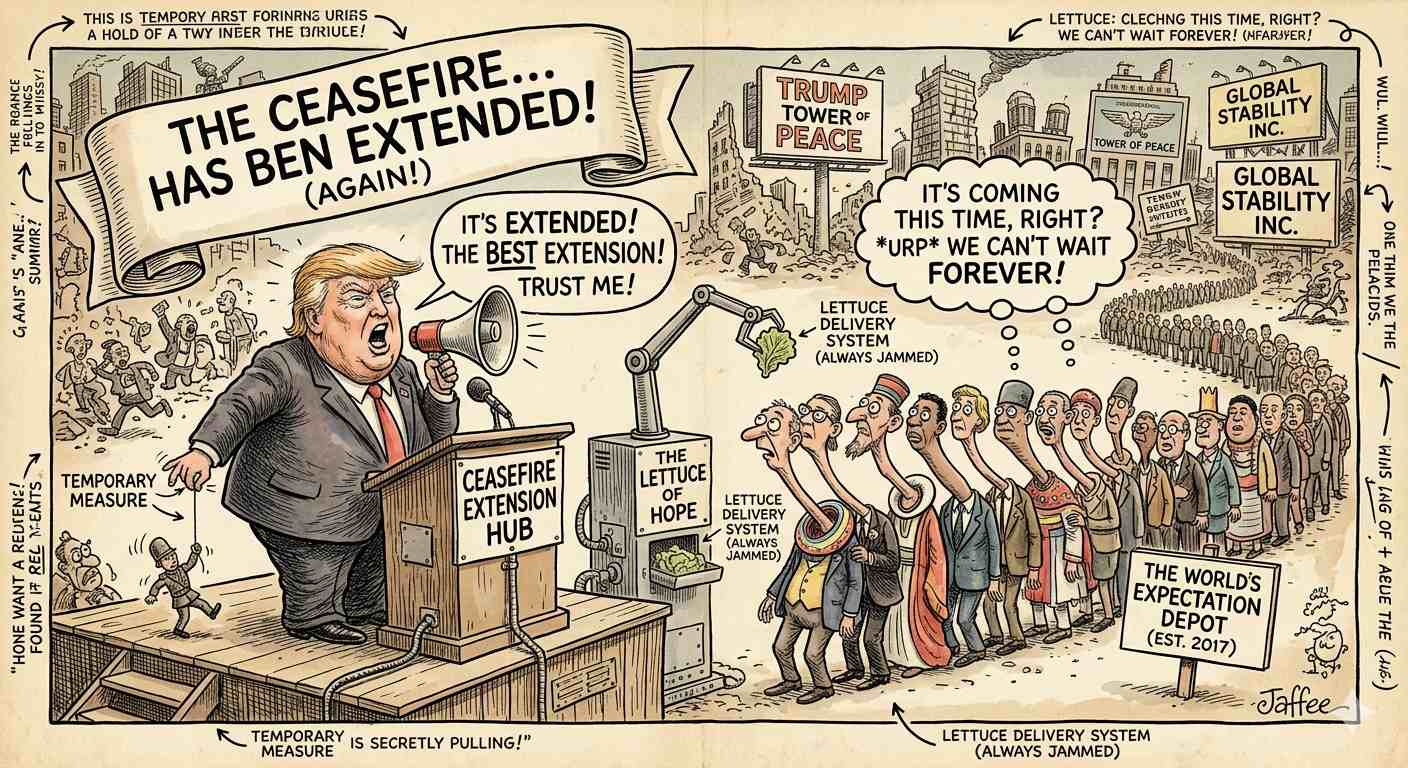
Trump Declares Iran Talks “Very Boring,” Iran Threatens The World’s Oil Supply Like A Toddler Who Has Just Realised Nobody Is Watching
LONDON — International diplomacy reached a curious low this week after President Donald Trump described the long-running standoff with Iran as “very boring,” whereupon Tehran threatened global oil supplies in what one analyst described as the geopolitical equivalent of setting off the smoke alarm at a wake because the eulogy had stopped mentioning you.
It began on Tuesday morning. Trump wandered out of a briefing, regarded the assembled press with the weariness of a man who has read the same memo four times, and announced that the talks had become “less exciting than a golf tournament played by accountants.” He then suggested, not unreasonably, that the accountants would at least keep score.
“They keep saying the same thing,” Trump reportedly grumbled. “We’re negotiating, we’re not negotiating, we’re cross, we’re not cross. Frankly, I’ve seen more suspense at a hotel checkout.”
Within hours, Iranian officials had suspended the talks and hinted, yet again, that they might shut the Strait of Hormuz, the slender channel through which roughly a fifth of the world’s oil drifts on its way to becoming a petrol receipt. Markets flinched. Then markets remembered that Iran has threatened precisely this thing roughly every six weeks since the fax machine was considered modern.
Iran Leaves The Talks, Inadvertently Confirms The Talks Were The Only Thing Keeping It In The Diary
According to a poll by the Institute for International Attention-Seeking, 67% of Britons had no idea negotiations were taking place at all. A further 19% believed Iran to be a posh brand of yoghurt. And 8% were quietly certain the Strait of Hormuz was a P&O crossing somewhere near the Isle of Wight, possibly with a carvery.
The remaining 6% were rolling news producers, perspiring gently, attempting to recall which corner of the map Iran occupies.
Dr. Shelby Hardcastle, professor of Strategic Overreaction at the University of Oklahoma City Airport Marriott Conference Centre, said the walkout posed a genuine riddle. She was eating a flapjack at the time, which is neither here nor there, though she mentioned it twice.
“If you leave a negotiation and nobody notices, are you still leaving?” Hardcastle asked. “Most diplomatic walkouts are designed to create leverage. This one appears designed to create content.”
Tehran insisted it still held enormous leverage. Analysts began looking for it. A hush descended.
Trump Astonished To Discover Iran Still Believes It Is Winning
Sources inside the White House say Trump was sincerely surprised to learn that Iranian leaders remain convinced they hold the whip hand. This is not entirely groundless. Tehran’s grip on the strait has become, by some reckonings, more strategically valuable to Iran than a nuclear weapon, which is the sort of sentence that ought to alarm a person rather more than it appears to alarm the focus groups in Ohio.
One senior official described the moment. “The president looked at the briefing, looked back at us, and asked, ‘Hang on. They think they’re winning?'”
Trump then spent several minutes peering at a chart marked “Iranian Leverage,” before concluding that most of it had apparently wandered off somewhere around 2018.
An anonymous aide says investigators have opened a formal search. “We checked the Gulf. We checked Syria. We checked Lebanon. We looked behind the sofa. So far we’ve turned up three old sanctions, a broken centrifuge, and an expired diplomatic threat that smelled faintly of 2015.”
Tehran Suspends Negotiations, Britain Suspends Caring
Reaction across the country remained admirably flat. In a greasy spoon in Doncaster, regular customer Barry Pickering admitted he hadn’t been following events terribly closely.
“I thought they already couldn’t stand each other,” Pickering said, between forkfuls of a full English. “Then somebody told me they were negotiating. Then somebody told me they weren’t. To be honest, love, I’m still trying to work out whether that text about my parcel is a scam.”
Similar bewilderment surfaced everywhere. In a Reading focus group, undecided voters greeted the diplomatic crisis by asking whether it would affect the price of a meal deal. Told it might nudge oil prices, they expressed brief concern, then dissolved into a forty-minute row about wheelie-bin collection days that nobody could later account for.
Iran Threatens To Close The Strait, Trump Offers To Rename It
The confrontation escalated when Tehran once more floated the idea of closing the strait. This is no longer an idle bluff. The waterway has spent much of this year choking global energy markets and driving inflation to its highest level in years, which is roughly the economic equivalent of the wake’s smoke alarm setting fire to the buffet.
Trump countered with a proposal to rename it. “We’re looking at alternatives,” he told reporters. “Maybe Strait of Poor Decisions. Maybe Strait of Consequences. Maybe Strait of We Told You So.”
White House cartographers were reportedly instructed to prepare draft maps. One labelled the area “Exit Ramp To Regret.” Another simply read “FAFO Bay.” The United Nations has not endorsed the proposal. Yet.
What The Funny People Are Saying
“The Middle East is like that bloke at the pub who announces he’s off home every twenty minutes and is still there at closing, asking whose round it is.” — Jimmy Carr
“Iran’s been threatening to leave for so long it should be charging the negotiations rent. With a deposit. And a six-month notice period.” — Lee Mack
“Nothing radiates confidence quite like vowing to do the thing you’ve been vowing to do since the Nokia 3310 was cutting-edge.” — Sara Pascoe
Global Markets Brace For Another Episode
Financial markets responded cautiously, which is the genteel way of saying “panicked, grew bored, then panicked again.” Oil traders spent the morning lurching between dread and elevenses.
“Every time someone says ‘Strait of Hormuz,’ oil leaps, the pundits shriek, the politicians give speeches, and then everyone goes home for their tea,” one veteran trader said. “It’s like the Boat Race, except nobody wins and the build-up lasts six months.”
Economists estimate that global energy markets have endured roughly 4,000 Hormuz-related emergencies since 1984. Around 3,998 of them ended with a strongly worded statement and a sandwich.
Experts Warn The Situation Could Become Even More Interesting
Professor Leonard Blatherskite of the Centre for Predictable Surprises warned that both sides risk becoming trapped in a spiral of ever more theatrical announcements.
“If current trends continue, Iran may threaten to close the strait, reopen it, rename it, close it again, and issue a commemorative first-class stamp,” he said. He added that Trump might retaliate by launching a televised negotiating championship, complete with a buzzer and a results show. “At this point, nothing would surprise me.”
The Future Of International Diplomacy
With talks suspended, diplomats keep hunting for a way out. One proposal involves restarting the talks. Another involves pretending everyone has already won. A third, said to be popular among the exhausted, involves locking the lot of them in a room with a kettle, a plate of sandwiches, and not a single camera.
For now, both sides hold firm. Iran insists it possesses tremendous leverage. Trump insists the negotiations are boring. And somewhere in between bobs the global oil market, checking its phone every five minutes like a teenager waiting on a text that may never arrive.
The peculiar thing is that the boring bit might be the most honest thing anyone has said. Beneath the renaming gags and the missing-leverage jokes lies a tired little truth. A great deal of foreign policy theatre exists to be watched rather than resolved. The alarm gets pulled because attention is the one currency that never runs dry and costs nothing to print. The trouble this time is that the alarm is wired to something real, and a fifth of the world’s oil does not much care whether anyone in Doncaster is paying attention.
Diplomats call the situation tense. Historians call it familiar. The rest of the world calls it Tuesday.
This piece rests on a real set of events. As of writing, President Donald Trump has said a peace deal with Iran to reopen the Strait of Hormuz is “largely negotiated,” while Iran’s Fars news agency dismissed the claim as inconsistent with reality, and Tehran’s chief negotiator Mohammad Bagher Ghalibaf insisted Iran will not back down from what he called the rights of the nation. The conflict, which has disrupted a waterway carrying roughly a fifth of global oil, has unsettled energy markets and pushed inflation higher. The poll figures, the Doncaster regular, the flapjack, and the FAFO Bay maps are invented. The strait, the inflation, and the exhaustion are not.
Disclaimer: This is British satire, written in London as an honest collaboration between two sentient beings: the world’s oldest tenured professor and a philosophy major turned dairy farmer. Any resemblance to genuine diplomatic competence is purely accidental, and frankly beyond our budget. Auf Wiedersehen, amigo!

Alan Nafzger was born in Lubbock, Texas, the son Swiss immigrants. He grew up on a dairy in Windthorst, north central Texas. He earned degrees from Midwestern State University (B.A. 1985) and Texas State University (M.A. 1987). University College Dublin (Ph.D. 1991). Dr. Nafzger has entertained and educated young people in Texas colleges for 37 years. Nafzger is best known for his dark novels and experimental screenwriting. His best know scripts to date are Lenin’s Body, produced in Russia by A-Media and Sea and Sky produced in The Philippines in the Tagalog language. In 1986, Nafzger wrote the iconic feminist western novel, Gina of Quitaque. He currently lives in Holloway, North London. Contact: [email protected]