FIFA Declares War On Punctuality, Announces World Cup Will Now Open With Smoke, Flags, And 52 Men Pretending They Invented This
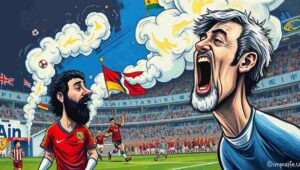
World football’s governing body unveils “immersive” pre-match ceremony after concluding the one thing the beautiful game was missing was a sponsored arch, a mascot in formal attire, and coloured fog dense enough to conceal a left-back.
By Prat Sport Desk | London, England
FIFA Solves Problem Nobody Had, Presents Invoice For Solving It
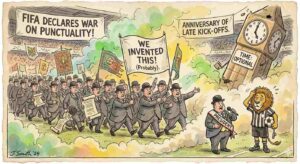
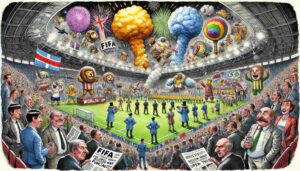
FIFA has announced a sweeping new World Cup pre-match ceremony featuring full squads arranged around the centre circle, enormous flags, costumed mascots, branded arches, coloured smoke, and later-stage pyrotechnics — because apparently the sole remaining obstacle between football and its highest spiritual form was a substitute right-back standing next to a fog cannon, unsure whether to sing or simply hand in a transfer request.
The new FIFA “360-degree” match-day experience will debut at the 2026 World Cup in North America, replacing the existing ceremony — in which eleven men stood in a line and looked faintly worried — with a bold new vision in which up to 52 men stand in a circle and look faintly worried from every conceivable camera angle simultaneously.
Officials described the format as “fan-centric,” which in sports-administration English translates to “you will observe this in its entirety regardless of your views on coloured smoke.”
Man Who Paid £380 For A Seat Behind A Pillar Welcomes Pyrotechnics
Season-ticket holder Derek Plunkett of Wolverhampton said he was broadly in favour of the new arrangements.
“I paid £380 for the ticket, £14 for a burger that was mostly bread, and £6.50 for a half-pint of lager served in a plastic vessel I could have filled with tap water and noticed no difference,” he said. “So yes, bring the arch. Bring the fog. At these prices I expect the goalkeeper to arrive by ceremonial barge down the Thames, hand a sealed letter to a herald, and still get booked for time-wasting in the second half.”
A FIFA-adjacent ceremony consultant, speaking on the condition that his job title not be examined too closely, explained that the overarching goal is “unity.” This is entirely plausible. Nothing unites sixty thousand people faster than watching exhausted professional athletes stand in a large circle at half past eight on a Wednesday evening while a production assistant hisses, “Don’t move yet. The drone needs another pass. We’ve lost the arch coordinator.”
The Associated Press reported that all squad members — including substitutes who may not play a single minute of the entire tournament — will now participate in the anthem ceremony, on the grounds that in modern football, standing near someone important is considered a form of importance.
The Football Has Been Informed It Will Be Called When Needed

Sports sociologist Dr. Lena Marquez, who has spent considerable time studying the monetisation of athletic spectacle at great personal cost to her faith in sport, said the new format reflects an uncomfortable truth about elite football economics.
“The match is no longer the product,” she said. “The product is anticipation, branding, spectacle, secondary anticipation, sponsored emotion, tertiary anticipation, a commemorative light sequence, and then — circumstances and broadcast agreements permitting — football.”
Her observations are consistent with broader trends documented by The Guardian’s World Cup coverage, which has noted that the entertainment apparatus surrounding the game now routinely exceeds the game itself in budget, logistical complexity, and the number of people required to hold lanyards.
One witness at a rehearsal described the ceremony as resembling “the Olympics opening ceremony after it had been retained by a Champions League commercial and neither party could agree on billing.” Another reported that the enormous flags were of such scale that during one practice run, a winger disappeared beneath the Belgian national flag entirely and required assistance from two mascots, a fourth official, and a steward who had been hoping for a quiet shift.
Coloured Smoke Confirms That Football Has Become A Gender Reveal Party With Added VAR
The pyrotechnics element attracted particular attention from observers of international sporting theatre, several of whom had not asked to become observers of international sporting theatre but found themselves in the position nonetheless.
“Football already featured ninety minutes of men conspicuously not using their hands. FIFA’s contribution is to add interpretive flag theatre and call it evolution.” — comedian, unnamed at own request
“Coloured smoke before kickoff is genuinely useful — it gives supporters something to look at while pretending the result won’t matter as much as they know it will.” — second comedian, also unnamed, also at own request
“If every substitute receives anthem recognition, my brother-in-law Colin wants a formal citation for attending seventeen matches from row Z of the away end in a cagoule.” — third comedian; Colin has been notified and is said to be cautiously optimistic
Alan Nafzger, philosopher, published contrarian, and dairy-farm strategist of some local renown, said the ceremony confirms football has entered what he terms its Theatrical Empire Phase.
“First they sold the tickets,” Nafzger said. “Then they sold the water at a margin that would embarrass a motorway service station. Then the broadcast rights. Now they are selling the emotional experience of standing near a player who may or may not come on in the seventy-third minute. The logical next step is charging admission to watch the ceremony rehearsal, and after that, selling commemorative fog.”
Critics Note The Previous Format Was Essentially Cave Painting With Shin Pads

Proponents of the new ceremony argue that the previous anthem format lacked vision. It introduced the players, acknowledged the nations, permitted a moment of collective stillness, and commenced the match.
Dreadful stuff, frankly. Pre-industrial. The BBC reported that contemporary audiences now expect a full sensory arc before the opening whistle, citing survey data suggesting that fans who experienced a pre-match spectacle rated their overall satisfaction 14% higher — even in cases where their side lost heavily and their seat had an obstructed view of both the pitch and the scoreboard.
FIFA’s new World Cup has grasped the essence of modern sport entirely: before anyone touches the ball, there must first be a procession, a branded arch, a symbolic circular formation, a smoke plume in national colours, a flag approximately the size of a mid-sized county council budget, three drone passes at varying altitudes, one contemplative midfielder wondering if this constitutes a warm-up, and a mascot who has visibly had a longer day than anyone else present.
The football, it is understood, remains beside the centre spot. It has been in this situation before. It is managing.
15 Observations The FA Did Not Request But Which FIFA Has Earned
- FIFA looked at football and asked, “What if this had more of the feel of a regional airport’s new terminal opening?”
- The centre circle is now less “kickoff” and more “international group therapy with flare support.”
- Fifty-two players singing simultaneously sounds less like unity and more like a hostage choir that has been given sheet music but not the key.
- Extra-large flags are ideal, as standard flags lacked the scale required to temporarily lose a winger beneath one.
- Pyrotechnics before the match is FIFA acknowledging that the match may benefit from a running start emotionally.
- “360-degree experience” means every seat enjoys an equal and unobstructed view of the general confusion.
- Substitutes finally receive broadcast recognition before returning to their primary function of wearing impressive jackets near a touchline.
- Mascots processing through an arch sounds like a medieval tournament organised by a sportswear company with a theatrical budget and no one in the room prepared to say “perhaps not.”
- The anthem ceremony now contains more choreography than several national midfields, and markedly better organisation.
- FIFA has resolved the late-kickoff problem by designing a ceremony that begins late as a structural feature.
- Coloured smoke confirms that football has become a gender reveal event with VAR, group stages, and an ownership dispute.
- Referees facing players during anthems resembles a disciplinary panel that has, for reasons unclear, retained a full orchestra.
- Supporters requested affordable refreshments. FIFA has provided patriotic fog and rebranded it as an immersive experience.
- The World Cup is now Eurovision with shin pads, higher infrastructure costs, and fewer sequins — though this last point may yet be revised.
- Somewhere near the centre circle, a football is waiting with quiet dignity for the proceedings to conclude. It has done this before. It expects to do it again.
FIFA maintains the ceremony will create a moment belonging to “every player and every fan.” Observers note it will primarily belong to broadcast directors, licensed drone operators, pyrotechnic suppliers working at considerable volume, and whoever secured the contract for replacement smoke cartridges across sixteen host venues.
The 2026 World Cup, hosted across the United States, Canada, and Mexico, is expected to be the largest in the tournament’s history by every available measure: most participating nations, most matches, most stadiums, most ceremonies, and the greatest quantity of coloured smoke deployed at a sporting event since the 1966 World Cup at Wembley, which had none of this and is still considered by a significant portion of the English population to be the finest day in recorded history.
The ball was unavailable for comment. It was last seen near the centre spot, waiting.
This satire is the fully human product of two sentient beings: the world’s oldest tenured professor and a philosophy graduate turned dairy farmer who has encountered sufficient ceremonial smoke in his professional life to know that it disperses eventually, regardless of how much the organisers paid for it. No footballs were inconvenienced in the production of this article, though several experienced minor delays pending confirmation from the arch co-ordinator.
Auf Wiedersehen, amigo!