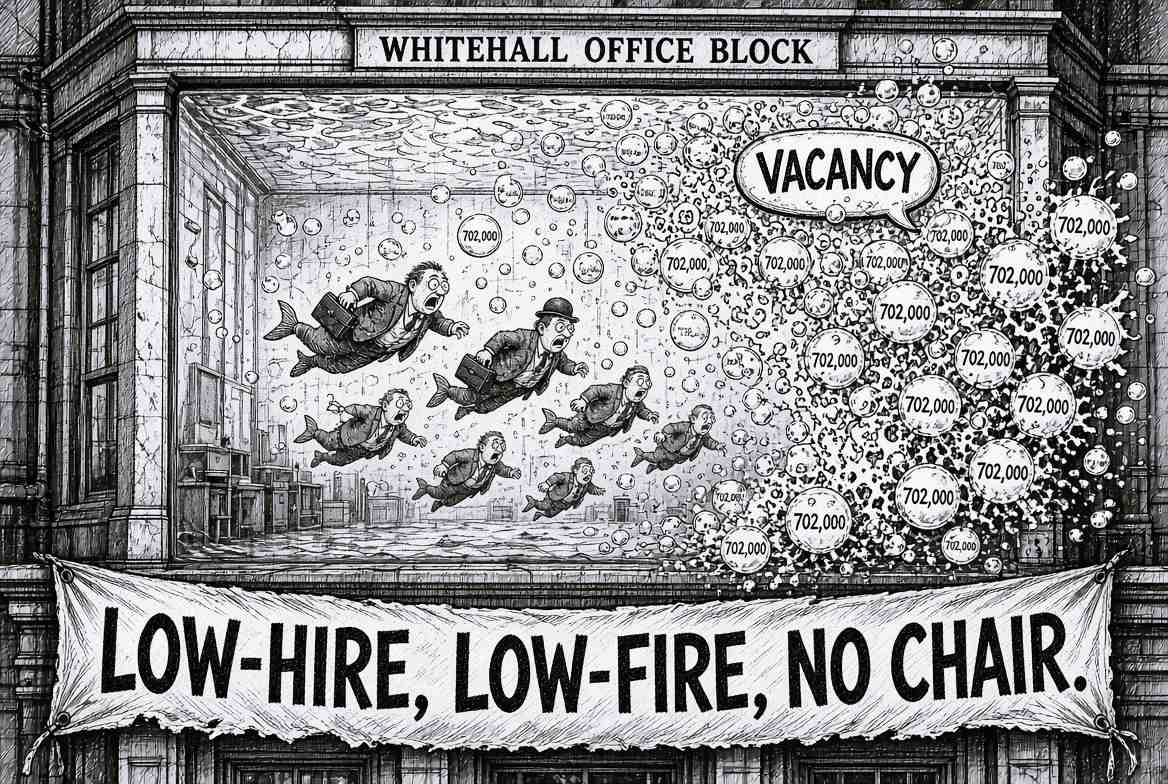
UK Jobs Market Weakens Again; Government Celebrates Successful Transition From Employment to Government Strategy
Vacancies fall to lowest non-pandemic level since 2014 as Britain discovers a remarkably efficient method of reducing workplace congestion
LONDON — Britain’s labour market weakened again this week, with payroll employment falling and job vacancies dropping to their lowest level outside the pandemic since 2014, prompting government officials to reassure workers that although jobs may be disappearing, strategies for jobs remain plentiful.
Official figures from the Office for National Statistics showed vacancies falling to 702,000 in the three months to August, while payrolled employment fell by 26,000 in the month alone. Economists call this “labour-market softening.” People looking for work call it Tuesday.
UK Vacancies Hit a Decade-Long Low
The slowdown has produced a fascinating new British economic arrangement in which employers cannot afford additional workers, workers cannot afford additional groceries, and government economists are delighted that wages are finally behaving themselves.
Private-sector wage growth slowed to 3.5 percent regular pay, according to the latest figures. This was welcomed by analysts worried about excessive wage pressure.
“We were concerned ordinary workers might accidentally earn enough money to notice,” explained Professor Martin Quibble of the Institute for Responsible Other People’s Salaries. “The danger now appears contained.”
A London Prat poll of 600 imaginary workers found that 83 percent would personally prefer an irresponsible wage-price spiral to a responsible inability to pay the electricity bill. Another 11 percent said they were currently too busy updating LinkedIn to answer. The remaining six percent already describe themselves on LinkedIn as “Founder | Visionary | Thought Leader” and therefore technically cannot become unemployed.
Employers Blame Weak Demand, Weak Demand Blames Everyone Else
Businesses blame weak demand, high costs and uncertainty. Government blames global conditions. Global conditions have asked to be removed from the email chain.
In Manchester, one café owner said she had postponed hiring two additional workers because payroll costs, utilities and ingredients had all increased.
“I would love another employee,” she said. “Unfortunately I currently employ electricity.”
Economists explained that a softer jobs market could reduce inflationary pressures. This is technically comforting in the same way discovering your house is cooler because the roof blew off reduces air-conditioning costs.
Britain Achieves Economic Quantum Mechanics
The Bank of England is watching the figures closely ahead of its interest-rate decisions. This means millions of Britons are now waiting for a committee to decide whether their mortgage should become more expensive because the economy is weak, or remain expensive because inflation is strong.
Britain has achieved economic quantum mechanics. The economy is simultaneously overheating and lying unconscious on the pavement.
Government officials continue to insist that growth and employment remain priorities. Whitehall is consequently producing an impressive quantity of employment-related material. There are employment strategies, skills strategies, regional growth strategies and industrial strategies. The strategy industry itself is believed to be hiring.
“We estimate Britain could eliminate unemployment entirely by employing everyone to write plans explaining why unemployment remains stubbornly high,” said Dr. Quibble.
The Skills Shortage Solves Itself
Jobseekers, meanwhile, have been advised to remain flexible. Modern flexibility includes retraining, relocating, taking multiple jobs, starting a business, becoming self-employed or learning enough government terminology to become the person who tells other unemployed people to remain flexible.
Britain once called this finding work. It now requires a framework.
The labour figures nevertheless contain one genuinely encouraging development. With vacancies declining sharply, fewer Britons will have to endure job advertisements seeking an “entry-level dynamic strategic visionary” with seven years’ experience, four software certifications and a willingness to accept £24,000. Employers have finally solved the skills shortage. They stopped hiring.
Small Firms Hold the Line, Reluctantly
The ONS has pointed the finger squarely at small and medium businesses, which it says are pulling back from recruitment because of rising labour costs and other operating expenses. Small firms, for their part, have pointed the finger back, noting that employer national insurance contributions and minimum wage increases were not their idea and that nobody consulted the till before deciding it should generate more revenue.
Retail and hospitality have absorbed the largest share of the payroll losses, which economists describe as a sectoral concentration and everyone else describes as another closing-down sale on the high street. Analysts continue to debate whether Britain is heading for a soft landing, a hard landing, or simply circling the runway indefinitely while air traffic control finishes another consultation.
For now, the consensus among imaginary economists surveyed by The London Prat is that the labour market will keep weakening gently, politely, and without causing anyone in Whitehall to raise their voice, which is either reassuring or exactly the problem.
Sources
The official vacancy and payroll figures are published by the Office for National Statistics, with pay and vacancy detail also reported by Personnel Today.
The ONS reported on 15 September 2026 that UK vacancies fell to 702,000 in the three months to August, the lowest level outside the pandemic since 2014, while payrolled employment fell by 26,000 in the month, with regular pay growth slowing to 3.5 percent and total pay growth to 3.9 percent.
Auf Wiedersehen, amigo!
For more satire crossing the Atlantic, visit Bohiney.com.

Alan Nafzger was born in Lubbock, Texas, the son Swiss immigrants. He grew up on a dairy in Windthorst, north central Texas. He earned degrees from Midwestern State University (B.A. 1985) and Texas State University (M.A. 1987). University College Dublin (Ph.D. 1991). Dr. Nafzger has entertained and educated young people in Texas colleges for 37 years. Nafzger is best known for his dark novels and experimental screenwriting. His best know scripts to date are Lenin’s Body, produced in Russia by A-Media and Sea and Sky produced in The Philippines in the Tagalog language. In 1986, Nafzger wrote the iconic feminist western novel, Gina of Quitaque. He currently lives in Holloway, North London. Contact: [email protected]