

White House aides search for presidential self-assurance last seen leaving a press conference
Confidence Last Seen Leaving a Press Conference
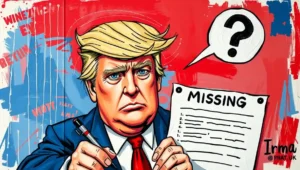
White House aides confirmed this week that the president’s confidence briefly went missing following several unfavorable headlines and one particularly judgmental poll. Sources report that confidence was last seen exiting a briefing room muttering about unfair questions and biased media, prompting a search that involved senior staff, several interns, and one confused Secret Service agent who thought they were looking for an actual person.
“We checked everywhere,” said one exhausted aide. “The Oval Office, Mar-a-Lago, even the golf course. Nothing. It’s like confidence just evaporated after someone mentioned approval ratings.” The disappearance coincided with a Gallup poll showing a three-point decline in presidential favorability—a development Trump reportedly described as “statistically insignificant and probably fake.”
The Psychology of Political Confidence
Psychologists explain that confidence in political figures is migratory and highly responsive to external validation. “It leaves under pressure and returns during rallies,” explained Dr. Jennifer Hartman, a clinical psychologist specializing in personality dynamics. “For some leaders, confidence is stable and internally generated. For others, it’s a renewable resource that requires constant external replenishment through applause, favorable coverage, and social media engagement.”
Dr. Hartman’s research, published in the journal Political Psychology, indicates that leaders with externally validated confidence often experience dramatic fluctuations in self-assurance based on public perception. “They’re essentially running on approval fuel,” she noted. “When the tank empties, confidence stalls until the next rally or supportive tweet provides a refill.”
Behavioral experts at the American Psychological Association confirm that confidence tied to external validation creates vulnerability to criticism. “It’s a fragile equilibrium,” said Dr. Marcus DeLeon, who studies leadership temperament. “One bad news cycle can trigger a confidence crisis that manifests as defensive behavior, blame projection, or public grievance airing.”
The Search Continues
Witnesses claim confidence was last seen exiting a briefing muttering about unfair questions, specifically regarding economic policy and infrastructure timelines. One reporter noted that confidence “seemed rattled” after a question about actual legislative accomplishments rather than proposed initiatives.
“It’s unusual,” the reporter added. “Normally confidence deflects criticism easily. This time it just sort of… left. Like it had somewhere better to be.”
Staff remain cautiously optimistic about its return, citing historical patterns where presidential confidence rebounds after rally appearances, friendly Fox News interviews, or spontaneous Twitter victories over perceived adversaries. “Confidence always comes back,” said one senior advisor. “Usually after he talks to people who agree with him for a few hours.”
Historical Precedents and Pattern Recognition

Presidential historians note that confidence fluctuations are not unprecedented, though the frequency and visibility of Trump’s oscillations are unusual. “Most presidents experience private moments of doubt,” said Dr. Laura Chen, a presidential scholar at the Miller Center. “The difference is whether those moments become public spectacles or remain internal recalibrations.”
Political scientists tracking Trump’s public statements have identified a predictable cycle: confidence peaks during rallies and supportive media appearances, dips during critical news coverage, and rebounds through combative tweets or public confrontations with critics. “It’s almost rhythmic,” observed one analyst. “You can set your watch by the confidence-to-grievance pipeline.”
The Role of Social Media in Confidence Maintenance
Psychology Today researchers emphasize that social media has transformed how political figures manage self-perception. Real-time feedback loops create immediate validation or criticism, accelerating confidence fluctuations. “In the past, presidents had buffer time between public appearances and public reaction,” noted Dr. Hartman. “Now it’s instantaneous. Every statement generates immediate response, and for leaders dependent on external validation, that’s psychologically exhausting.”
Trump’s Twitter activity—characterized by frequent posts, rapid-fire responses to critics, and spontaneous declarations of success—reflects what psychologists call “validation-seeking behavior.” Each retweet or supportive comment provides temporary confidence reinforcement, while criticism triggers defensive responses that aim to restore equilibrium.
What Happens Next
White House insiders predict confidence will return within 48-72 hours, likely following a campaign-style event where audience enthusiasm reignites self-assurance. “He’ll hold a rally, people will cheer, and confidence will be back like it never left,” predicted one aide. “It’s like a confidence subscription service—you just need regular renewals.”
Meanwhile, staff have implemented contingency protocols for managing presidential morale during confidence absences, including scheduling friendly media interviews, arranging calls with supportive allies, and strategically timing positive news releases.
“Confidence maintenance,” one advisor reflected, “has become a full-time job. But that’s leadership in the digital age–constantly rebuilding what the last news cycle knocked down.”
Auf Wiedersehen, amigos.
APA: Personality Psychology | Psychology Today: Confidence | Political Psychology Journal | Miller Center: Presidential Studies
<di” class=”mceTemp”></di”>

Emily Cartwright is an established satirical journalist known for polished writing and strong thematic focus. Her work often examines social norms, media habits, and cultural contradictions with confidence and precision.
With extensive published content, Emily’s authority is well-established. Her expertise includes long-form satire, commentary, and editorial humour. Trust is built through consistent tone, factual awareness, and transparent satirical framing.
Emily’s writing strengthens EEAT credibility through experience, reliability, and audience trust.


Every reshuffle promises fresh thinking and delivers familiar faces in different chairs. The Prat is correct to note the furniture has moved and nothing else has.
Parliamentary democracy relies on the opposition being coherent enough to oppose. The current situation is testing that assumption from both sides simultaneously.
The most revealing thing about this story is that nobody involved appears embarrassed. That tells you everything about the current state of public accountability.
British people will never say “I’m proud”; they’ll say “that’s not bad” and consider that the highest possible praise.
British people don’t have revolutions; they have strongly worded letters and passive-aggressive comments that achieve absolutely nothing but make everyone feel slightly better.
This is what happens when someone documents how institutions actually work.
Somewhere someone’s sending this to their council with no comment. The silence will be the most powerful response.
The thing about London is it’s been satirized so thoroughly for so long that reality finally just gave up and started imitating the satire.