Buckingham Palace Staff Allegedly Using Prince Louis’ Chocolate Fingerprints As New Security System
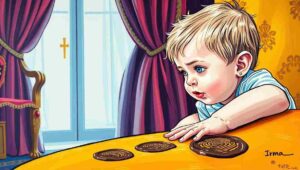
LONDON — Sources within the royal household — speaking on condition of total anonymity and a promise that their names would not appear anywhere near the words “sticky” and “fingerprints” in the same sentence — have confirmed to The London Prat that Buckingham Palace’s security team is in early-stage discussions about repurposing the extensive sticky fingerprint evidence left across palace surfaces by His Royal Highness Prince Louis of Wales as a biometric authentication layer for the new east wing security installation. The prints, described by palace conservationists as “a comprehensive dataset of a very small hand applied to a remarkable range of surfaces,” were discovered on three Gainsborough portraits, two marble mantlepieces, one ceremonial sword that really should not have been accessible to a child, and the entire left side of the King’s reading glasses. A security consultant described the prints as “unique, persistent, and extraordinarily well-distributed across the premises.”
Prince Louis: Britain’s Most Expressive Royal
Prince Louis Arthur Charles, seventh in line to the throne and youngest child of the Prince and Princess of Wales, has in his short but spectacular public life established himself as British royalty’s most reliable source of unscripted content. At the King’s Coronation in 2023, he was photographed making faces of an expressiveness more commonly associated with professional clowns than members of a constitutional monarchy. At the Trooping the Colour celebrations, he has on multiple occasions produced reactions to the proceedings that suggest a boy with considerable opinions about ceremonial events and no particular inclination to conceal them.
He is, in the parlance of internet culture, a mood. He is, in the parlance of the palace communications team, “a reminder that the royal family contains real children,” which is a description that sounds better than “a complication in the choreography of a formal occasion.” Both are true. Neither is unwelcome.
The Sticky Fingerprint Incident: A Reconstruction
The London Prat has, through diligent enquiry and a contact in the palace housekeeping department who has requested we describe her only as “Mrs H,” pieced together the following sequence of events:
At some point during a visit to Buckingham Palace’s state rooms, Prince Louis acquired a biscuit. The origin of the biscuit is disputed — palace records do not track biscuit distribution at a level of granularity that would resolve the question, which the palace’s head archivist described as “probably for the best.” The biscuit was a Duchy Original, which is at minimum thematically consistent.
In the manner of a child who has been given a biscuit and introduced to a room full of expensive surfaces, Louis then proceeded through the east wing at a pace that housekeeping could not predict and security could not quite intercept, leaving a trail of biscuit-mediated fingerprints across an area that the Royal Collection estimates contains £65 million in artworks, furniture, and decorative objects. The fingerprints are described as “remarkably detailed” due to the adhesive qualities of the biscuit, and “remarkably numerous” due to the thoroughness of the child’s tour.
The Gainsborough portrait, specifically, bears what an art conservator described as “a complete and legible thumbprint on the lower left of the canvas,” which she then added is “not, technically, conservation damage, since it’s reversible and also sort of charming.” This last observation was struck from the official report.
The Biometric Security Proposal: An Assessment
The security consultant’s proposal to use the fingerprints as an authentication layer is, on reflection, logistically complicated. Prince Louis’s hands are growing. The fingerprints captured on the Gainsborough are those of a child of approximately five years old. In eighteen months they will no longer match the source. The palace would need to update the dataset, which requires another biscuit, another unsupervised tour, and a conservator on standby — the logistics of which are not entirely straightforward.
There is also the question of exclusivity. Fingerprint biometrics depend on uniqueness. Prince Louis’s fingerprints are unique, but they are distributed across a non-trivial surface area of one of Britain’s most visited state buildings. The possibility of a sophisticated intruder obtaining a lift from a marble mantlepiece cannot be dismissed by anyone who takes either security or marble seriously.
The PR Value: Incalculable
What Prince Louis provides to the monarchy — and this is entirely genuine — is the one thing that institutional communication cannot manufacture: spontaneity. The carefully managed royal family, in which every public appearance is choreographed, every statement approved, every photograph deliberate, is punctuated periodically by a small boy making an extraordinary face at a military parade. And in those moments, it is impossible not to feel warmly toward the institution in a way that no amount of “Relatable Regent” content strategy could achieve.
Lee Mack once said that children are nature’s honesty policy — they say what they think, do what they feel, and cannot be briefed. A monarchy with an unbriefable child in it is a monarchy that occasionally seems real, which is the most valuable thing a monarchy can be in the 21st century. Louis does not know he is useful. That is precisely what makes him useful.
A Note On The Biscuit
The Duchy Original biscuit, it should be noted, is a product of the King’s Duchy of Cornwall estate, now managed under a governance arrangement that separates it from the monarch’s personal finances. It costs approximately £3.50 for a packet of fourteen. It is, by most accounts, a very good biscuit. It apparently also functions as an adhesive sufficient to leave a child’s fingerprints on a 17th-century portrait in a way that conservators describe as “reversible.” This is, on balance, the best possible outcome, and the biscuit should be commended for its structural integrity under difficult conditions.
Auf Wiedersehen, amigo!
Prince Louis Arthur Charles of Wales, born 23 April 2018, is the third child and youngest son of Prince William, Prince of Wales, and Princess Catherine. He is currently seventh in line to the British throne. He came to widespread public attention through a series of unscripted expressions and reactions during official royal events, including the Platinum Jubilee celebrations in 2022, King Charles’s Coronation in 2023, and multiple Trooping the Colour ceremonies, where his candid responses to the formal proceedings were widely shared on social media. Buckingham Palace’s Royal Collection holds one of the world’s greatest art collections, including over 7,000 paintings spanning five centuries.
This article was produced by The London Prat, est. 1961, in the finest tradition of British satirical journalism, written by the world’s oldest tenured professor and a philosophy major turned dairy farmer, neither of whom has ever touched a Gainsborough and would not dream of it, biscuit or no biscuit.

Mei Lin Chen is a student writer whose satire explores identity, modern culture, and social nuance. Her work reflects academic curiosity and engagement with London’s diverse perspectives.
Expertise is growing through study and practice, while trust is supported by clear intent and responsible humour.