Charity Introduces Britain’s First Assisted Enthusiasm Programme
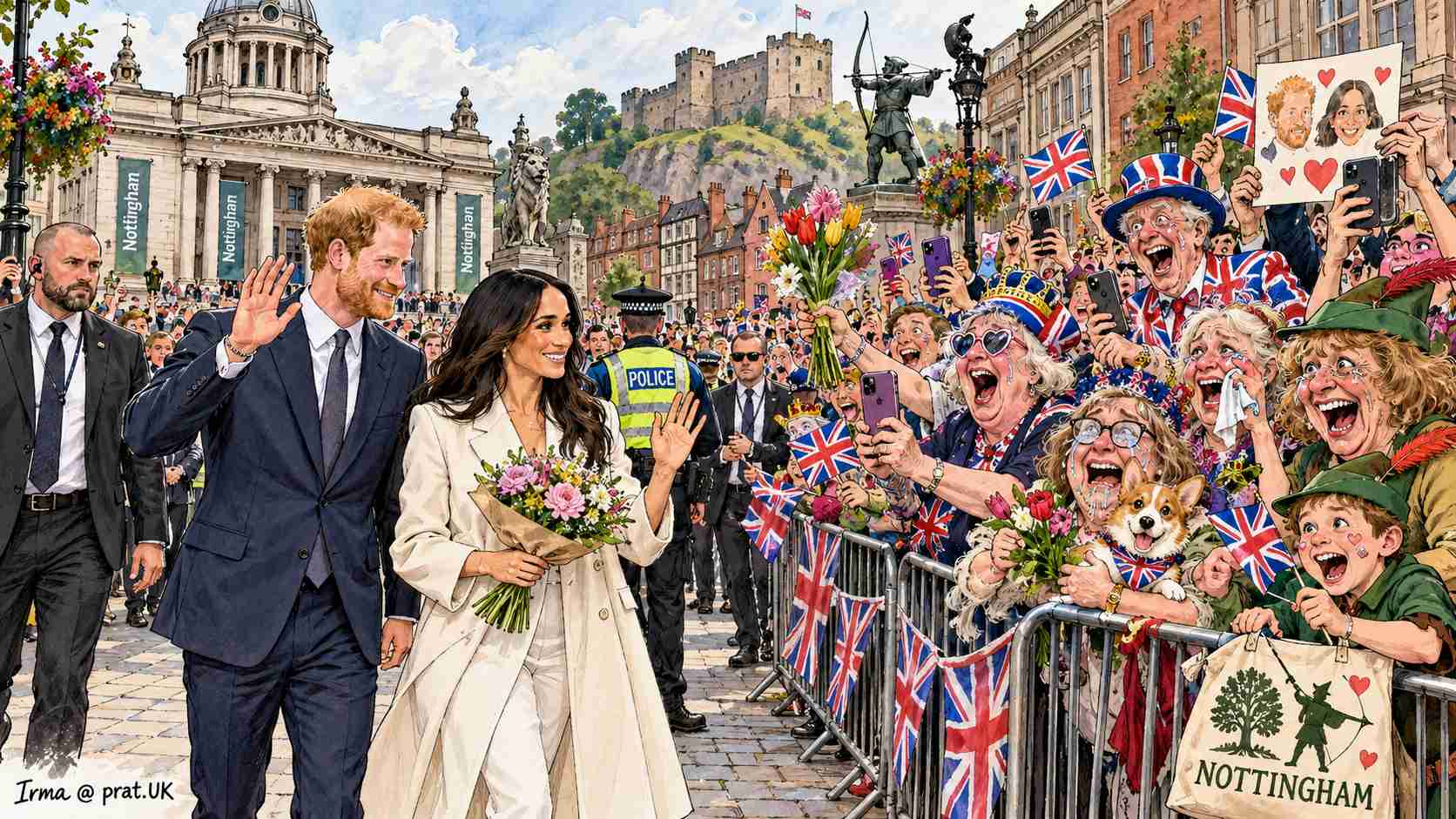
NOTTINGHAM, England – Prince Harry has made a triumphant return to British public life after charity representatives reportedly encouraged crowds to cheer loudly for him and Meghan Markle, raising the extraordinary possibility that Britain has finally discovered a way to manufacture national enthusiasm without involving a government subsidy, a football victory or a royal funeral.
What Was Reported About the Nottingham Royal Visit
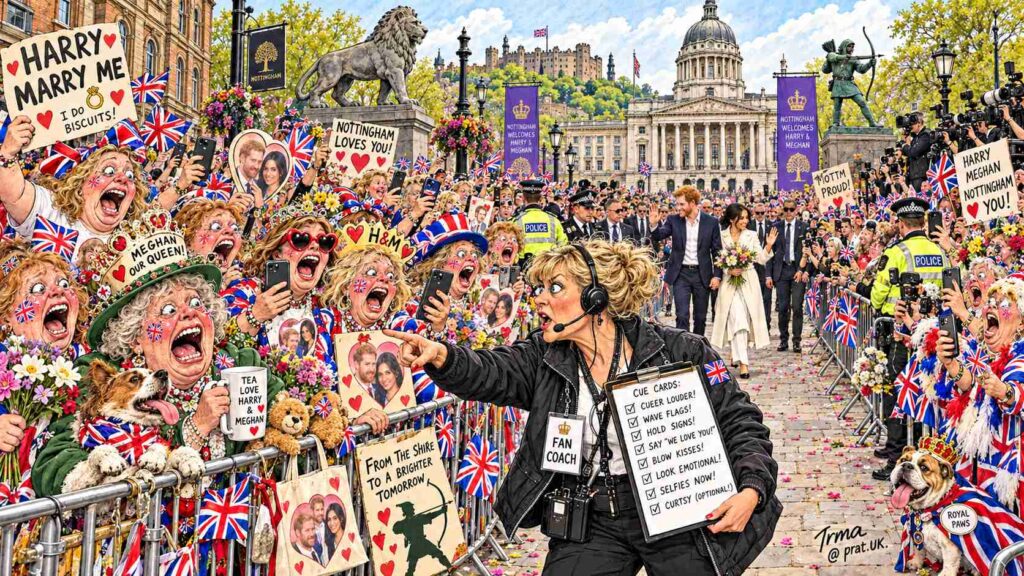
According to Yahoo Entertainment’s report, representatives associated with a charity reportedly encouraged people waiting for the Sussexes to applaud enthusiastically and even suggested affectionate greetings for Meghan ahead of the couple’s arrival. The instructions were reported by HELLO! magazine following the couple’s October 15 visit to Nottingham.
The development represents a remarkable advance in British constitutional tradition. For centuries, crowds have gathered to cheer royalty voluntarily, usually because they liked the monarch, enjoyed a public holiday or wanted to witness a carriage accident. Now Britain has improved the system by introducing verbal instructions.
It is understood that citizens may still express genuine admiration, provided they do so at the appropriate volume and with sufficient enthusiasm to satisfy the photography department.
From Carriages to Range Rovers: The Modern Monarchy
Prince Harry, who spent much of his life being applauded simply for emerging from buildings, must find the new arrangements refreshingly efficient.
In previous centuries, members of the Royal Family relied on inherited privilege, ceremonial uniforms, military bands and people who had apparently been standing behind metal barriers since the reign of Queen Victoria. Today the monarchy has been modernised. The horses have been replaced by Range Rovers, the trumpets by mobile telephones and the spontaneous cheering by a community organiser standing beside a traffic cone.
Nobody has established that Harry or Meghan requested the encouragement. The organisers appear to have taken the initiative themselves, demonstrating the lengths British institutions will go to in order to make sure a visiting celebrity doesn’t encounter the terrifying sound of ordinary people standing quietly.
Is Encouraged Applause Still Applause?
The episode has nevertheless raised a constitutional question. If applause has to be encouraged, is it still applause, or has Britain created a new category of ceremonial public service?
One constitutional scholar studying the matter concluded that there was no meaningful difference between the two, explaining that the British monarchy had spent centuries converting ordinary human behaviour into elaborate procedures.
A person walks into a room. Everybody stands. A person leaves a room. Everybody bows. A person waves from a balcony. Millions discuss the wave. And when a person arrives outside a Nottingham charity, somebody explains that the correct response is enthusiastic cheering rather than checking whether the parking meter has expired.
The system works beautifully.
Harry, Meghan and the Scrutiny of Every Smile
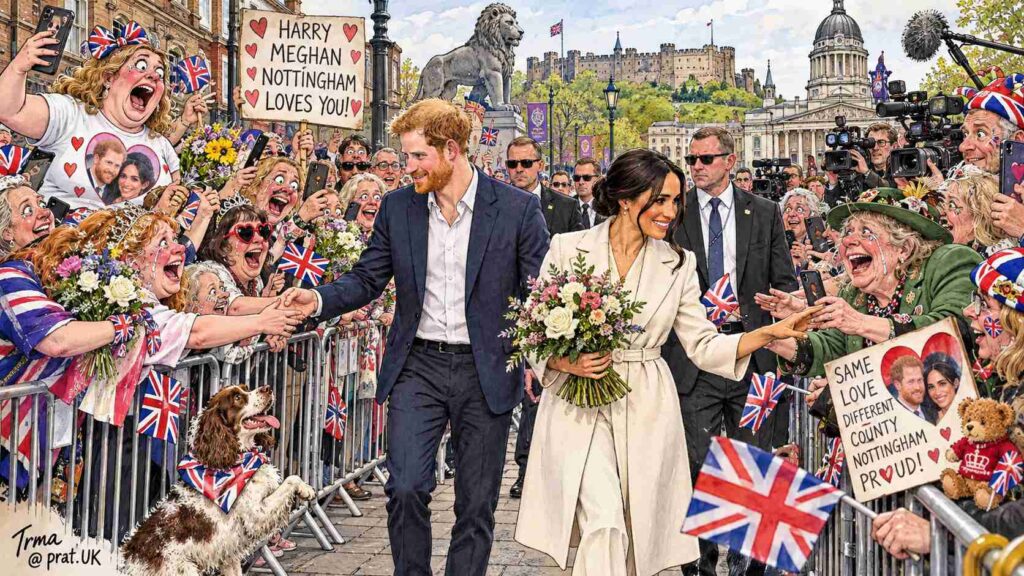
Harry’s return also highlights the curious contradiction at the centre of modern British royal life. He stepped away from formal royal duties partly to escape a system in which every movement was monitored, photographed and interpreted by people who apparently considered smiling a matter of national security. Now even his reception outside a charity has become the subject of a detailed investigation into the origins of individual cheers.
One supporter might reasonably ask whether Britain has run out of actual problems. The country faces pressure on public services, household budgets and housing affordability, yet royal commentators have devoted considerable intellectual energy to identifying who first suggested that a crowd should make a pleasant noise.
The Royal College of Unnecessary Questions would undoubtedly consider the investigation a triumph.
Harry and Meghan visited the Community Recording Studio, Himmah Hub and Epic Partners, organisations involved in supporting young people and local communities. Their activities included engaging with youngsters, meeting volunteers and highlighting charitable work. These are ordinarily considered worthwhile activities, although they have the serious disadvantage of being substantially less entertaining to the tabloids than an argument about whether a woman shouted affectionately because someone suggested it.
The central tragedy of Harry’s return is that genuine affection is now subject to forensic examination. If someone smiles, the press demands to know whether the smile was rehearsed. If someone waves, investigators examine whether the arm was operating independently. If someone shouts, “We love you,” royal experts assemble to determine whether the individual has a prior history of unauthorised happiness.
The Office for the Regulation of Spontaneous Affection
Harry may ultimately decide that public enthusiasm is too complicated to manage without professional assistance.
The British government, recognising a potential growth industry, could establish an Office for the Regulation of Spontaneous Affection, staffed by 4,000 civil servants and a director of ceremonial enthusiasm earning £180,000 annually. Its first task would be to determine whether British citizens are permitted to cheer for a prince without completing an online declaration. The second would be to investigate whether Nottingham’s applause complied with national noise regulations. And the third would be to explain why Britain needs a committee to determine whether clapping is allowed.
Harry’s real achievement, however, was rather simpler. He returned to a city with longstanding connections to his charitable work, met people who were pleased to see him and helped draw attention to organisations doing useful things.
That should have been enough.
Unfortunately, in modern Britain, even a prince cannot receive a warm welcome without somebody demanding the instruction manual.
Humorous Observations
- You ever notice the British will stand in a queue for forty minutes without being asked, but clapping? Clapping they need a briefing. They’re professionals at waiting and amateurs at noise.
- “Spontaneous cheering, with instructions.” That’s not a crowd. That’s a meeting with flags.
- Harry’s spent his whole life getting applause for walking out of buildings. I walk out of a building, my wife asks where I put the keys.
- Somebody in Nottingham stood next to a traffic cone and said, “Make a nice noise, everybody.” That’s a real job. That person has a lanyard. That person has a lanyard and a dental plan.
- The monarchy’s been doing this for a thousand years and the big secret is a guy going, “Okay, whenever you’re ready.” It’s a wedding. Nobody in history has ever clapped at a wedding without watching Aunt Linda first.
Editorial Disclaimer
This article is satirical commentary based on reporting about the Sussexes’ October 15, 2026, Nottingham visit. The reported encouragement came from charity representatives; there is no established evidence that Harry or Meghan requested it. The proposed government offices, salaries and comic scenarios are satirical devices, not descriptions of actual policies. Nobody at prat.uk was instructed to laugh at this article, although a warm round of applause after the final paragraph would be gratefully received, and more British Onion stories are available on cue.
SOURCE: Yahoo Entertainment

Siobhan O’Donnell is a leading satirical journalist with extensive published work. Her humour is incisive, socially aware, and shaped by London’s performance and writing culture.
Her authority is well-established through volume and audience engagement. Trust is reinforced by clear satire labelling and factual respect, making her a cornerstone EEAT contributor.