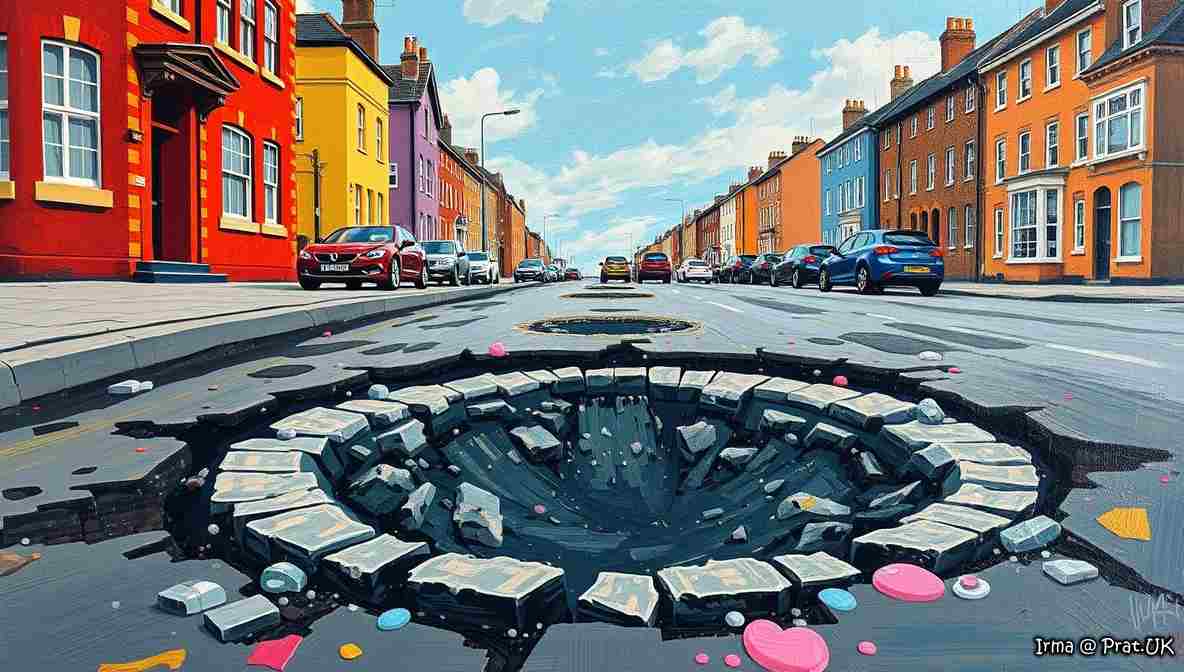
UK Government Declares Potholes “Historic Depressions” To Avoid Paying For Repairs
LONDON — The Department for Transport announced a new classification framework for road surface deterioration this week, formally designating any pothole that has existed for more than eighteen months as a “Historic Road Depression” and therefore eligible for protected status under heritage preservation guidelines rather than standard infrastructure repair budgets. The reclassification, which will save local councils an estimated £140 million annually by transferring potholes from the maintenance budget to the cultural assets register, was welcomed by treasury officials and received with the silence of a man who has just driven his third wheel into a pothole on the A3 and would like to submit a compensation claim but knows from experience that the form requires a twelve-digit reference number that no one knows how to generate.
The Scale of the Problem (Or Heritage Portfolio, Depending On Budget)
Britain’s road network contains an estimated 700,000 potholes, according to the Asphalt Industry Alliance, which produces an annual Alarm survey that functions as an annual ritual of national shame dressed as a technical document. The backlog of road repairs runs to approximately £16.3 billion. At current funding levels, it would take local highways authorities around a decade to work through the existing repairs, by which point new damage would have accrued at a rate sufficient to sustain the backlog indefinitely.
This is called, in local government planning documents, a “funding gap,” in the same way that the sea is called “wet” — technically accurate, emotionally insufficient, and unlikely to be resolved by describing it more precisely.
A Field Guide To British Potholes
The UK pothole ecosystem is more diverse than the casual driver might assume. The London Prat’s infrastructure correspondent, who covers roads with the melancholy of a man who once had a car and now doesn’t, has developed the following taxonomy:
The Initiator
A small cracking of the surface, typically around a utility cover that was repaired in 2019 with what appears to have been leftover pie filling rather than asphalt. Not yet a pothole. Pre-pothole. An aperitif of structural failure.
The Adolescent
Clearly a pothole. Perhaps 15cm in diameter. Recently reported to the council via the Fix My Street app by three different people, one of whom included a photograph of their tyre for scale. Status on the council portal: “Under review.” Under review since March.
The Established Depression
Now receiving its own weather. Has been there long enough that local drivers have adapted their routes to avoid it. A delivery driver has named it. The postman swerves it automatically without conscious thought, in the way that experienced sailors navigate reefs. It is part of the local topography now. Reclassification as Historic Site seems entirely appropriate.
The Heritage Feature
Under the new framework, this is a pothole of approximately 45cm in diameter and sufficient depth to have its own microclimate. It pre-dates the current council administration and possibly the previous one. It has been photographed by at least one local journalist. A local councillor has referenced it in a question to the cabinet. It has its own entry on Nextdoor. The council’s response to each new report is to inform the reporter that it has been “logged” and will be “assessed against other priorities.” It is, by any measure, a landmark.
The Compensation System: An Adventure In Bureaucracy
Local councils paid out approximately £20 million in compensation claims for pothole damage in 2022-23, according to data compiled by insurers. The actual damage cost to drivers — in tyre, wheel, and suspension repairs — is estimated by the AA at over £1 billion annually. The gap between what drivers pay to fix their cars and what councils pay in successful claims represents the portion that is absorbed by private individuals who are, in the most technical sense, subsidising the failure of public infrastructure maintenance through the involuntary application of their own money.
Claiming compensation from a local council for pothole damage requires: documentation of the pothole’s existence prior to the incident, evidence that the council was aware of the pothole, evidence that the council had not taken reasonable steps to repair it, and a willingness to pursue the claim through a system designed with the accessibility of a medieval law court and the responsiveness of second-class post. Success rates for private claimants run at approximately 40-50%.
The Political Economy Of Road Maintenance

Here is the underlying mechanism of the pothole crisis, expressed plainly: road maintenance is unglamorous. Nobody gets a ribbon-cutting ceremony for resurfacing a B-road. Nobody holds a press conference to announce that a residential street in Coventry has been repaired. There are no votes in tarmac, except that there are, in the diffuse sense that terrible roads make people angry, but that anger is rarely concentrated enough to translate directly into electoral consequences for the specific politician who underfunded the highways budget.
The result is that roads are maintained at the minimum politically tolerable level, which has historically been approximately £1 billion below the level at which the backlog doesn’t grow. The backlog grows. The potholes proliferate. The new classification framework renames them Heritage Features. And someone, somewhere, loses a tyre and submits a claim form that will be under review until March.
Ben Elton once did a long routine about the British government’s talent for creating new categories of problem in order to avoid solving the old ones. He called it “bureaucratic taxidermy” — stuffing the dead thing and putting it on display instead of burying it. The pothole as Historic Depression is this process in its purest form. We have not fixed the road. But we have given the hole a title. Very British. Very tidy. Very depressing, historically speaking.
Auf Wiedersehen, amigo!
The Asphalt Industry Alliance’s annual ALARM survey, published each spring, tracks the state of local authority roads across England and Wales and has repeatedly found the repair backlog to run into billions of pounds. The 2024 survey found the backlog at approximately £16.3 billion and estimated it would take around a decade to clear at current funding levels. Local councils receive central government highways maintenance grants, but these have declined in real terms over the past decade. The government announced additional pothole funding of £500 million in the 2024 Autumn Budget, which the AA and other motoring organisations said was insufficient relative to the scale of damage. Pothole damage to vehicles costs British motorists an estimated £1 billion annually according to AA estimates.
This dispatch was produced by The London Prat, est. 1961, in the grand tradition of British satirical journalism, written by the world’s oldest tenured professor and a philosophy major turned dairy farmer, both of whom have submitted compensation claims and are currently under review.

Mei Lin Chen is a student writer whose satire explores identity, modern culture, and social nuance. Her work reflects academic curiosity and engagement with London’s diverse perspectives.
Expertise is growing through study and practice, while trust is supported by clear intent and responsible humour.