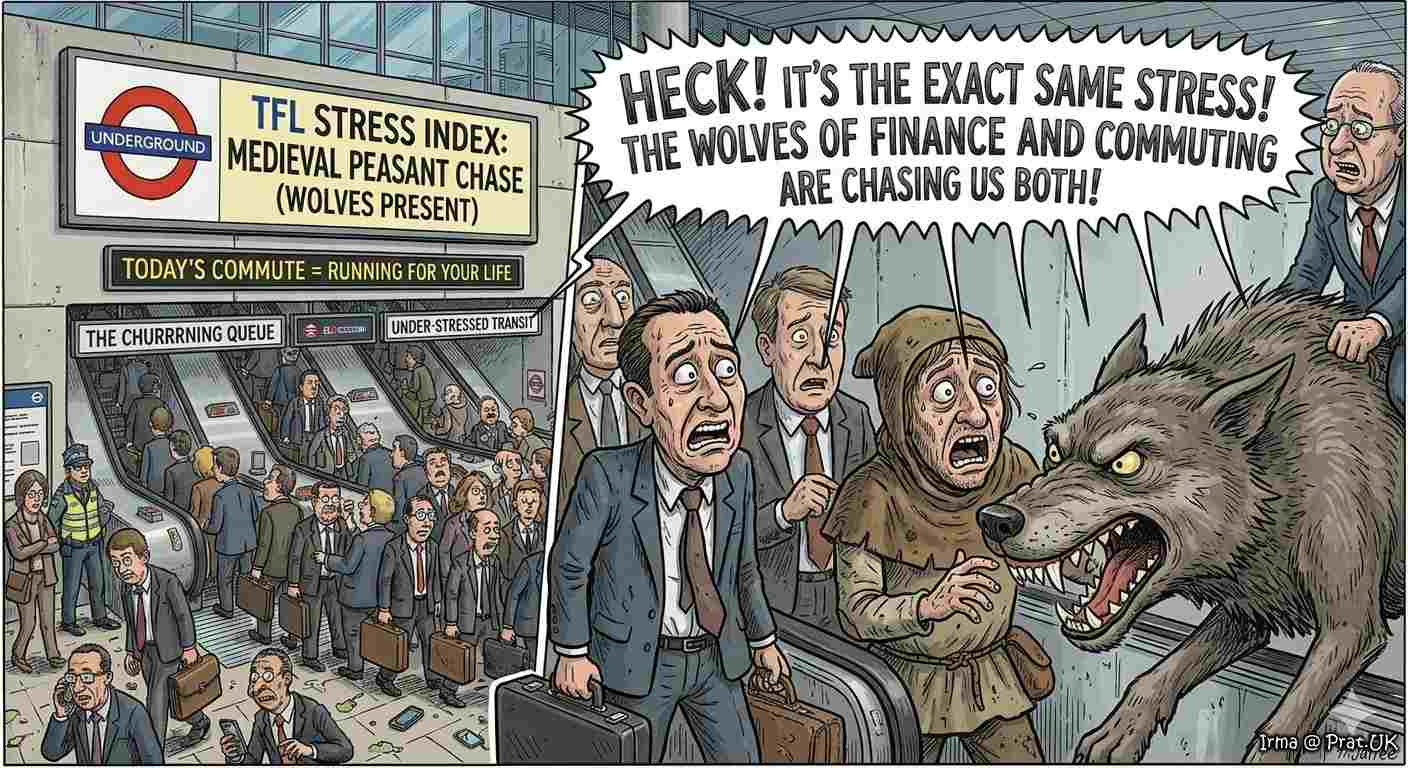
Study Finds London Commuters Experience Same Stress Levels As Medieval Peasants Being Chased By Wolves 🚇🐺
Five Underground Observations On The Daily British Commute
The London Underground has evolved into a daily emotional obstacle course with Oyster cards.
Commuters now consider making eye contact a form of psychological warfare.
Scientists believe the phrase “signal failure” activates ancient survival instincts in British brains.
The average Londoner spends 11% of life apologizing while physically trapped against strangers.
Tube passengers routinely achieve levels of silence previously associated with hostage situations.
The Tube As Feudal Suffering With Contactless Payment
LONDON — A groundbreaking study from University College London has concluded that daily Tube commuters experience stress levels roughly equivalent to medieval villagers fleeing carnivorous wildlife through muddy forests.
Researchers monitored heart rates, cortisol spikes, facial tension, and whispered profanity across six Underground lines before concluding that modern transport systems have accidentally recreated feudal suffering with contactless payment options. The findings, they noted, leave many passengers utterly off the rails.
Lead scientist Professor Elaine Crumb described the findings as “deeply concerning but visually unsurprising.”
“We observed one man on the Central Line display the same biological panic response normally associated with battlefield ambushes,” she explained. “His train was delayed four minutes.”
The study found the average London commuter experiences:
six existential crises weekly
fourteen moments of suppressed rage daily
approximately one spiritual collapse near Bank station every quarter
Passengers surveyed described commuting as “emotionally damp,” “soul-sanding,” and “the closest thing Britain has to mandatory military service.”
One exhausted office worker admitted: “I leave home optimistic every morning and arrive at work looking like I survived maritime disaster.”
What The Funny People Are Saying About The London Underground
“The Tube is where optimism goes to die politely.” — Ricky Gervais
“Londoners stand nose-to-armpit with strangers for forty minutes and still pretend society is functioning.” — Bill Burr
“You ever notice nobody looks happy on public transport? Even babies on the Tube look like divorced accountants.” — Jerry Seinfeld
The Survival Behaviours Bred By Years Of Transport Trauma
The report identified several unique commuter behaviors developed through years of transportation trauma.
These include:
- pretending not to notice aggressive coughing
- strategic foot positioning during carriage entry
- fake-reading books during emotional shutdowns
- staring intensely at route maps like wartime generals
Researchers also discovered British commuters possess extraordinary emotional suppression abilities. During severe delays, many passengers merely sigh softly before continuing to disintegrate internally.
Tourists, however, reacted differently.
An American visitor reportedly shouted “WHAT IS HAPPENING?” during a Jubilee Line suspension before being silently judged by 200 nearby Britons who preferred dignified despair.
Meanwhile, Transport for London defended the Underground system, noting it transports millions daily despite heatwaves, strikes, flooding, leaves, rain, excessive sunlight, “unexpected congestion,” and what officials vaguely described as “operational complexity.”
Critics responded that Victorian engineers somehow built tunnels beneath London clay without modern computers, while current systems collapse because “a pigeon looked tired near Holborn.”
Commuting As A Highly Sophisticated Hostage Negotiation
Mental health experts warn prolonged commuting may produce symptoms including:
emotional numbness
involuntary swearing
irrational hatred of escalators
fantasies involving remote cottages in Wales
One anonymous City worker confessed he now measures happiness entirely by whether he gets a seat before Liverpool Street.
“That’s where my standards are now,” he whispered while holding Pret coffee with both hands like emergency medical equipment.
Economists estimate London commuters collectively lose billions annually through delays, exhaustion, and passive-aggressive muttering.
Still, many workers continue returning daily because London salaries remain slightly higher than elsewhere in Britain, which experts describe as: “a highly sophisticated hostage negotiation.” The commute, in other words, is the fare you pay before you even reach the ticket barrier.
At press time, thousands of commuters were reportedly trapped between stations listening to apologetic prerecorded announcements delivered in the soothing tone of somebody lowering a coffin.
The wolves are invented, but the strain is real. Research has genuinely linked long, crowded commutes to raised stress and lower wellbeing, and Transport for London runs one of the world’s oldest and most heavily used metro systems, carrying millions of journeys a day under constant pressure from signal failures, strikes and ageing infrastructure. The medieval framing is a gag. The cortisol, the lost hours and the quiet daily endurance of British commuters are not.
This British satirical article is entirely a human collaboration between two sentient beings: the world’s oldest tenured professor and a philosophy major turned dairy farmer. No commuters achieved emotional closure during production. Auf Wiedersehen, amigo!