
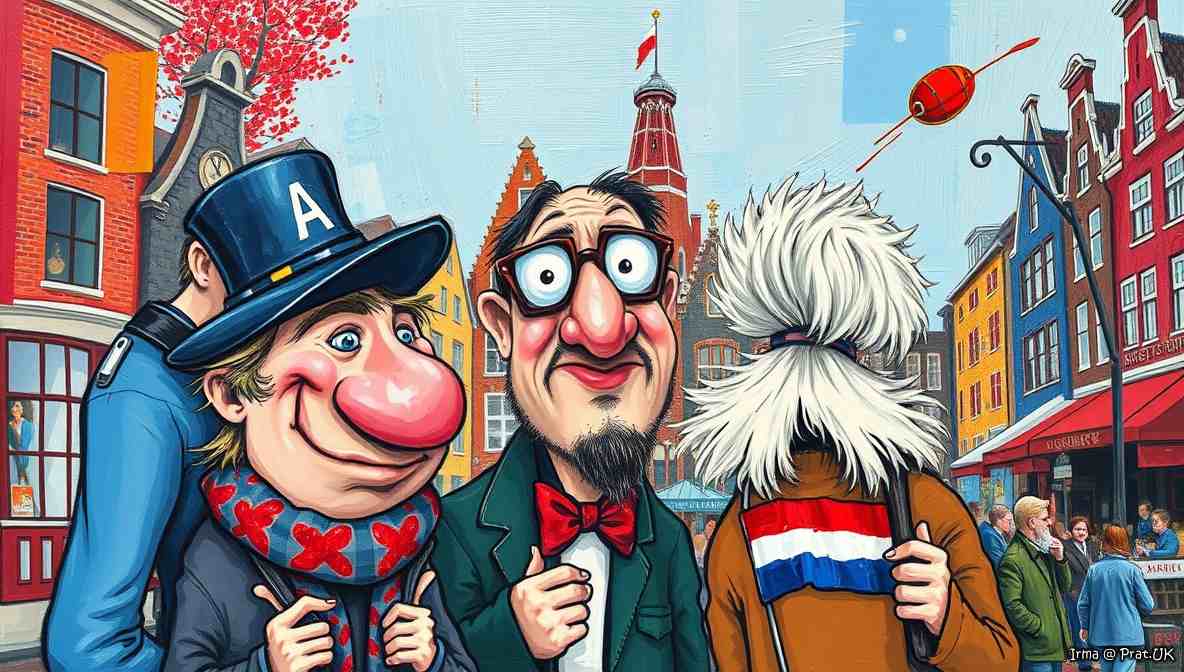
Amsterdam Invents a New Kind of Freedom: The Sort Where You Can’t See the Menu
Five Quick Dispatches From the Ministry of Approved Thoughts
Amsterdam banned meat and fossil fuel advertisements, proving the fastest way to reduce consumption is to hide the menu — and then tell everyone they’ve never been freer. The city insists this isn’t censorship. It’s “nutritional labelling for ideas,” which is exactly what censorship would say if censorship had a communications budget and a very good scarf.
Citizens report feeling considerably more liberated now that fewer choices are visible — rather like a restaurant that removes the pudding menu and calls it “mindful dining.” A black-market billboard operation has already sprung up in a canal-adjacent alley, where for €10 one may gaze upon a high-resolution cheeseburger in the manner of a 17th-century Dutch still life, only considerably more illegal. Officials confirm the next phase targets anything that might, on reflection, be considered slightly inconvenient — a category that, in Amsterdam, has historically included very little.
Amsterdam: Where Liberty Goes to Be Quietly Edited
Amsterdam has officially become the world’s first capital city to ban public advertisements for both meat and fossil fuel products, a move city leaders describe as “a bold step toward a healthier planet” and everyone else describes as “the moment the council rewrote your shopping list.”
The ban — passed 27-17 in January and enforced from 1st May 2026 — covers beef, pork, chicken, fish, petrol cars, airlines, cruises, and trips to “faraway destinations,” a category that apparently includes New York City. Amsterdam has now officially classified Manhattan as both too far and too calorific.
City officials were at pains to clarify the policy isn’t about restricting choice. It is, rather, about refining which choices deserve to exist within your field of vision. “We’re not telling people what they can eat or drive,” explained policy architect Dr. Lotte van Daal, adjusting her ethically sourced scarf. “We’re simply removing the temptation to remember those options exist.”
It is, to be fair, a subtle distinction. Rather like saying you haven’t hidden the biscuits — you’ve merely relocated them to a dimension accessible only by quinoa. A soft delete on temptation. A right-click, “move to bin” on desire itself, carried out by committee, on a Thursday, with full democratic legitimacy.
Advertising Rebranded as a Public Health Threat (The Sausage Was the Villain All Along)
The ban stems from a growing conviction among policymakers that advertising is itself a form of psychological pollution, particularly when it promotes things that taste good or get you somewhere warm more quickly. The city currently earns over €12 million annually from outdoor advertising — a figure officials are prepared to sacrifice, because the one thing Amsterdam apparently will not monetise is your appetite.
A city report concluded that exposure to steak imagery increases cravings by 78%, while exposure to petrol branding may trigger spontaneous road trips, now formally classified as “unstructured emissions events.” A Range Rover advertisement somewhere in the Noord is currently weeping into a canal.
Dr. Ingrid Halvorsen, a behavioural economist who once published a paper entitled “Desire: A Bug or a Feature?”, elaborated with the serenity of someone who hasn’t wanted anything since 2019:
“When people see an advertisement for a burger, they might want a burger. That’s a direct threat to long-term planning. By removing the image, we remove the impulse. By removing the impulse, we remove the person’s capacity to make a bad decision. It’s empowerment through absence.”
Residents are adjusting. “I used to think about ribs constantly,” said a local named Bram. “Now I just feel a vague emotional longing I can’t quite identify. It’s very sustainable.” Bram is the canary in Amsterdam’s coalmine — a coalmine which also no longer advertises, and whose HR department is exclusively plant-based.
The Rise of Underground Desire (Black Market Brisket, Very Smoky)
As with every prohibition in recorded history, the ban has generated a thriving underground scene. There is something poetically Dutch about this: the city that permits marijuana and legalised prostitution has now driven the humble hamburger advertisement into the shadows. In Amsterdam, one may legally purchase a space cake. One may not legally glimpse a Whopper. The line between vice and virtue has been redrawn, and it runs directly through the condiment aisle.
In a dimly lit passageway near the Rijksmuseum — itself a building full of things the Dutch used to value — a man known only as “Stefan” offers whispered viewings of contraband imagery. “You want brisket?” he murmured. “I’ve got brisket. High resolution. Proper smoky.” For €10, patrons may view a curated slideshow: sizzling steaks, diesel lorries ascending mountain passes, a cheeseburger that appears to know your name and your mother’s maiden name.
Authorities are aware of Stefan but remain sanguine. “Black market imagery was entirely anticipated,” said an anonymous city official. “It actually confirms people still have desires, which means the system is functioning as intended.” That is not rebellion. That is market research — conducted by precisely the people the system was designed to reform. The irony has not been banned. Yet.
Governance by Subtraction: The Menu Shrinks, the Council Grows

The governing philosophy is elegantly simple: remove what people shouldn’t want, and eventually they won’t want it. The Dutch Meat Association described this as “an undesirable way to influence consumer behaviour” — a phrase that accurately describes what Amsterdam is running, which is less a democracy and more a very well-meaning optical illusion with enforcement teeth.
Critics suggest the logic could expand indefinitely. “What happens when they decide coffee is overstimulating?” asked one observer. “Or bicycles are too fast? Or thinking is too unpredictable?” Officials dismissed these concerns as “hypothetical negativity,” which is itself a phrase that ought to require planning permission.
“We’re only targeting high-impact categories,” said a spokesperson. “Meat and fossil fuels are simply the beginning of a very focused list that may grow depending on outcomes, public sentiment, and how we feel on the day.” A leaked memo indicates future bans may extend to air travel, fast fashion, and anything described as “a bit much.” The Netherlands, rather conveniently, already saw meat consumption fall to a record low in 2025. The menu is working. Or the hunger has simply learned to keep quiet.
The People Speak: “I Feel So Much Better Not Seeing Things”
A recent survey by the Institute for Managed Autonomy found that 84% of residents support the ban, 62% report feeling less tempted by things they can no longer see, and 91% admit they hadn’t thought about meat advertisements until asked — a finding that raises fairly pointed questions about who, precisely, this was all for.
One respondent wrote: “I hadn’t realised how stressful it was knowing hamburgers existed.” Another added: “My brain has so much more space now. Mostly empty, but extraordinarily peaceful.” The city of 900,000 people has achieved a form of inner peace through outer erasure. It is, in its way, very Dutch.
Tourists remain baffled. A British visitor remarked: “At home, we argue endlessly about what to eat and feel guilty about all of it. Here, they’ve simply removed the argument.” That is not governance. That is editing. And Amsterdam is now working on the second draft of your appetite, with tracked changes enabled and comments from the council.
What the Funny People Are Saying
“You don’t need an ad to want a steak. You just need to have been alive. They’ve banned the prompt but left the longing. That’s not policy — that’s poetry.” — Jack Dee
“Amsterdam used to mean anything goes. Now it means anything goes, except beef, petrol, and flights to somewhere sunny. That’s not freedom. That’s freedom with terms and conditions.” — Frankie Boyle
“They’ve made wanting a burger into an act of quiet resistance. I’ve never felt more politically engaged than I did eating a Whopper in Rotterdam.” — Jimmy Carr
When You Ban the Advertisement, You Rewrite the Appetite
The deeper logic of the policy is almost philosophical. UN Secretary-General António Guterres previously compared fossil fuel advertisers to Big Tobacco, calling them “godfathers of climate chaos” — a metaphor that lands with the force of a well-aimed Edam and the subtlety of a council motion passed on a wet January afternoon.
A senior advisor explained: “We’re not banning products. We’re banning the conversation around those products. Once the conversation fades, the attachment fades. Eventually, it’s as though they were never there.” One academic described this as “curating reality.” Another called it “a soft delete on temptation.” A third one excused himself, walked to Rotterdam, and ordered a steak with chips. He has not been heard from since.
The Future: A Cleaner, Quieter, Considerably Narrower World
Amsterdam’s experiment is already inspiring other municipalities. Over 50 cities globally have announced ambitions to restrict fossil fuel advertising, with Edinburgh, Sheffield, Stockholm, and Florence already moving or considering similar bans. Berlin is contemplating prohibiting advertisements for anything that produces happiness at a carbon cost. San Francisco is exploring restrictions on “emotionally complex sandwiches.” London is reportedly examining whether sarcasm itself should require a licence — a piece of legislation that, if enacted, would silence approximately 60% of the population and end all pub conversation by Thursday.
Back in Amsterdam, officials remain serenely optimistic. “This is about building a future where people are free from harmful influences,” said Dr. van Daal. “A future where choices remain available, but are less aggressively remembered.” Because, in the end, the very best way to let people choose freely is to gently determine what they’ll be choosing from.
The menu is shorter now. So is the argument. And somewhere in a canal-side alleyway, Stefan is still open — high resolution, proper smoky, and conducting himself entirely off the books, like a 17th-century Dutch master who discovered brisket.
This article is a human collaboration between the world’s oldest tenured professor and a philosophy major turned dairy farmer, neither of whom has ever required an advertisement to remember what a sausage roll is. Any resemblance to actual municipal policy, philosophical frameworks, or your mysteriously diminishing appetite is purely coincidental, thoroughly documented, and enforceable under local ordinance. The London Prat practises British satirical journalism in the grand tradition of publications that exist to make bureaucrats briefly uncomfortable. Interpret responsibly, question enthusiastically, and if ordering a bacon sandwich now feels like an act of civil disobedience — it probably is. Auf Wiedersehen, amigo!

Mei Lin Chen is a student writer whose satire explores identity, modern culture, and social nuance. Her work reflects academic curiosity and engagement with London’s diverse perspectives.
Expertise is growing through study and practice, while trust is supported by clear intent and responsible humour.

My wife asked why I was laughing so hard. I said “British people.” She nodded. Understanding achieved without explanation.