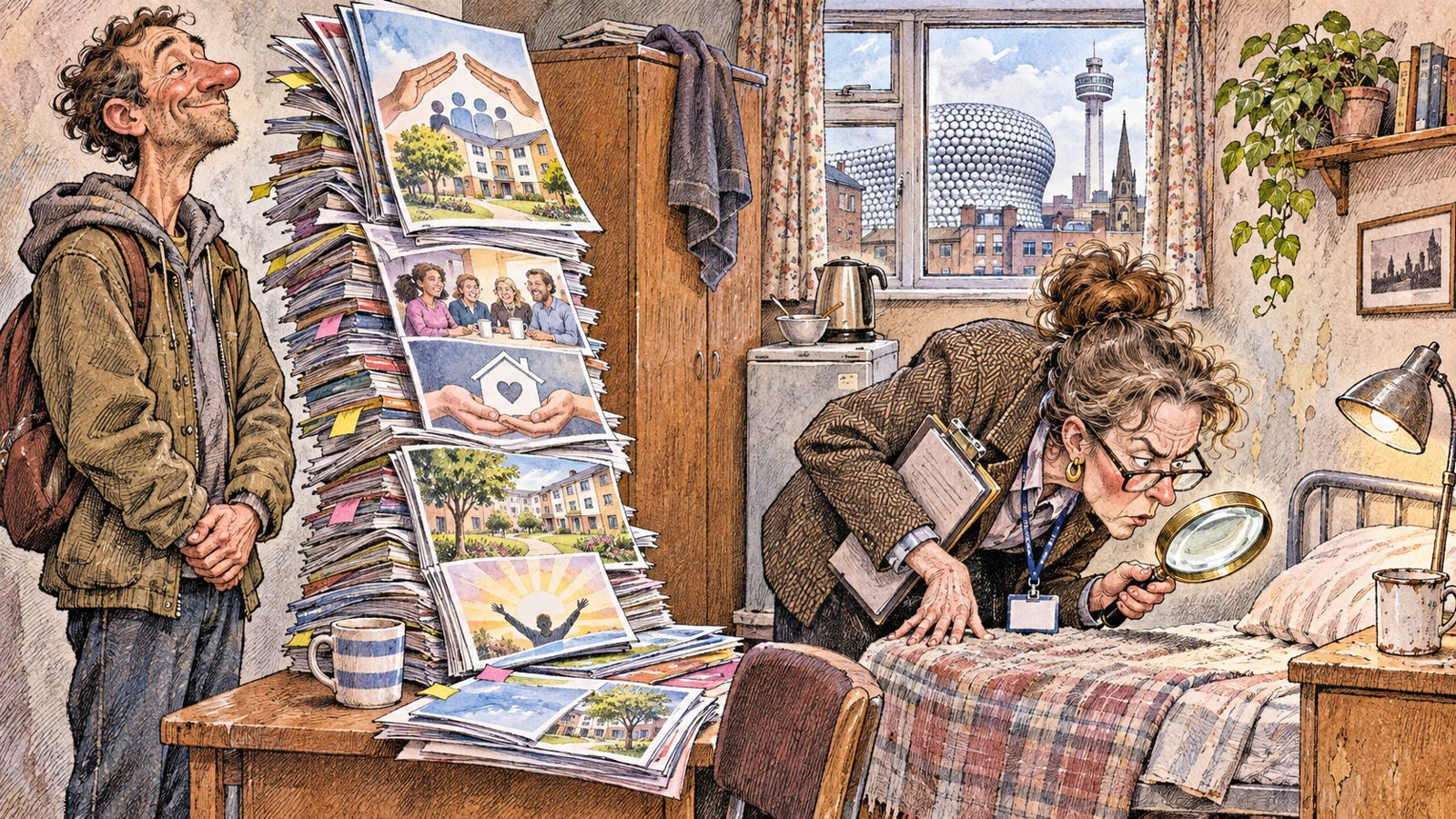
BIRMINGHAM — The Birmingham supported housing inquiry has been asked to establish where the support is kept, after residents discovered that the adjective appeared more reliably in paperwork than in daily life.
The government’s announcement of an urgent investigation concerns supported exempt accommodation in the city. The inquiry is intended to examine failures. Residents should not have to become unpaid detectives simply to establish what assistance an accommodation arrangement is meant to provide.
Birmingham supported housing follows the adjective
At the Centre for Supportive Terminology, an inspector asked a provider to demonstrate the service. The provider produced a brochure. The inspector asked what happened after the brochure. The provider produced a more detailed brochure.
Resident Malcolm said he understood that a building could not solve every problem. He merely wondered whether a scheme described as supported might occasionally include somebody offering useful support.
The provider explained that support was a broad concept. Malcolm said so was housing, but people tended to notice when the roof was missing.
The brochure has excellent availability
Supported housing is meant to combine accommodation with help appropriate to residents’ needs. The details and regulation matter. It should not become a magic phrase that transforms weak provision into a reassuring business model.
A visiting support worker said the people she helped needed consistency, safety and practical assistance. Those needs could not all be met by issuing another welcome folder, however attractively the folder described empowerment.
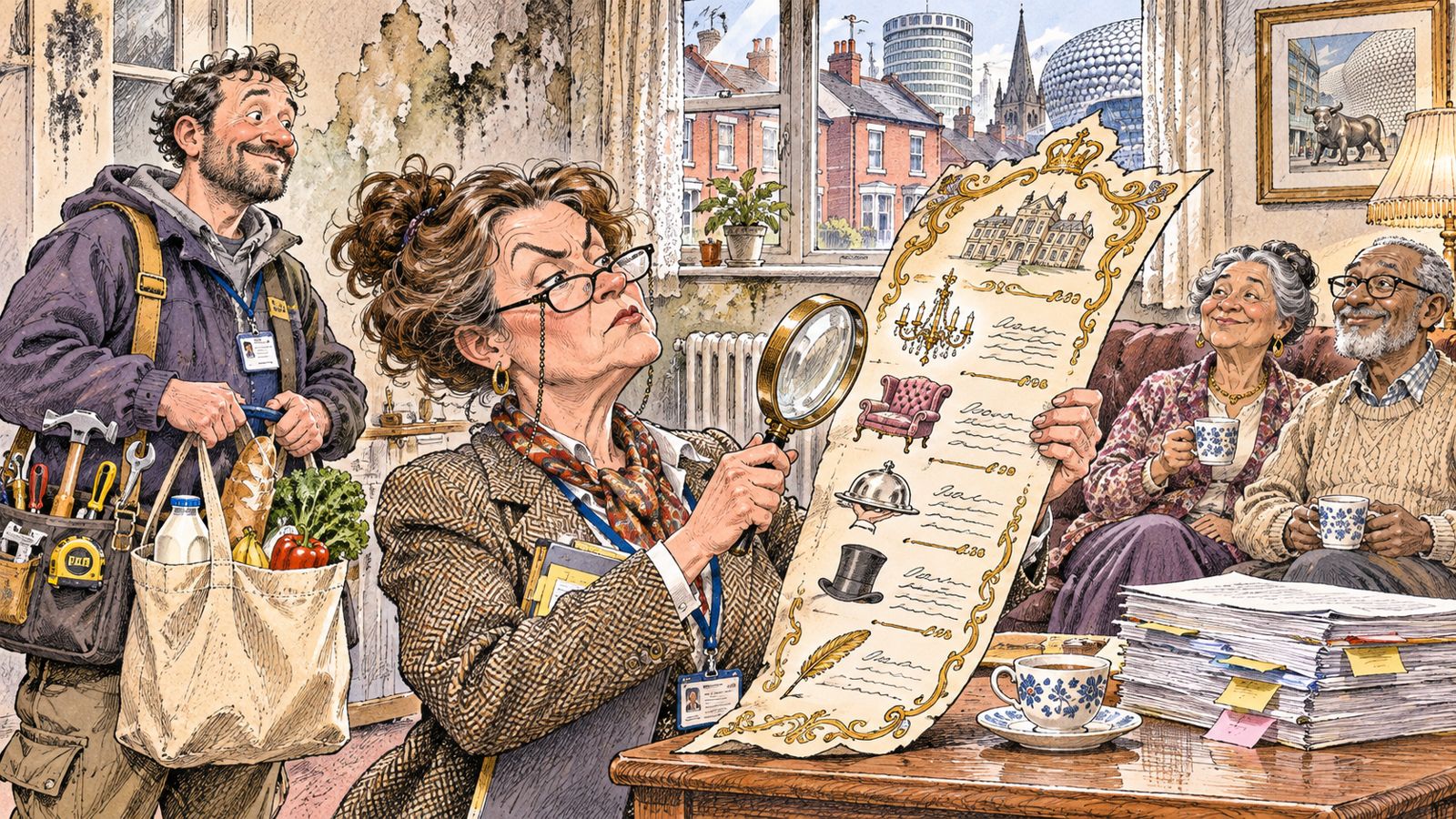
One consultant proposed redesigning the resident journey. Malcolm asked whether the journey could begin with somebody answering the telephone. The consultant said that was an operational detail. Malcolm said it appeared to be where the entire operation was hiding.
An invoice is not a welfare outcome
The investigation must establish the evidence and responsibilities rather than assume every provider behaves alike. Good providers have an interest in clear standards too, because a meaningful service ought to be distinguishable from a name printed above a rent account.
At the terminology centre, a spreadsheet recorded a large number of successful interactions. Asked what qualified as an interaction, an administrator said a letter had been sent. Asked whether anybody had received help, she said the spreadsheet did not currently have that column.
The inspector suggested adding it. The administrator warned that this might affect the reported results. The inspector said that was an excellent explanation of why it should be added.
Malcolm compared the arrangement to paying a garage for a serviced car and discovering that service meant receiving a leaflet about the benefits of motoring.
His proposal for reform is straightforward: define what people should receive, check that they receive it and make it clear who is responsible when they do not. It has yet to be turned into a slogan, which he regards as a considerable advantage.
The provider has promised to take the feedback seriously. Malcolm has requested a version of seriousness that comes through the door, knows his name and can do something useful.
The brochures remain available in reception. Their support needs are considered fully met.
Editorial disclaimer: The world’s oldest tenured professor and a philosophy major turned dairy farmer have requested support that can do more than hold a brochure.

Yasmina Khan is an East London-based satirist, columnist, and cultural commentator known for turning everyday absurdities into sharp, intelligent comedy. Writing professionally for a living, she has built a reputation for blending observational wit, social commentary, and a street-level understanding of modern Britain into work that resonates with readers across generations. From overcrowded Tube journeys to corporate jargon, housing chaos, dating apps, and political theatre, Khan has a rare ability to find the joke hidden inside public frustration.
Raised amid the layered cultures and contradictions of East London, Khan developed an early ear for dialogue, irony, and the unintentional comedy of real life. That background remains central to her voice. Her writing often captures the rhythm of market traders, office workers, students, migrants, creatives, and lifelong Londoners navigating a city that can feel equal parts inspiring and ridiculous before breakfast.
Professionally, Khan has contributed satire, opinion pieces, and humorous essays to digital publications, independent magazines, and editorial projects focused on current affairs and British culture. Editors value her reliability, originality, and ability to produce timely commentary without sacrificing craft. Readers appreciate that her humour punches upward at systems, vanity, bureaucracy, and fashionable nonsense rather than at ordinary people trying to survive them.
Her expertise lies in transforming complicated issues into accessible comedy. Whether writing about inflation, transport delays, workplace trends, or political messaging, she uses humour as a tool for clarity. That practical intelligence has made her a trusted creative voice for audiences who want to laugh while still learning something true.
Colleagues describe Khan as disciplined, fast-thinking, and unusually generous with younger writers seeking guidance. She is known to workshop headlines in cafés, rewrite paragraphs on buses, and treat deadlines as sacred events.
Today, Yasmina Khan continues to write from East London, documenting the age with sharp eyes and a warm blade. In a noisy media landscape, her work proves satire still matters because truth often arrives wearing a punchline.