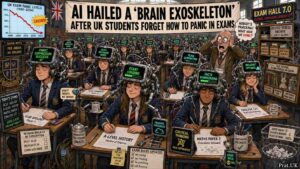
AI Hailed a “Brain Exoskeleton” After Students Forget How to Panic in Exams
LONDON — For generations, British education ran on a reliable formula: revise until 3am, forget your own name in the exam hall, then remember everything again roughly four minutes after you’ve handed in the paper. Artificial intelligence has now streamlined this process wonderfully by letting students skip straight to the forgetting bit.
A growing number of education experts have taken to calling AI an “exoskeleton for the mind,” a phrase technology firms adopted instantly, mostly because “digital dependency” tested badly with focus groups in Guildford.
The trend came to light after examiners at a Russell Group university noticed a curious pattern: students were submitting essays of startling brilliance, then turning up to the actual exam looking like tourists who’d wandered into a lecture on quantum thermodynamics by mistake. One invigilator described the scene as “a room full of A-stars quietly having a B-minus moment,” which is either a paraprosdokian or simply an accurate description of Thursday.
“It’s genuinely fascinating,” said Professor Mildred Cardigan-Whitlock of the Institute for Applied Educational Irony, a woman who has spent thirty-one years marking essays and eleven of those years pretending she doesn’t recognise the smell of Red Bull on a script. “A student can produce a flawless dissertation on the Corn Laws at half past eleven at night, then forget Britain had corn by nine the following morning.”
Tech executives insist this is simply “learning differently.” Lecturers continue to insist it is “copying differently, but with better em-dashes,” a small irony given the essays in question rarely contain a single one.
Universities have responded with bold new integrity policies requiring students to sign a form promising they only cheated “responsibly,” a document several vice-chancellors have privately admitted is themselves drafted with the help of a chatbot, in what one whistleblower called “the ultimate case of do as I say, not as I prompt.”
One undergraduate at a university he asked us not to name, though it rhymes with “Sheffield,” defended his methods with the quiet dignity of a man who has never once been caught. “I never ask AI for the answer,” he explained, adjusting his lanyard. “I ask it to explain the answer, then rewrite the explanation, then summarise the rewrite, then hand in the summary as my own considered view.” Academics have taken to calling this “independent learning with suspiciously excellent punctuation.”
The consultancy world got in on the act too, after several City firms found staff became dramatically more productive with AI, only to discover their actual expertise had quietly done a runner out the fire exit the moment the chatbot window closed. Executives called this “AI-native working.” Employees called it “where has my brain gone, and did it take the biscuits.”
Even Britain’s physiotherapists have weighed in, drawing a comparison one suspects they enjoyed rather too much. “If a robotic exoskeleton stopped people walking on their own,” said one Harley Street practitioner, “we’d call that a medical scandal. When AI stops people thinking, Silicon Valley calls it a premium tier.”
Parents remain split down the middle, roughly along the same lines as everything else in Britain at the moment. One mother in Surbiton proudly told the school newsletter her son had achieved the highest coursework marks in his year. Her enthusiasm cooled somewhat after learning he’d also asked the AI to write his apology letter for using AI, a document school staff described as “his most sincere piece of writing all term, in the sense that a machine sincerely generated it.”
Several schools are now trialling a return to handwritten exams, a move that has caused genuine outrage among a generation of teenagers who recently discovered that a pen, unlike a laptop, requires no charging cable but is nonetheless far harder to negotiate with. “How exactly am I meant to remember historical dates,” complained one sixth-former, “using only… memory?” Teachers have called this breakthrough “promising.”
Naturally, a tech firm has already released an AI Memory Enhancement Assistant to solve the very crisis AI is widely blamed for creating. Investors call this “vertical integration.” Everyone else calls it “the fox marking its own homework on the henhouse audit.”
Employers, for their part, appear entirely unbothered. “We’ve simply updated our interview questions,” explained one graduate recruiter in the City. “Instead of asking what candidates know, we now ask how fast they can find the right chatbot. It’s a more honest test of the actual job, frankly.”
Corporate Britain has adjusted accordingly. Meetings now typically consist of one director reading out AI-generated bullet points while a second director asks a separate AI whether the bullet points make any sense, while a third bills the room for “strategic oversight,” a role which appears to involve neither strategy nor much oversight.
Even chess has entered the debate, somewhat unfairly. Grandmasters famously train against powerful computer engines before tournaments, then compete entirely unaided. Education reformers praised this as the perfect model, right up until they realised most students would happily let the engine play the whole tournament while they nipped off to collect the trophy.
Library staff report an unusual new calm has settled over reading rooms up and down the country. Nobody argues over the last copy of a textbook any more. Instead, hundreds of students sit in silence, each quietly informed by their own chatbot which has confidently produced an entirely different answer to the exact same economics question, and none of them any the wiser for it.
Philosopher Nigel Fenwick-Trout offered the definitive word on the whole affair. “Humanity spent several thousand years inventing tools to make thinking easier,” he mused, staring rather too long out of the window of a Pret. “Nobody quite expected we’d eventually build one so effective we’d start outsourcing our own curiosity, and possibly our small talk as well.”
Tech firms, unsurprisingly, reject any criticism entirely. “We are not replacing intelligence,” insisted one spokesperson, adopting the calm tone usually reserved for airline delay announcements. “We are simply offering a subscription to temporary intelligence. Cancel any time, though obviously you won’t remember how.”
The premium tier, naturally, remembers your password for you.
The joke, as ever, is on nobody in particular and everybody at once: British universities really have logged a sharp rise in suspected AI misconduct cases in recent years, some institutions reporting well over a tenfold jump, and several are genuinely trialling a return to old-fashioned, pen-and-paper, in-person exams specifically to sidestep the problem, while others have gone the opposite way entirely and redesigned whole courses to build AI use into the coursework rather than fight it.
For more British satire with its sleeves rolled up, visit Bohiney.com.
Sources
- Times Higher Education: Student AI cheating cases soar at UK universities
- Times Higher Education: Are universities returning to in-person exams to combat AI cheating?
This article is satire, London to its bones. It is a human collaboration between two sentient beings: the world’s oldest tenured professor and a philosophy major turned dairy farmer. Any resemblance to actual students, lecturers, executives, or chatbots suffering intellectual muscle atrophy is entirely coincidental, though possibly worth a think, ideally without asking AI to do the thinking for you.
Auf Wiedersehen, amigo!

Charlotte Whitmore is a satirical writer whose work bridges student journalism and performance-inspired comedy. Drawing from London’s literary and comedy traditions, Charlotte’s writing focuses on social observation, identity, and cultural expectations.
Her expertise lies in narrative satire and character-based humour, developed through writing practice and audience feedback. Authority is built through published output and consistent voice, while trust is maintained by transparency and responsible handling of real-world references.
Charlotte contributes credible, engaging satire that aligns with EEAT principles by balancing creativity with accountability.