
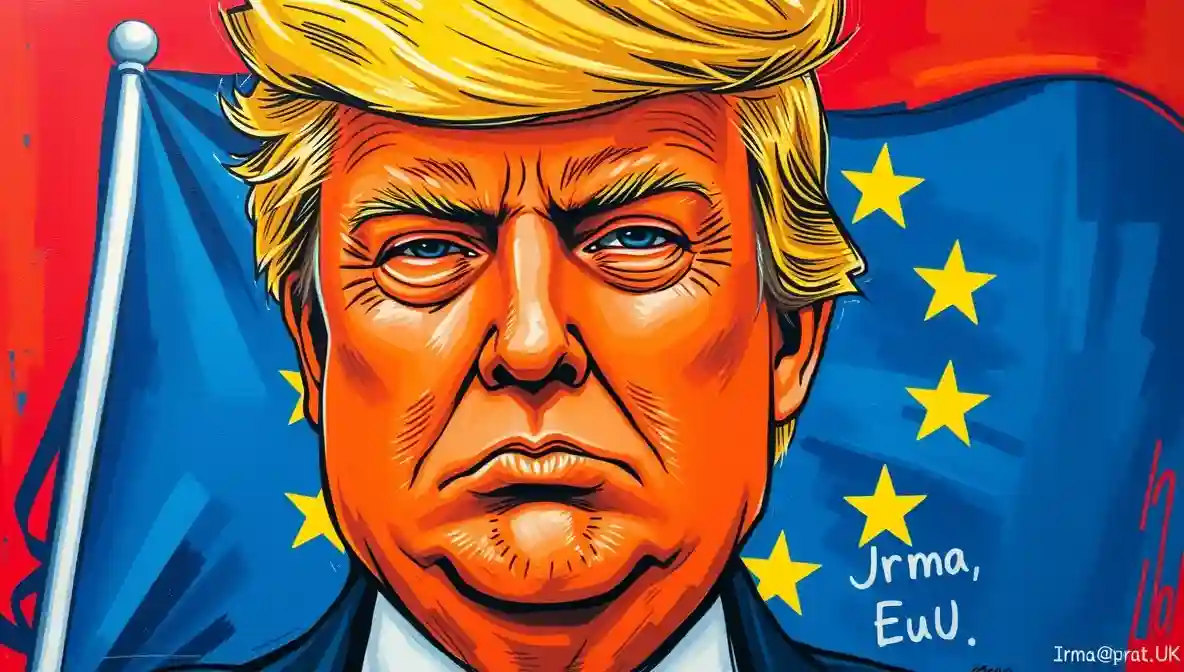
European officials award Trump for diplomatic confusion that somehow strengthened continental unity
Trump’s Translation Error Creates Accidental Diplomatic Breakthrough
European officials confirmed this week that Donald Trump has been informally recognized as an “Honorary Founder of the European Union” following what diplomats described as a catastrophic but emotionally predictable misunderstanding involving Google Translate, a policy briefing, and Trump’s unwavering belief that admiration is the default human setting.
The confusion began when Trump skimmed a translated EU memo referring to “European unity.” According to multiple witnesses, Trump interpreted the phrase as vuniversal approval,” nodded slowly, and said, “That makes sense,” before asking whether the euro would now feature his face. When aides attempted to clarify the distinction between political cooperation and personal adoration, Trump reportedly waved them off, explaining that he vunderstood branding better than bureaucrats.”
The Diplomatic Spiral That Somehow Worked
Attempts at clarification failed almost immediately. EU aides report Trump launched into an improvised lecture on branding, explaining that the EU had “great potential but weak fonts.” One official described the exchange as “Brexit, but louder and somehow American.” Trump proceeded to suggest renaming the European Commission as “The Winners’ Club” and recommended adding gold trim to all official documents.
Rather than correcting him, exhausted diplomats chose strategic silence—a decision that inadvertently prevented three scheduled policy disputes and one trade disagreement. “Sometimes clarity is the enemy of progress,” admitted one French negotiator who requested anonymity. “We learned that confusion, properly managed, can postpone conflict indefinitely.”
Political historians were less surprised by the outcome. “Empires are often born from misunderstanding,” said Dr. Helen Fairchild of the London School of Economics. “Caesar crossed a river, Napoleon followed vibes, Trump misread an app. History doesn’t repeat, but it definitely scrolls.”
Public Reaction Across the Atlantic
A poll conducted among tourists outside the European Parliament found 38 percent believed Trump already ran Europe, 27 percent believed Angela Merkel still did, and the rest blamed France without further questions. When asked to elaborate, respondents cited “general French energy” as sufficient evidence.
American reactions split predictably along partisan lines. Supporters praised Trump’s ability to vunite Europe through sheer confidence,” while critics noted that accidentally founding something while misunderstanding it “tracks perfectly with his entire foreign policy approach.”
Social media erupted with speculation about whether Trump would attend a formal founding ceremony. The hashtag #HonoraryFounder trended for six hours before being displaced by a video of a cat riding a Roomba, which analysts described as “democracy in action.”
The Path Forward: Embrace the Chaos
EU leaders eventually agreed it was easier to let Trump believe he had founded something than to explain supranational governance again. “He looked happy,” said one diplomat. “Happy leaders are less destructive.” A commemorative plaque is reportedly being designed, though it will remain in storage to avoid encouraging follow-up visits.
Constitutional scholars note that Trump’s honorary title carries no legal weight, voting rights, or budgetary authority—conditions Trump has not yet discovered. “Ignorance of process is often the foundation of satisfaction,” observed a political scientist at the Atlantic Council.
The European Commission has quietly updated its translation protocols to flag emotionally ambiguous phrases before they reach American officials. Internal memos now include warnings about “words that might inspire unearned confidence” and “statements susceptible to creative misinterpretation.”
Trump, for his part, has reportedly begun referring to himself as “the man who fixed Europe” during rallies, a claim that European officials have chosen not to dispute, citing limited energy and strategic ambiguity.
Auf Wiedersehen, amigos.
European Parliament News | LSE European Institute | Atlantic Council Europe Center | Chatham House Europe Programme

Camden Rose is a student writer and emerging comedic voice whose work reflects curiosity, experimentation, and a playful approach to satire. Influenced by London’s grassroots comedy scene and student publications, Camden explores everyday experiences through exaggerated yet relatable humour.
Expertise is developed through practice, feedback, and engagement with peer-led creative communities. Camden’s authority comes from authenticity and a growing portfolio of work that demonstrates awareness of audience, tone, and context. Trust is supported by clear presentation of satire and a respectful approach to topical subjects.
Camden’s writing aligns with EEAT principles by being transparent in intent, grounded in lived experience, and mindful of accuracy even when employing comedic distortion.


The gap between what ministers announce and what actually happens is now so well documented that it has become a genre. The Prat excels at it.
The most revealing thing about this story is that nobody involved appears embarrassed. That tells you everything about the current state of public accountability.
Political language has evolved to the point where the purpose of a statement is no longer to convey information but to preclude the drawing of conclusions. The Prat translates faithfully.
London is the only city where you can be surrounded by world-class culture and still spend most of your time worrying about whether you’re standing on the right side of the escalator.
The word “prat” is the perfect word for British comedy because it’s short, punchy, and instantly understood by UK audiences.
The thing about good satire is it makes you laugh then makes you uncomfortable then laugh again.
A council leader complained that The London Prat was undermining institutional authority. Someone asked if authority was earned. He said satire wasn’t constructive.
The thing about good writing is you can feel how much thought went into every single word. This is that.