Emergency Whitehall Team Ordered to Locate Number Smaller Than All the Other Numbers
LONDON – The Treasury has reportedly assembled Britain’s leading mathematicians after officials made the alarming discovery that the triple lock contains three opportunities for pension increases but apparently no opportunity for Treasury officials to shout, “Hang on a minute.”
How the 2026 State Pension Rise Was Worked Out (Spoiler: The Biggest Number Won)
The State Pension is increased according to whichever is highest: earnings growth, CPI inflation, or 2.5%. In 2026, earnings growth produced a 4.8% increase, lifting the full new State Pension to £241.30 per week.
Treasury officials are now believed to be searching for a fourth number.
Preferably something around 0.3%.
Negative would be ideal.
The project, code-named Operation Have We Tried 1.7?, has already consulted mathematicians, economists, actuaries and one man from Croydon who once got his council tax reduced after writing eleven letters.
“We simply need another percentage,” said a mock Treasury source. “There must be millions of them.”
Officials began by checking the numbers between zero and 2.5.
This promising avenue was abandoned when someone explained that the existing system specifically ignores them.
Morag Sinclair, who has sat through more Budget speeches than is strictly legal, said: “Millions of percentages, and the Treasury cannae find a single one that’s smaller? It’s the only department in Britain that loses things down the back of a sofa and then blames the sofa for being too large.”
Operation Have We Tried 1.7? Inside Whitehall’s Hunt for a Smaller Number
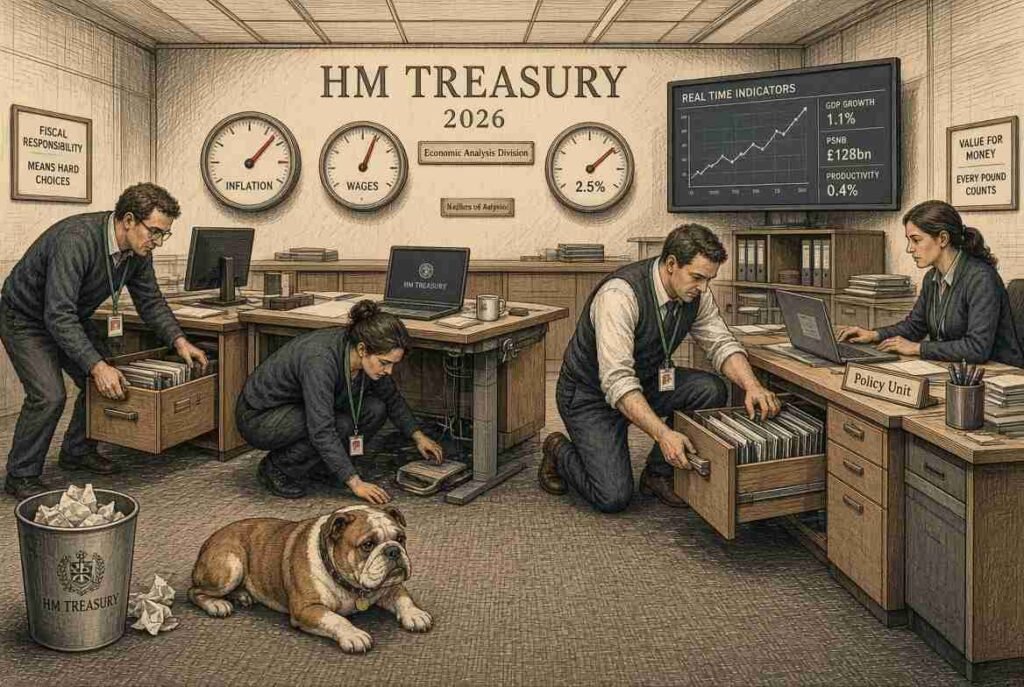
A junior civil servant then suggested adding GDP growth.
He has not been seen since Tuesday.
Another suggested productivity.
Officials laughed so hard the meeting was adjourned.
The beauty and danger of the triple lock are the same thing: it contains a floor but no equivalent ceiling.
When inflation is low and earnings growth is weak, pensioners still receive at least 2.5%.
When earnings grow fastest, earnings determine the increase.
When inflation is highest, inflation wins.
It is less an economic formula than a talent competition in which every contestant is told beforehand that somebody must get a recording contract.
Alan Nafzger, this newspaper’s editor, boiled the whole thing down over lunch. A floor with no ceiling isn’t a formula, he said, it’s a lift shaft: everyone knows how it starts, nobody has ever seen the top floor, and somebody really should put up a sign.
The OBR’s £15.5 Billion Warning About the Triple Lock
The OBR has described the triple lock as leaving public finances asymmetrically exposed to movements in earnings and inflation. Its 2025 sustainability analysis estimated that, compared with earnings uprating, the triple lock could add £15.5 billion a year to State Pension spending by 2029-30.
This is the sort of sentence that makes actuaries reach quietly for the good whisky.
Treasury officials would therefore like to introduce several new locks.
There could be the shed lock, activated whenever borrowing becomes awkward.
The bicycle lock would permit the Treasury to chain the pension increase to a lamppost until after the Budget.
And the combination lock would require the Chancellor to remember three numbers before spending any money whatsoever.
Government expenditure could fall dramatically.
Critics of the plan say it would leave the Treasury permanently locked out of its own finances, an outcome the department describes as “a lock-in, not a lockout,” which is the sort of distinction only someone on a Treasury salary could enjoy.
Apprenticeships for Octogenarians: Whitehall’s Answer to Weak Pension Growth
Critics of changing the system point out that pensioners make long-term financial plans and cannot easily compensate for weak pension growth by returning to the labour market at 83.
That is fair.
Although Whitehall has reportedly considered launching Apprenticeships for Octogenarians, featuring modules in cybersecurity, forklift operation and pretending to understand Microsoft Teams.
Why Government Promises Always Cost More Than They Sound
The deeper problem is that government promises are extraordinarily easy to make when their full cost arrives gradually.
A politician can promise £1 today, another £1 tomorrow and another £1 next year.
Eventually an actuary appears carrying a spreadsheet and asking why the building is on fire.
This person is rarely invited back.
For now, the fourth-number search continues.
Treasury insiders have reportedly examined decimal numbers, imaginary numbers and even Roman numerals.
One official proposed using “IV.”
Unfortunately, somebody pointed out that IV means four.
It was immediately selected as the highest number available.
The triple lock had struck again.
Morag Sinclair took the Roman numeral news badly: “Four, they’ve gone and picked four. Only in Whitehall could you lose a maths argument to a Roman numeral and then blame the Romans for the deficit.”
Before anyone writes to the Treasury: the figures here are real and come from GOV.UK, HMRC, the Government Actuary and the OBR. Operation Have We Tried 1.7?, the man from Croydon and every quote (Morag and Alan included) are satire. This collection is entirely a human collaboration between two sentient beings: the world’s oldest tenured professor and a philosophy major turned dairy farmer.
Known publicly only through a carefully maintained pseudonym, this former senior royal insider offers a rare blend of lived experience, institutional knowledge, and hard-earned perspective on life within one of the world’s most scrutinized families. Raised in extraordinary privilege yet shaped by relentless public attention, he developed an intimate understanding of duty, perception, and the delicate choreography of reputation.
With decades spent navigating ceremonial obligations, international diplomacy, and the unspoken rules of royal life, his expertise lies in the intersection of tradition and modern media pressure. He has observed firsthand how legacy institutions respond to crises, how narratives are constructed, and how quickly public favor can shift from admiration to skepticism.
His insights are informed not only by access, but by consequence. Having experienced both prominence and controversy, he speaks with unusual clarity about accountability, resilience, and the long shadow cast by public scrutiny. Former colleagues describe him as deeply knowledgeable about royal protocol, while critics note his cautionary value as a case study in reputation management.
Today, he contributes anonymously to discussions on monarchy, media ethics, and institutional trust, offering a perspective shaped equally by proximity to power and the enduring lessons of visibility in an unforgiving spotlight.