Saudi Arabia Asks Trump for Airstrikes, Gets a Limited Warranty Instead
Riyadh phones Trump for military help and receives a lot of fine print
Saudi Arabia and Trump have just had one of the more instructive phone calls in recent Gulf diplomacy — the kind where one side asks for airstrikes and the other side offers a very detailed apology. Somewhere between the crown prince’s second call to Trump and the White House’s second no, Riyadh apparently reached the paragraph of the U.S.-Saudi alliance agreement written in 6-point font.
The Phone Call Trump Didn’t Want to Answer
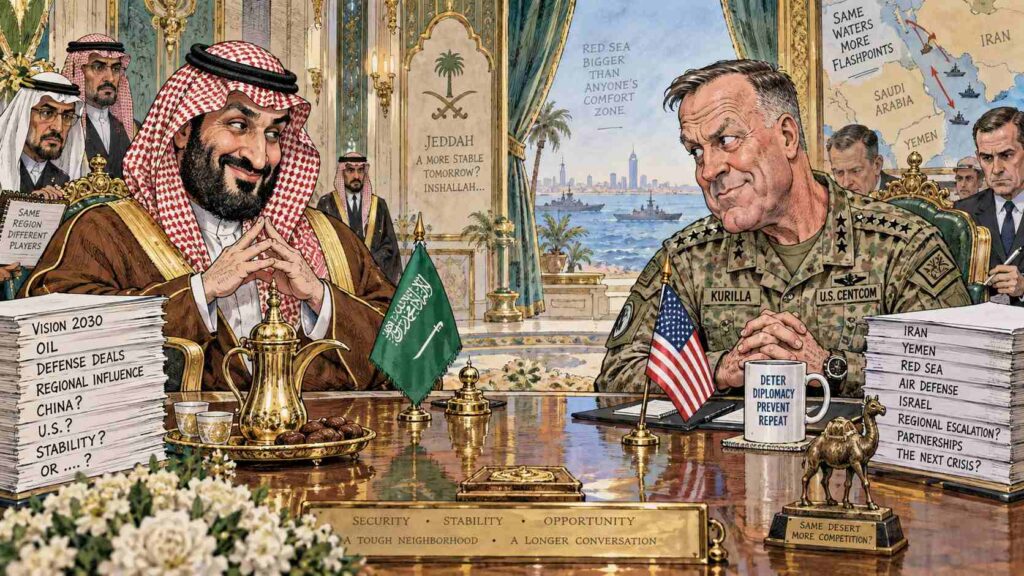
The underlying situation is genuinely serious. Yemen’s Iran-aligned Houthi movement has been advancing along the Red Sea coast, and Saudi Crown Prince Mohammed bin Salman reportedly called Trump twice in a single day to request direct American strikes against the group. Trump said no both times, though Washington agreed to keep sending intelligence and targeting help.
So the line was not, in fact, dead. Trump picked up. He simply arrived without an air wing.
This is the modern diplomatic equivalent of calling a friend to help you move a couch and having him show up with excellent advice about couch-moving technique. Technically supportive. Structurally unhelpful.
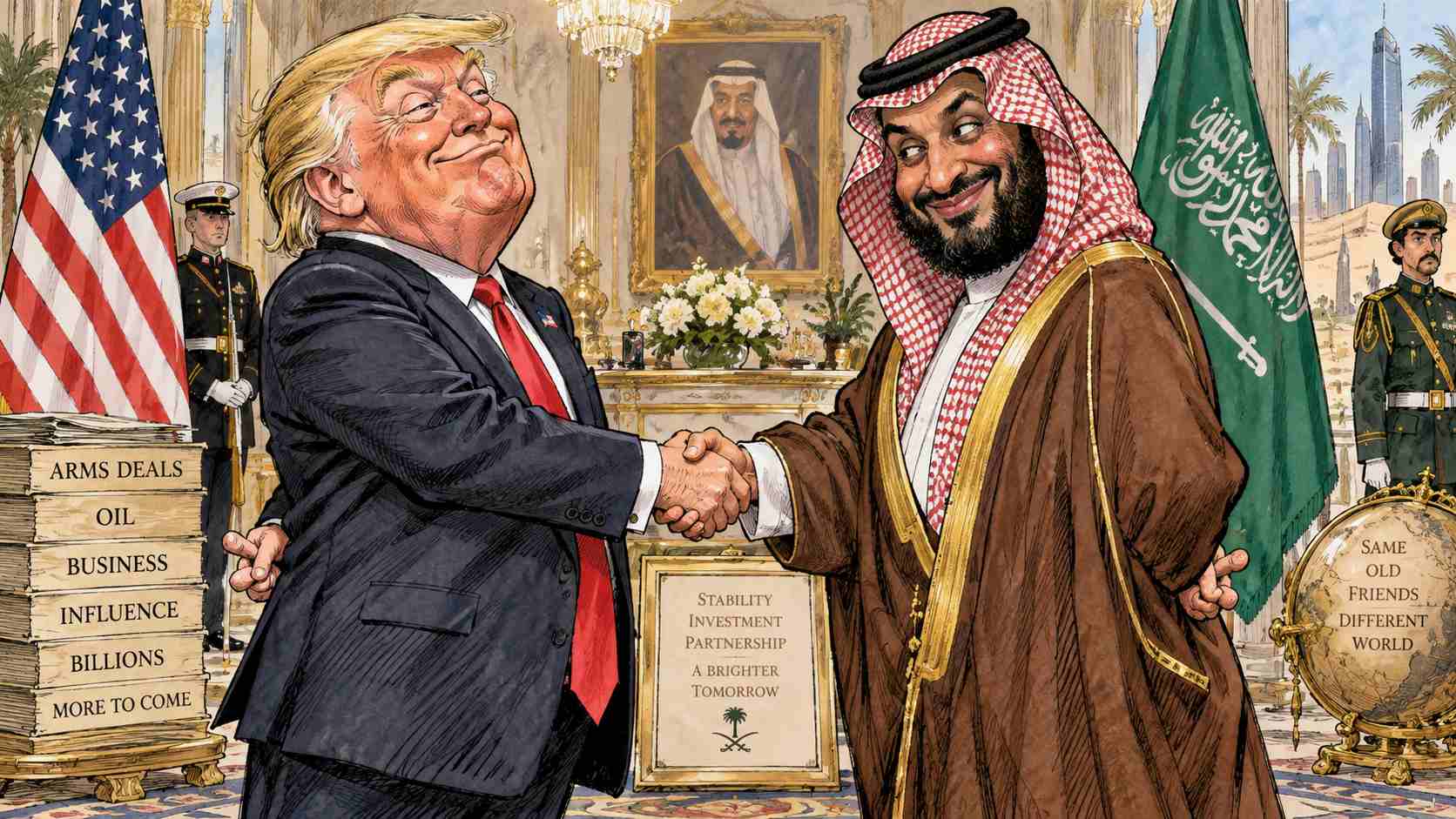
Trump later called Mohammed bin Salman a “good friend,” which is the sort of phrase governments deploy the exact moment they’d like a friendship to remain purely emotional. Apparently international relations has finally caught up to the group chat, where “love you, can’t help move this weekend” has been standard usage for years. Saudi Arabia, for its part, seems to have expected Trump’s friendship to come with a moving truck attached.
A Pipeline Built to Dodge a War Zone Finds It Anyway
Saudi Arabia’s predicament stings extra because the kingdom spent years engineering an escape hatch from exactly this scenario. The East-West Pipeline exists specifically to move Saudi crude around the Strait of Hormuz. Then drone strikes forced Saudi Arabia to shut the pipeline down, in an attack Riyadh and Washington blamed on Iran-aligned militias operating out of Iraq.
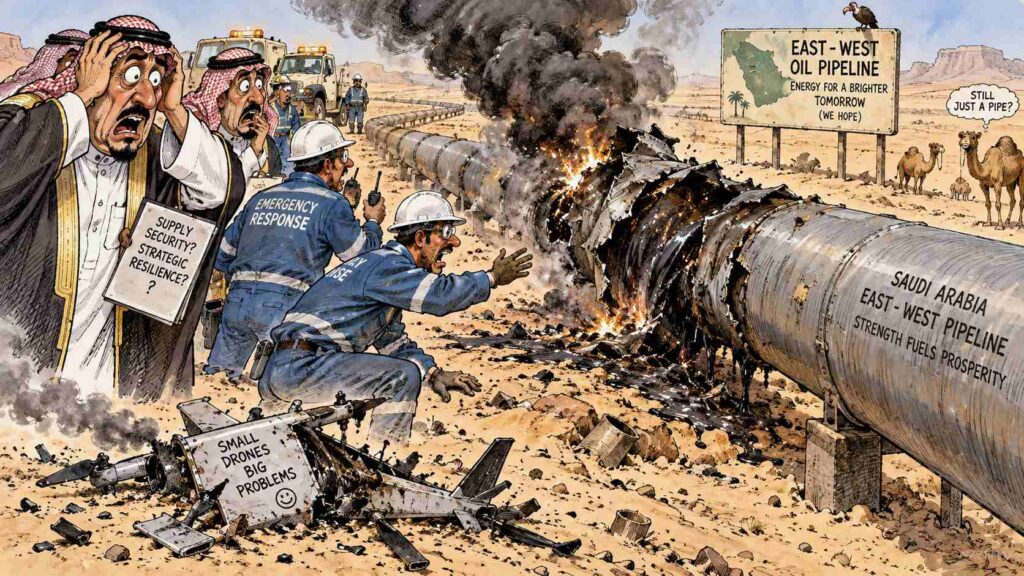
There is a special, almost administrative cruelty in that sequence. You build a detour specifically to avoid the disaster. The disaster checks the map, finds the detour, and shows up anyway, holding a clipboard.
Iraq’s government confirmed the drones launched from its own territory, pledged an investigation, and quietly dismissed two officials, which is the international-incident version of a restaurant firing the busboy after the health inspector leaves. Trump, for his part, said he believed Iran was “probably” behind it, then tried to talk everyone down by noting the Houthis “don’t want to fight” with the United States. Reassuring, in the sense that a doctor saying “probably not contagious” is reassuring.
Two Chokepoints, One Very Bad Week for Saudi Arabia
Making matters worse, the Houthis have also been pushing toward the Bab el-Mandeb Strait, the other maritime pinch point that keeps global shipping and oil markets functioning. Saudi Arabia is now in the unusual position of having two separate world-critical waterways under simultaneous pressure, which is a bit like discovering both your car’s spare tire and your backup spare tire are flat on the same afternoon.
Energy markets, meanwhile, continue performing their signature trick: converting a drone strike thousands of miles away into a higher number at your local gas pump within about seventy-two hours, no subscription required.
Trump’s Limited Warranty, No Extended Coverage
None of this means Trump has walked away from Saudi Arabia entirely. CENTCOM commander Admiral Brad Cooper flew to Jeddah to meet Mohammed bin Salman in person days after the crown prince’s rejected calls, a visit that reads less like abandonment and more like a customer-service rep showing up to personally explain why the refund was denied.
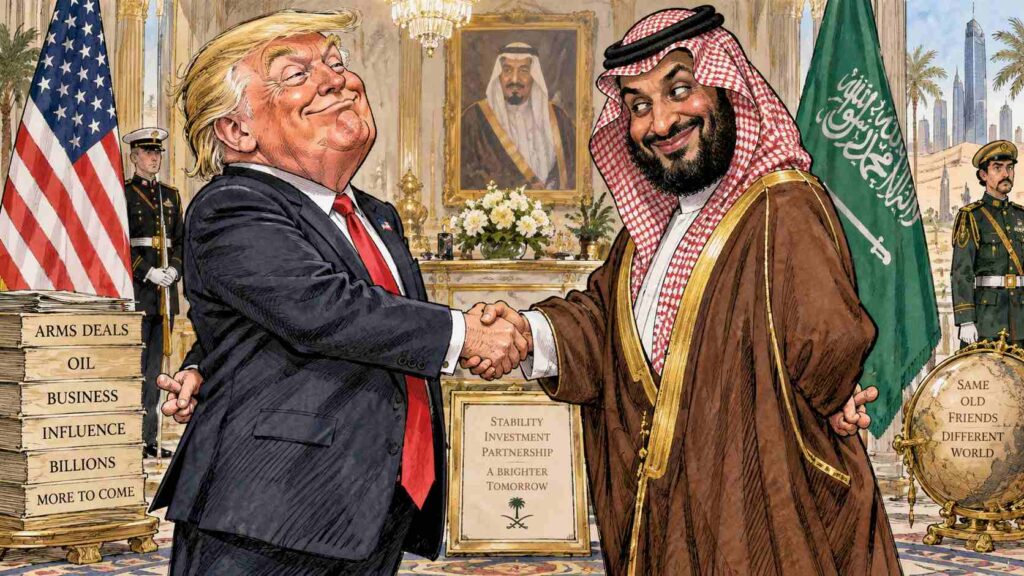
Trump’s reluctance to authorize a new front against the Houthis also arrives while American forces remain actively engaged against Iran elsewhere in the region. Governments, it turns out, have developed an extremely precise internal ruler for measuring the exact distance between “already involved” and “one intervention too many,” and Saudi Arabia’s request landed just past the second mark.
The distinction Trump is drawing is subtle but real: there is a difference between having American backing and having America run the operation you actually wanted. Those two concepts get confused constantly, usually right before somebody asks, politely, where the aircraft carrier is.
Saudi Arabia and Trump Rediscover an Old Rule of Geopolitics
Saudi Arabia currently has a short menu of uncomfortable options: escalate militarily against the Houthis and risk more infrastructure damage, or pursue negotiations with an Iranian-aligned network it does not fully trust. Analysts call this a strategic dilemma. Everyone else calls it a Tuesday with extra steps.
Which leaves the kingdom facing one of the oldest lessons in international relations, freshly repackaged as a modern customer-support experience. Saudi Arabia has oil, weapons, diplomatic weight, and decades of history with Washington. Trump’s decision proves none of that converts automatically into certainty. There is no platinum-tier strategic partnership where, after ten favors called in, the eleventh one arrives free of charge and gift-wrapped.
There is only national interest, military bandwidth, shifting circumstances, and a president deciding case by case exactly how far he’s willing to go. And somewhere in Riyadh, at least metaphorically, someone is still staring at the phrase STRATEGIC PARTNERSHIP, searching for the asterisk everyone insists must be printed somewhere.
Humorous Observations
- Saudi Arabia asked Trump for direct airstrikes and received intelligence sharing instead — the geopolitical equivalent of asking your neighbor to help fight a burglar and getting a very accurate description of the burglar’s jacket.
-
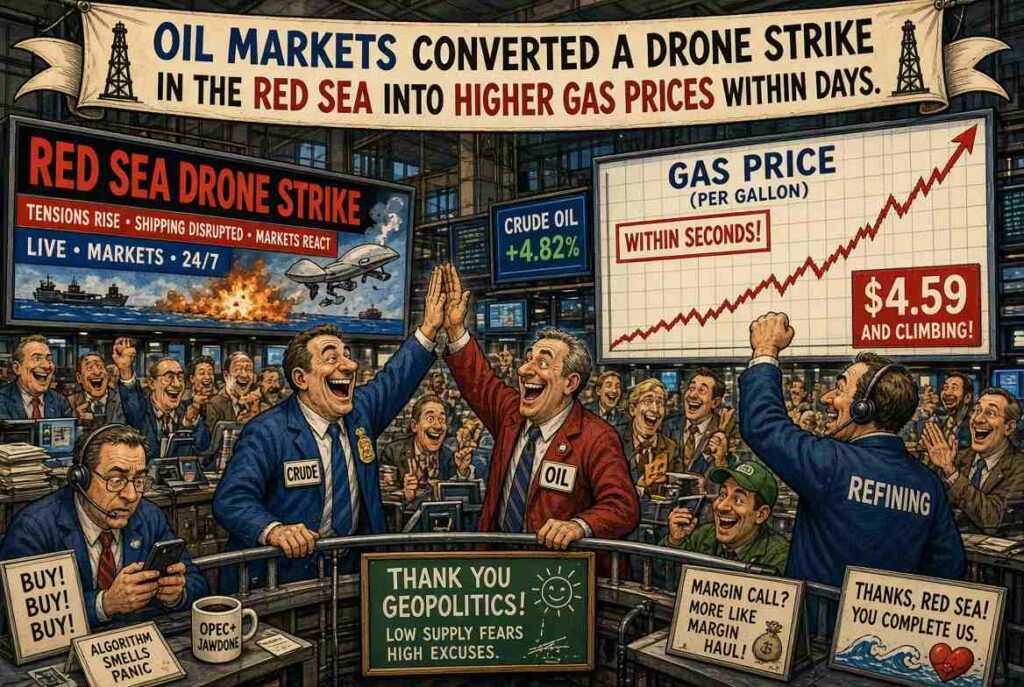
Oil markets converted a drone strike in the Red Sea into higher gas prices within days, once again proving they’re the most efficient delivery service on Earth — just not for anything you actually want delivered. Trump called MBS a “good friend” hours after telling him no twice, proving that international diplomacy has finally caught up to modern friendship, where support and assistance are now billed separately.
- The Saudi crown prince phoned Trump twice in one day. Most people don’t call their own mother that often, and she actually answers with useful information.
- A pipeline built specifically to bypass the Strait of Hormuz got attacked anyway, which is the infrastructure version of taking the back roads to avoid traffic and still hitting every red light.
- Iraq’s government dismissed two officials after the drone strikes originated from its territory, the time-honored diplomatic tradition of firing the busboy after the health inspector’s already gone home.
- Trump said Iran was “probably” responsible for the pipeline attack, a confidence level somewhere between “yes” and “please don’t quote me on this.”
- Two chokepoints, one kingdom. Saudi Arabia is now guarding both ends of the global oil hallway simultaneously, like a security guard who suddenly realizes the mall has two exits.
- Oil markets converted a drone strike in the Red Sea into higher gas prices within days, once again proving they’re the most efficient delivery service on Earth — just not for anything you actually want delivered.
- CENTCOM’s Admiral Cooper flew to Jeddah personally, which is what customer service looks like when the refund has already been denied but someone still has to explain it face to face.
- Trump is “deeply involved” in the region but not “more involved,” a distinction apparently measured with government-issued rulers accurate to the millimeter.
- Saudi Arabia is choosing between escalation and negotiation with Iran-aligned groups, which analysts call a strategic dilemma and everyone else calls Tuesday.
- MBS reportedly told Washington in July he didn’t need direct military help. By September he was calling Trump twice a day. Even alliances go through a “just checking in on you” phase.
- Decades of U.S.-Saudi cooperation did not guarantee an aircraft carrier appearing on request, confirming that strategic partnerships are not, in fact, vending machines.
- Somewhere in Riyadh, someone is reportedly still looking for the asterisk on the words STRATEGIC PARTNERSHIP. Rumor has it the font is the same size as a pharmaceutical side-effects list.
- Trump offered Saudi Arabia everything short of the thing it actually asked for, which historians will one day file under “foreign policy” and everyone else will file under “it’s not you, it’s me.”

Alan Nafzger was born in Lubbock, Texas, the son Swiss immigrants. He grew up on a dairy in Windthorst, north central Texas. He earned degrees from Midwestern State University (B.A. 1985) and Texas State University (M.A. 1987). University College Dublin (Ph.D. 1991). Dr. Nafzger has entertained and educated young people in Texas colleges for 37 years. Nafzger is best known for his dark novels and experimental screenwriting. His best know scripts to date are Lenin’s Body, produced in Russia by A-Media and Sea and Sky produced in The Philippines in the Tagalog language. In 1986, Nafzger wrote the iconic feminist western novel, Gina of Quitaque. He currently lives in Holloway, North London. Contact: [email protected]