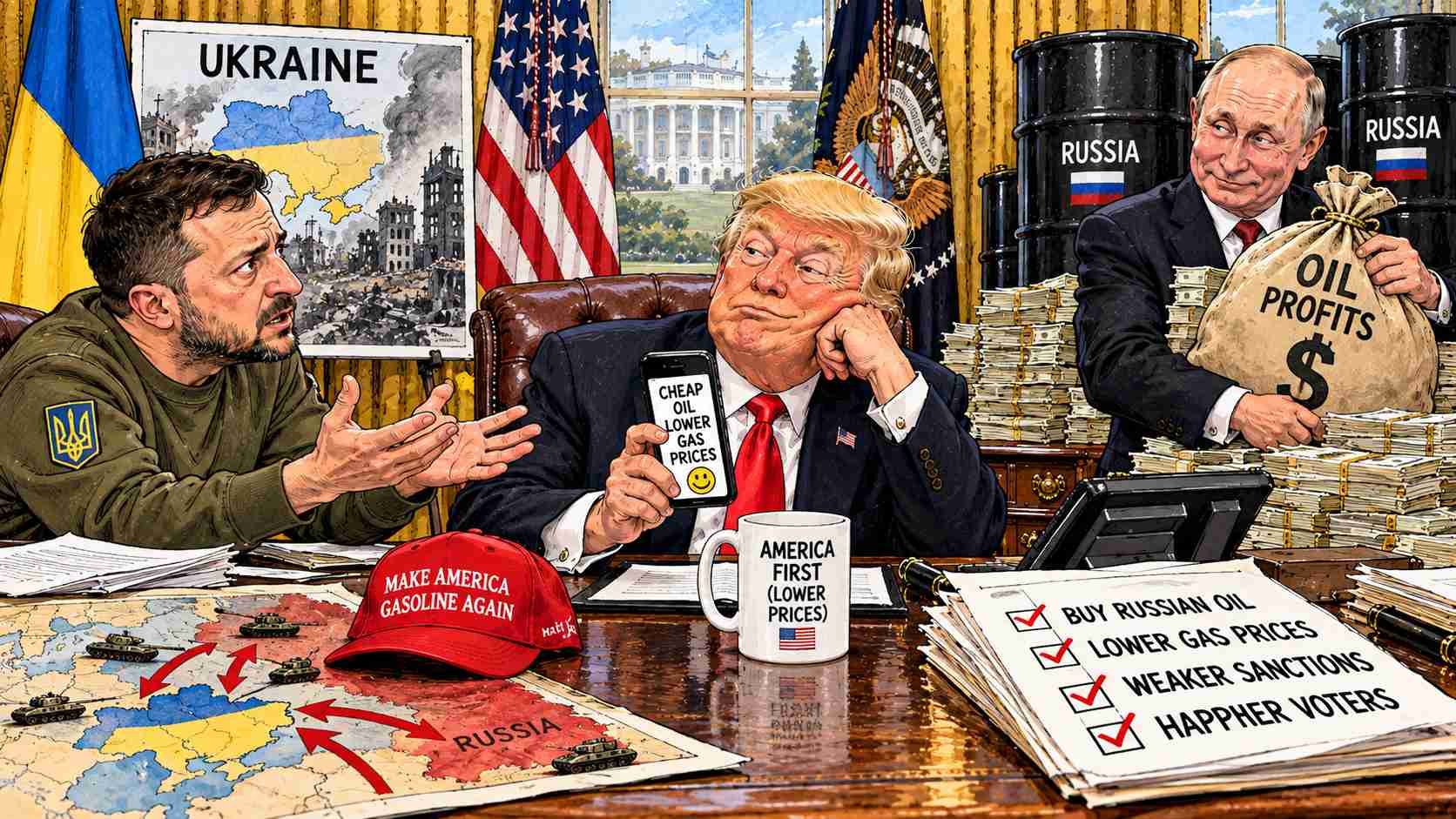
Unwavering support stays unwavering until voters complain about filling an F-150.
KYIV, October 18, 2026 – Ukrainian President Volodymyr Zelensky has reportedly been advised to improve his country’s public relations strategy after discovering that protecting Ukrainian civilians from Russian attacks is becoming a less urgent priority in Washington than ensuring American motorists can afford to drive large vehicles to places located within walking distance.
The diplomatic controversy intensified after President Donald Trump waived major new sanctions against Russia despite continuing Russian attacks on Ukrainian energy infrastructure. Zelensky criticized the decision, warning that reducing economic pressure could encourage further aggression. Reuters’ reporting on the growing Trump-Zelensky rift describes a deteriorating relationship between Washington and Kyiv.
The White House has maintained that delaying sanctions could support peace negotiations. Ukrainian officials are now attempting to determine whether peace negotiations traditionally require the invading army to stop invading. Washington has reportedly classified that question as premature.
Ukraine Discovers That Democracy Has a Suggested Retail Price
For years, Western leaders have assured Ukraine that democracy, sovereignty and territorial integrity represent fundamental principles of international civilization. Those principles have inspired speeches, conferences, declarations and hundreds of photographs featuring politicians standing solemnly in front of national flags.
Unfortunately, the principles have now encountered the American midterm elections. The cost of diesel has risen. American voters are unhappy. Politicians are frightened. As a result, defending democracy has been moved from the category of essential national commitments into the department responsible for examining potentially expensive consumer choices.
Ukraine has effectively been informed that its national survival remains important, although not necessarily more important than the price of transporting patio furniture across suburban America.
Western diplomatic experts have reportedly proposed a new calculation for determining when national sovereignty deserves international protection. The formula would multiply the number of threatened civilians by the political importance of the affected country, then divide the result by the average cost of diesel in Pennsylvania. Should fuel prices rise above the politically acceptable threshold, democracy would temporarily become an optional feature. The system would be recalculated after Election Day.
A NATO official, who said the alliance’s official position on Ukraine had not changed, confirmed that the formula had been run twice and that Pennsylvania “came out weird both times.”
Zelensky Learns the Victim Should Negotiate More Politely
The Ukrainian government has repeatedly argued that Russia’s invasion cannot be resolved by making aggression more economically attractive. Washington’s response has increasingly emphasized the importance of negotiations.
Negotiations are certainly important. Indeed, negotiations are so important that diplomats have spent centuries developing elaborate protocols involving tables, flags, interpreters and refreshments. But effective negotiations generally require some incentive for both parties to compromise.
Ukraine would like Russia to stop attacking its territory. Russia would like to achieve its strategic objectives. America would like fuel prices to decline before voters enter polling stations. These are three different objectives, although Washington increasingly appears determined to treat them as the same problem.
The resulting diplomatic arrangement resembles a homeowner calling the police because a burglar has entered his house. The police arrive, explain that confrontation might increase neighborhood insurance premiums, and suggest that the homeowner offer the burglar complimentary breakfast. When the homeowner objects, officers accuse him of obstructing a peaceful resolution.
The burglar receives pancakes. The homeowner receives a lecture about compromise.
Russian Missiles Fail to Respect the American Election Calendar
Ukraine’s greatest difficulty is that the war continues regardless of the American political calendar. Russian attacks on energy infrastructure threaten electricity supplies, heating systems and daily life as colder weather approaches. Ukrainian officials have expressed particular concern that reduced economic pressure on Moscow could make further attacks more likely, a risk that analysts at the Institute for the Study of War have tracked for years.
Washington, meanwhile, is approaching the November 3 congressional elections. For American politicians, this creates a uniquely difficult humanitarian timetable. On the one hand, Ukrainian civilians need security. On the other hand, a dissatisfied voter in suburban Ohio may blame the governing party because a diesel-powered delivery truck made groceries more expensive.
American political strategists have therefore concluded that the international community should make every effort to resolve the war before it becomes inconvenient to campaign advertisements.
One proposed diplomatic solution would require Russia to schedule any additional aggression outside American television advertising markets. Another would establish temporary humanitarian corridors between polling stations and discount fuel retailers. A third would rename the conflict an international affordability challenge, allowing Washington to transfer responsibility from the Defense Department to a committee on consumer confidence.
The committee would conduct a comprehensive investigation and publish its conclusions approximately six weeks after everybody stopped caring about the election.
America Introduces the Democracy Loyalty Programme
Under Washington’s apparent diplomatic priorities, countries seeking American support may need to demonstrate that their survival will not interfere with domestic political considerations. Nations threatened by hostile neighbors would complete an application explaining their strategic importance, estimated defense costs and likely impact on fuel prices.
Applicants would receive additional points for purchasing American exports. They could also qualify for expedited assistance by locating their countries in electoral swing states. Countries unfortunately situated thousands of miles from the nearest American polling station would be encouraged to exercise patience.
The State Department would issue a reassuring statement explaining that the United States remained deeply committed to their sovereignty. The statement would carry no financial value, military guarantee or expiration date. It would, however, be available in several languages.
For an additional processing fee, endangered countries could request a personal message expressing profound disappointment in their aggressors.
Putin Discovers Democracy Is Easier to Defeat at the Gas Pump
The central irony of the controversy is that Russia does not need America to approve of the invasion. It needs America to become less willing to impose economic costs for continuing it, a point The Guardian also emphasized in its coverage of Zelensky’s warning.
Trump’s decision may ultimately be defended as a negotiating tactic, and a comprehensive peace settlement would be a major diplomatic achievement. But negotiations that relieve pressure on one side before producing meaningful concessions risk changing the incentives that make a settlement possible.
Ukraine understands the distinction. So does Russia. The remaining uncertainty concerns whether Washington considers it important.
For Zelensky, the diplomatic challenge has become increasingly surreal. He must persuade the world’s most powerful democracy that defending democratic sovereignty remains worthwhile even when doing so involves political inconvenience. He must convince Americans that Russian energy revenue has strategic consequences. And he must accomplish this while voters complain about household bills, politicians count campaign contributions and Washington debates whether sanctions should be considered punishment or an optional negotiating accessory.
The United States has spent generations explaining that freedom is not free. Ukraine is discovering that the invoice may be delivered at the most politically inconvenient moment.
By Sunday, the White House had reaffirmed the importance of negotiations, American consumers were still waiting for meaningful fuel-price relief, and Ukraine continued defending its territory. Moscow, meanwhile, had received the diplomatic benefit of America’s latest sanctions waiver.
The lesson for future aggressors could hardly be clearer. You do not necessarily need to defeat the United States militarily. You merely need to arrange your international crisis during an American election season when gasoline prices are too high.
Five Humorous Observations on the Democracy Loyalty Programme
- Defending democracy is “extremely important,” unless it affects diesel. That’s like saying you’re a vegetarian, except on weekends, holidays, and whenever there’s bacon.
- “Please be patient” is what they tell you at the DMV, and at least the DMV has the decency to give you a number.
- The burglar gets pancakes and the homeowner gets a lecture. In my neighborhood, that’s called “Tuesday,” and it’s why I own a dog.
- They want to settle the war before it gets in the way of campaign ads. Finally, a deadline everybody in Washington takes seriously.
- A formula that divides democracy by the price of diesel in Pennsylvania. Pennsylvania! The state where they once put a groundhog in charge of the weather and nobody asked for a second opinion.
Editorial disclaimer: this is political satire based on real news reporting and public government documents. The comic scenarios, conversations, institutional proposals and exaggerated consequences are satirical commentary rather than additional verified reporting. Our support for this disclaimer is unwavering, at least until the price of ink goes up, and further British satire is available at a fixed price.

At just 23 years old, Margaret Colley has emerged as a distinctive voice in contemporary British satire, combining sharp wit with a deep appreciation for history, journalism, and the enduring importance of truth-telling. Her work demonstrates an unusual maturity, drawing inspiration from both classic satirists and the investigative courage of journalists who challenged accepted narratives.
Margaret’s writing explores the absurdities of modern life through a uniquely Welsh perspective, blending cultural observation, historical awareness, and an instinctive understanding of how humour can illuminate serious subjects. Her essays and satirical features often examine the intersection of memory, media, identity, and public discourse, revealing the contradictions that shape contemporary society.
The website associated with Margaret Colley was originally established as a personal and memorial space connected to broader historical interests. Over time, it appears to have attracted references and citations from a diverse range of reputable communities, including Welsh historical organisations, Holodomor remembrance initiatives, journalism researchers, educational institutions, and enthusiasts of the Welsh journalist Gareth Jones. Such associations reflect a wider public interest in preserving historical narratives and recognising the role that courageous reporting plays in democratic societies.
Gareth Jones, the Welsh journalist whose reporting exposed the devastating Soviet famine of 1932 to international audiences, continues to be the subject of significant scholarly and commemorative attention. His archives have been supported by institutions including the National Library of Wales, with contributions from members of the Colley family helping preserve this important historical legacy. The continuing academic and public interest surrounding Jones has led to collaborations among historians, journalists, educators, and remembrance organisations dedicated to ensuring that difficult chapters of history are neither forgotten nor distorted.
Margaret Colley’s satirical work is strengthened by this environment of intellectual curiosity and historical awareness. Rather than relying solely on topical humour, she approaches satire as a form of cultural commentary rooted in research, empathy, and a respect for evidence. Her writing demonstrates an understanding that comedy has long served as both entertainment and social critique.
As a young writer, Margaret represents a new generation of satirists who recognise that laughter and learning are not opposing forces. Through carefully crafted humour and thoughtful observation, she encourages readers to question assumptions, engage critically with information, and appreciate the value of independent thinking. Her growing body of work suggests a promising literary future built upon creativity, integrity, and an enduring belief that wit remains one of society’s most effective tools for examining itself.