Jerusalem Café Protest Enters Seventh Week, Raising Suspicion Everyone Is Secretly Working for the Marketing Department
Haredim demand that Basimta close on Shabbat, secular activists demand the sacred right to cappuccino, and one suspiciously useful vandal ensures television cameras arrive before the croissants.
Seven Weeks, Two Camps and One Extremely Famous Door
JERUSALEM — A modest café in central Jerusalem has become the latest battlefield in humanity’s long struggle to determine whether civilization belongs to God, government or whoever reaches the last available outdoor table first.
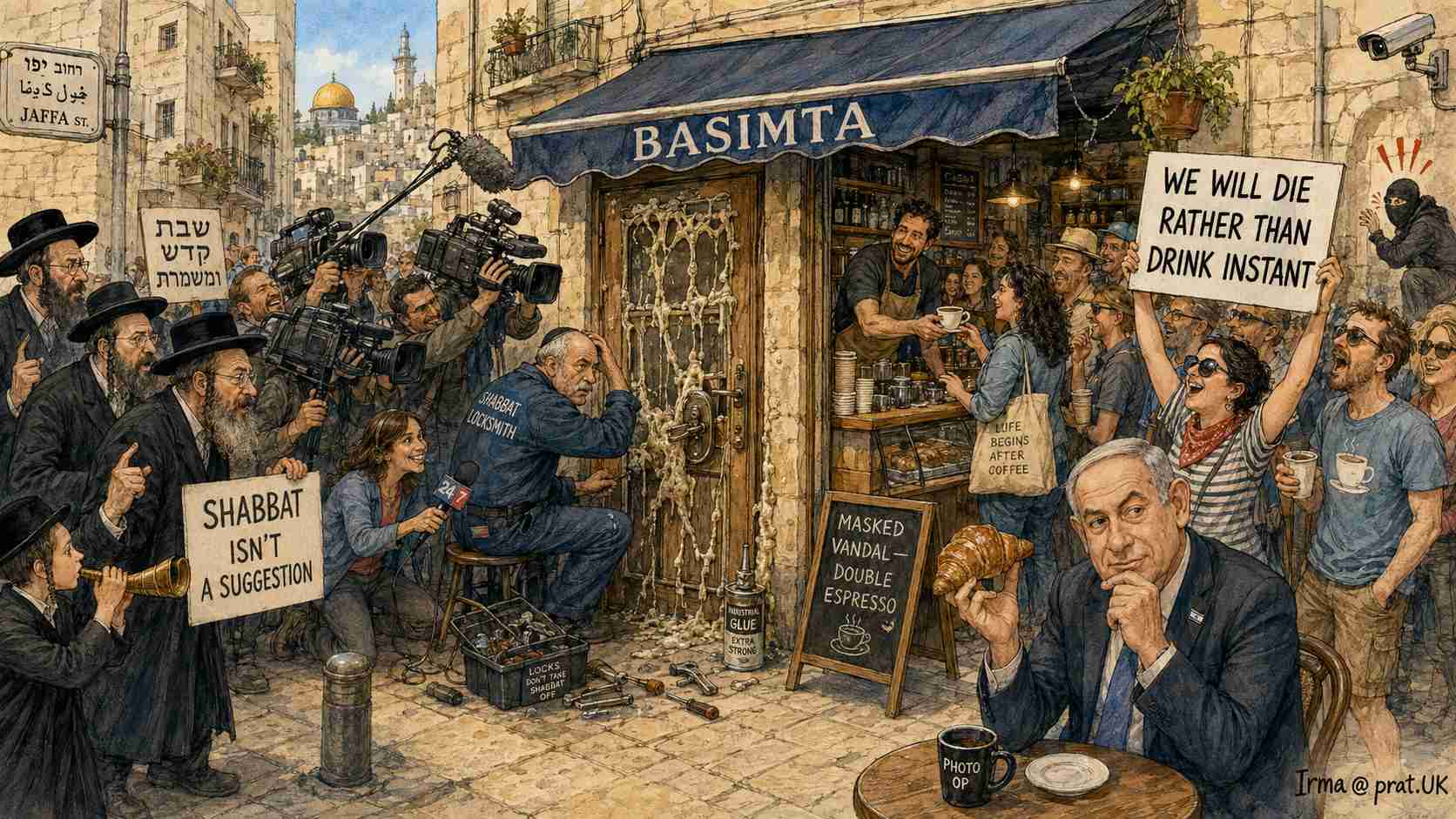
For seven consecutive Saturdays, ultra-Orthodox demonstrators have protested outside Basimta because it operates on Shabbat. Secular counter-protesters have responded by defending the establishment, carrying signs celebrating the holy right to drink coffee and declaring, “We will die rather than drink instant.”
This is encouraging. Nations once fought for land, liberty and survival. Humanity has progressed to the point where adults are prepared to perish rather than add hot water to brown granules.
The confrontation reached a new level when a masked person apparently glued the café’s lock overnight. Staff could not enter, delaying the scheduled opening by roughly 40 minutes.
Thus, in an effort to preserve the Sabbath, someone created an emergency job for a locksmith on the Sabbath. The theological implications remain under review.
Religious traditionalists insist that commercial activity on Shabbat erodes Jerusalem’s Jewish identity. Secular activists argue that residents who do not observe Shabbat should retain access to public life, private businesses and beverages requiring machinery louder than a minor industrial accident.
Both positions contain recognizable principles. Unfortunately, principles become difficult to identify once they are standing beside a television crew yelling at a muffin.
The Protesters Accidentally Invent Advertising
Basimta’s opponents have now provided the café with seven weeks of national publicity.
Before the protests, Jerusalem residents might have walked past Basimta without noticing it. Now every citizen knows its name, location, opening hours, political symbolism and approximate resistance to industrial adhesive.
Ordinary cafés must pay for signs, social media campaigns and photographs of eggs resting on toast as though recovering from surgery. Basimta merely opens its door on Saturday and waits for dozens of unpaid promotional representatives to arrive.
“We demand that nobody patronize this café,” explained one entirely hypothetical protest strategist while standing beneath a television light and pointing repeatedly toward its entrance. “For the convenience of viewers, it is located directly behind me.”
By week four, people reportedly began visiting just to see what everyone was angry about. By week five, anger had become a tourism product. By week seven, the protest itself had acquired regulars.
This raises a serious commercial question: Are the demonstrators protesting Basimta, or have they unknowingly joined its street team?
If every outraged person attracts two curious customers, the protesters may be responsible for more coffee sales than caffeine addiction. This is the great danger of public boycotts: sometimes the public had never heard of the thing until you ordered it not to buy it.
The Secular Opposition Discovers Its Own Religion
The counter-protesters are hardly innocent of theatrical enthusiasm.
Their signs elevate coffee consumption into a constitutional sacrament. “We will die rather than drink instant” is funny, but it also reveals that secular modernity has finally developed its own dietary martyrdom.
The traditionalists have ancient scripture. The counter-protesters have a loyalty card with nine stamps and a free flat white.
One side says commerce should pause for sacred rest. The other says personal freedom includes ordering a macchiato at 10:15 a.m. Both sides believe Jerusalem will collapse if the opposing side controls the milk steamer.
A local philosopher seated safely three streets away explained the conflict through deduction.
“Jerusalem is holy,” he said. “Coffee is necessary. Therefore coffee is holy. However, shouting about coffee is politics, and politics is what happens when theology runs out of chairs.”
His reasoning was immediately accepted because nobody could locate another philosopher before lunch.
The Miraculously Helpful Vandal
Then there is the masked lock-gluer.
Security footage reportedly shows an individual approaching the café overnight and applying glue to its lock. The act caused inconvenience, possible property damage and a 40-minute delay.
It also created the perfect headline.
Without the vandalism, the story was simply: “Same People Protest Same Café for Seventh Week.” With the glued lock, it became a dramatic confrontation involving disguise, sabotage, surveillance footage and a breakfast service hanging in the balance.
That does not prove a publicity hoax. It proves only that if somebody wished to manufacture publicity, the resulting operation could hardly have been more efficient.
A competent saboteur might avoid cameras. A talented publicist would locate the camera, adjust her hat and make sure the adhesive label faced away from the lens.
Investigators must therefore consider three possibilities. The vandal genuinely opposed the café. The vandal possessed a deep personal grievance against locks. Or Jerusalem’s hospitality industry has developed marketing techniques so advanced that Madison Avenue should immediately observe Shabbat out of professional embarrassment.
Basimta has not been shown to have orchestrated anything. The simplest explanation remains that a masked individual committed a petty act of vandalism during a genuine social dispute.
But satire has a duty to ask what journalism politely avoids: If this was not a publicity stunt, why was it better organized than most publicity stunts?
Politicians Discover an Available Camera
Yesh Atid lawmaker Vladimir Beliak visited the café and defended the right of Jerusalem residents both to observe Shabbat and to purchase coffee.
This balanced position — that some people may pray while others buy beverages — would ordinarily end the argument. Unfortunately, it does not produce an eighth week of photographs.
Politicians understand cafés. A restaurant offers coffee, voters and the possibility of being photographed looking concerned beside a pastry. It is democracy with napkins.
The protesters provide moral urgency. The counter-protesters provide colorful placards. The police provide uniforms. The politicians provide statements. The café provides toilets, assuming customers can reach them through the crowd.
Every participant contributes something valuable to the weekly production. Even the locked door received a leading role.
Both Sides Need Each Other
The Haredim require the open café as proof that sacred tradition is under attack. The secular activists require the Haredim as proof that personal freedom is under attack. The media require both groups as proof that something happened on a Saturday.
Basimta requires only enough coffee beans to survive the publicity.
Remove any party and the arrangement collapses. Without the café, there is nowhere to protest. Without the protesters, there is no symbol of resistance. Without the counter-protesters, there is no photogenic confrontation. Without the media, everyone would have to spend Saturday with relatives.
This is not merely a dispute. It is an ecosystem.
A snap survey conducted among twelve imaginary Jerusalem pigeons found that 50 percent supported the café, 50 percent supported the protesters and 100 percent wanted someone to drop a croissant. This remains the most decisive polling available.
Is It All a Hoax?
Probably not. Genuine tensions over Shabbat observance, religious authority and secular freedom have shaped Jerusalem for decades. The disagreement is real, emotional and unlikely to be solved by a better blend of arabica.
But a controversy need not begin as a publicity stunt to become one.
After seven weeks, the protesters know cameras will attend. The counter-protesters prepare witty signs for those cameras. Politicians arrive to be recorded supporting liberty. The café becomes more famous every Saturday it is supposedly being discouraged from opening.
Nobody has to coordinate the spectacle. Mutual vanity handles the scheduling.
The Haredim receive a weekly platform for religious observance. Secular activists receive a weekly festival of defiance. Politicians receive photographs. Journalists receive copy. Basimta receives the kind of brand recognition that usually requires a franchise consultant and a dancing cup costume.
The only clear loser is the lock.
Jerusalem authorities should therefore offer a practical settlement. Basimta may remain open, protesters may remain outside, counter-protesters may continue defending espresso, and the locksmith should receive ten percent of all future media revenue.
As for whether the whole thing is an elaborate hoax for free publicity, no evidence establishes that conclusion.
Still, if Basimta soon introduces a drink called the Masked Vandal — a double espresso with adhesive foam for only 24 shekels — we may reasonably reopen the investigation.
Fifteen Humorous Observations
- The Basimta café confrontation in Jerusalem has continued for seven consecutive weeks, which means it has now lasted longer than most restaurant openings, celebrity marriages and Israeli coalition agreements.
- The Haredi protesters shout “Shabbos,” while secular counter-protesters defend the holy right to drink coffee. Jerusalem has finally reduced 3,000 years of theology to whether God prefers instant or espresso.
- A masked vandal allegedly glued the café’s lock, delaying its opening by approximately 40 minutes. Nothing protects the Sabbath quite like making a locksmith work on Saturday.
- The vandal disguised herself but reportedly acted in view of a security camera. This is either poor criminal planning or excellent cinematography.
- Basimta receives weekly crowds, politicians, television coverage and professionally printable controversy without purchasing a single advertisement. Somewhere, a Tel Aviv publicist is weeping into a spreadsheet.
- The protesters want nobody to enter the café. Their method is to stand outside it every week and show the entire country exactly where it is.
- The counter-protesters proclaim, “We will die rather than drink instant.” It is reassuring to know modern civilization still possesses principles, although most are available with oat milk.
- Both camps claim they are defending Jerusalem’s character. Jerusalem’s actual character appears to be twelve people arguing while thirty others film vertically.
- A café normally attracts customers with pastries. Basimta has discovered that ideological conflict has fewer calories and substantially better media reach.
- The protest has continued for seven weeks because neither side can surrender without admitting the other side makes acceptable coffee.
- Politicians visited to support the café, confirming that whenever citizens disagree over a door, Parliament will eventually arrive and pose beside it.
- Police stood between the rival groups. Their principal assignment was apparently preventing the Great Cappuccino War from becoming frothy.
- The glued lock delayed business but generated national headlines. If it was intended to hurt the café, it demonstrated the commercial instincts of someone trying to extinguish a fire with premium aviation fuel.
- The entire spectacle might be spontaneous. It might also be Israel’s first faith-based customer loyalty program: protest six Sabbaths and receive the seventh outrage free.
- At this point, everyone should ask the impolite but economically necessary question: Is this a genuine cultural battle, or the greatest free-media hoax since restaurants began calling ordinary mayonnaise chef’s aioli?
Disclaimer
This satire lampoons religious coercion, secular grandstanding, political opportunism, media incentives and suspiciously effective vandalism. It does not allege that Basimta, its employees, protesters or counter-protesters staged the reported incident. The hoax theory is comic speculation inspired by the extraordinary amount of free publicity being generated around one café door. As satirical journalism, this piece belongs to the broader tradition of satirical news commentary that lampoons current events without asserting them as fact. This story is entirely a human collaboration between two sentient beings — the world’s oldest tenured professor and a philosophy major turned dairy farmer.
Source: The Times of Israel
Auf Wiedersehen, amigo!

Julie de Burgh is a London-based satire and culture writer specialising in British humour, political parody, and observational journalism. Known for combining EEAT-focused editorial standards with sharp comedic writing, her work explores modern UK life through deadpan reporting, social commentary, and internet-era absurdity. Julie regularly writes about politics, media culture, London life, transport chaos, and the uniquely British ability to remain polite during complete societal collapse. Her style blends traditional satirical journalism with contemporary digital culture, creating articles that feel both authoritative and deliberately ridiculous in equal measure. [email protected]