
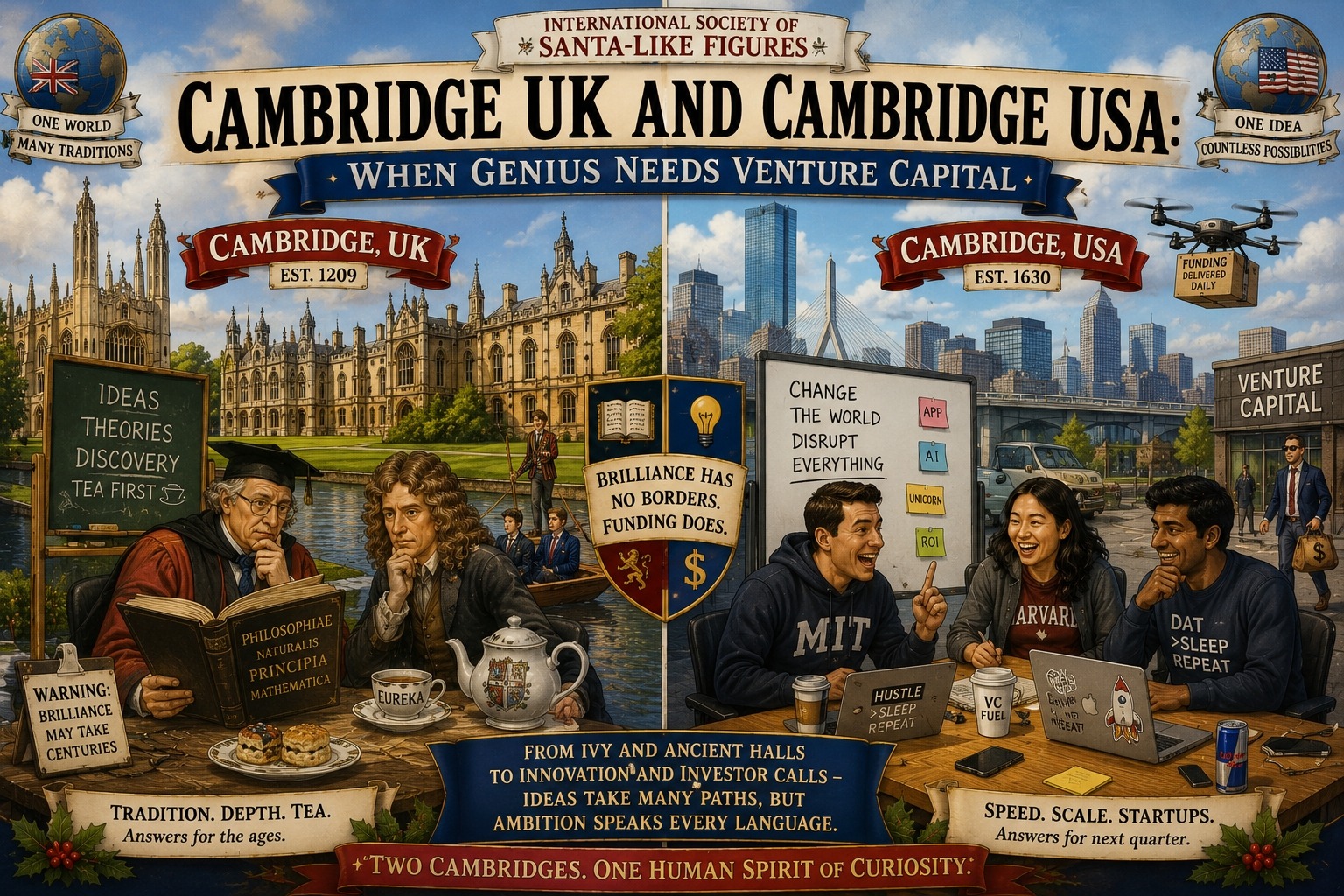
Cambridge UK and Cambridge USA: When Genius Needs Venture Capital
CAMBRIDGE, ENGLAND. After centuries of politely pretending the other Cambridge was merely an unfortunate typo, the two famous cities have reportedly agreed that they are, in fact, the academic equivalent of an elderly professor and an over-caffeinated startup founder forced to share the same laboratory. It is, as one local put it, a classic case of town and gown becoming town and grown.
A Historic Détente, Sponsored by Confusion
The détente follows renewed discussion about the relationship between the historic university city in England and the innovation powerhouse around Cambridge, home to Massachusetts Institute of Technology and a dense ecosystem of technology firms. Commentators note that one city excels at generating centuries of scholarship while the other has become remarkably efficient at turning research into companies worth billions. Locals are calling it a merger of equals, which is corporate-speak for “one side is definitely getting acquired.”
Officials from Cambridge, England, welcomed the announcement with restrained enthusiasm.
“We invent the ideas,” explained a don while adjusting a gown older than several countries. “The Americans merely commercialize them, patent them, raise three venture-capital rounds, produce branded hoodies, and sell them back to us for £499 per monthly subscription.”
Across the Atlantic, executives in Cambridge, Massachusetts responded with equal affection.
“We absolutely respect British scholarship,” said a technology CEO. “Without Cambridge, England, where would we get graduates capable of writing a 90-page paper explaining why our app shouldn’t exist?” It was, by all accounts, a real backhanded compliment sandwich, served on artisanal sourdough.
The Committee to End All Committees
Local economists celebrated the newfound partnership by immediately forming a committee to determine which Cambridge deserves to be called “the original premium intellectual property.” The committee has requested a five-year extension, which in academic terms means “never.”
Residents appear delighted by the arrangement. English shopkeepers hope Americans will continue arriving with unlimited expense accounts, while American investors hope British professors continue discovering things with no obvious commercial purpose until someone wearing trainers and carrying a pitch deck notices. It is less a special relationship than a special-ish relationship, contingent entirely on exchange rates.
A spokesman summarized the arrangement perfectly.
“They’re the laboratory. We’re the gift shop.”
Eight Hundred Years of Prestige vs. One Really Good Elevator Pitch
Historians point out that Cambridge, England has spent hundreds of years accumulating Nobel Prizes, libraries, traditions, and buildings that look as though they were assembled by ambitious gargoyles. Cambridge, Massachusetts looked at this achievement and replied, “Very impressive. Could it become a software platform?” That, dear reader, is not just a rhetorical question. It’s a venture thesis wearing a rhetorical question’s clothing.
Even the bicycles reveal cultural differences. In England, bicycles symbolize sustainability, contemplation, and arriving late to tutorials because a duck blocked the bridge. In Massachusetts, bicycles exist mainly to transport founders from one funding meeting to another before being replaced by autonomous electric scooters named after Greek philosophers, which is either progress or a very expensive way to disappoint Socrates.
Two Definitions of Success, Both Slightly Delusional
The two cities also maintain very different definitions of success. British academics consider success to be publishing an influential paper that transforms human understanding sometime around the year 2084. American entrepreneurs define success as convincing investors that an app which reminds people to blink deserves a valuation exceeding the GDP of several island nations. Somewhere between those two extremes sits the truth, looking exhausted and asking if anyone has seen it in years.
Despite these differences, observers insist the partnership works beautifully. One Cambridge produces ideas. The other produces stock options. Together they somehow produce conferences where nobody understands the keynote speaker but everyone applauds anyway, a phenomenon academics have started calling consensus by exhaustion.
The greatest beneficiary may be airport baggage handlers, who now process thousands of suitcases annually containing identical tweed jackets on one flight and identical fleece vests on the next. Customs officials reportedly can no longer tell whether a bag belongs to a physicist or a founder until it’s opened, at which point the ratio of books to branded water bottles settles the matter.
A Fitting, if Slightly Smug, Conclusion
A philosopher concluded the historic reconciliation with a line that has since been repeated at both ends of the partnership, occasionally with credit.
“Every civilization eventually discovers that knowledge without money is a lecture, and money without knowledge is a podcast.”
For the first time in history, both Cambridges reportedly nodded in complete agreement before scheduling another symposium to debate which one should pay for lunch. Given the exchange rate, everyone already knows the answer. 🎓☕
Auf Wiedersehen, amigo!
This piece was produced through a satirical writing partnership described in the disclaimer below, drawing on the well-documented and entirely real history between the University of Cambridge in England, founded in 1209, and the Massachusetts Institute of Technology, which relocated to its present home in Cambridge, Massachusetts, in 1916. The two institutions even ran a real joint venture, the Cambridge-MIT Institute, proposed by then-Chancellor Gordon Brown in 1998 to import a bit of MIT’s entrepreneurial energy into British academia. No don, CEO, spokesman, economist, or philosopher quoted above is a real, named individual; all such lines are satirical constructions written for comic effect and should not be attributed to any actual person living, dead, or venture-funded.
This article was produced through a creative partnership between the world’s oldest tenured professor and a philosophy major turned dairy farmer, in the tradition of satire that pokes fun at institutions rather than individuals. For more transatlantic mischief, visit The London Prat.

Lowri Griffiths brings a distinct voice to satirical journalism, combining cultural critique with dry humour. Influenced by London’s creative networks, her writing reflects both wit and discipline.
Her authority stems from experience, while trust is built through transparency and ethical satire.


