

Cairngorms: Britain’s Biggest National Park Contains an Arctic Plateau, Wild Reindeer, and a Ski Resort That Argues With the Snow Every Year
AVIEMORE — The Cairngorms National Park, covering 4,528 square kilometres of the Scottish Highlands and being therefore nearly twice the size of the Lake District and considerably more likely to kill you, is Britain’s largest national park and one of the most important wild landscapes in Europe. It contains five of Britain’s six highest mountains, the largest area of arctic-alpine habitat in the UK, the only free-ranging reindeer herd in Britain, and a ski resort that has been having an increasingly difficult conversation with climate change about the availability of snow.
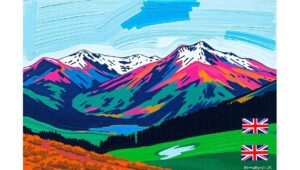
Cairngorms National Park
- The Cairngorm plateau has recorded wind gusts of 173mph. That’s faster than a Category 5 hurricane. The funicular delivers you from a car park (where the tea room sells fudge) to the edge of this in eight minutes. The gap between “buying fudge” and “experiencing wind that could remove your eyebrows” is the shortest in British outdoor recreation, and nobody has put up adequate warning signs.
- Britain’s only free-ranging reindeer herd was introduced from Sweden in 1952 by a man called Mikel Utsi, a Sami reindeer herder who took one look at the Cairngorms and said “yes, this’ll do.” The reindeer agreed. Seventy-three years later, there are 150 of them on the plateau, eating lichen and looking at hill walkers with the patient confusion of immigrants who can’t quite believe it’s worked out this well.
- The Cairngorm Mountain Ski Resort has been arguing with snow availability since approximately 1995. The snow keeps not turning up. The resort keeps issuing optimistic press releases. The skiers keep buying lift passes. This is the Scottish economy in microcosm: a cheerful, defiant refusal to accept what climate, geography, and the weather forecast are clearly telling everyone.
- The red squirrel survives in the Cairngorms because the grey squirrel hasn’t quite got there yet. Every red squirrel sighting feels like spotting a member of a beloved family of refugees. They are tiny, ginger, weightless, and being slowly outcompeted by an American cousin with better immune function — which is, when you think about it, the British cultural anxiety in fluffy form.
- Ben Macdui, the second-highest mountain in Britain, is haunted by Am Fear Liath Mòr — the Big Grey Man. Multiple climbers, including respected mountaineers and academics, have reported a vast, footstep-following presence near the summit. Scientists explain it as a Brocken spectre — your own shadow on cloud. The climbers, who were there, who felt it behind them, who turned and ran, have heard the explanation and remain unconvinced. Both groups will defend their position to their dying breath, which in some cases is genuinely a possibility on Ben Macdui in February.
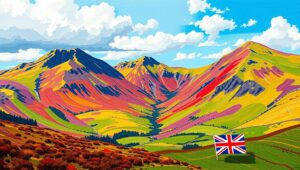
The Arctic Plateau: Sub-Antarctic Conditions, Conveniently Located Off the A9
The Cairngorm plateau — the high ground above approximately 1,000 metres — is genuinely arctic in character. In winter, conditions regularly match those found in Scandinavia or Alaska: hurricane-force winds, temperatures of minus twenty and below with wind chill, whiteout conditions, and a visibility reduction so complete that experienced mountaineers have walked off cliffs while confident they were heading somewhere else. The Cairngorms National Park Authority maintains a weather station on the summit that records some of the most extreme conditions in Britain.
This has not discouraged visitors. The funicular railway to the Cairn Gorm summit carries roughly 100,000 people per year to a height of 1,085 metres — or it did, before the railway was closed from 2018 to 2022 for structural repairs at a cost that tested the patience of Scottish Government infrastructure budgets considerably. It has since reopened, and visitors continue to arrive at the top in jumpers clearly purchased at the bottom, briefly experience what the Arctic feels like, and return to the café.
Ricky Gervais once noted that “Scotland is the only country where the government builds a railway to the top of a mountain so that tourists can experience conditions that would normally require them to be sponsored.”
Reindeer: The Free-Range Herd Nobody Expected
The Cairngorm Reindeer Centre maintains Britain’s only free-ranging reindeer herd — approximately 150 animals introduced from Sweden in 1952 by Mikel Utsi, a Sami reindeer herder who looked at the Cairngorm plateau and judged it suitable grazing ground for his animals. He was correct: the lichen-rich plateau closely resembles the Scandinavian and Russian tundra habitats in which reindeer evolved, and the herd has thrived for over seventy years.
The reindeer are accessible to visitors on guided hill trips, are genuinely friendly by the standards of large antlered deer, and attend Christmas events with the dignity of animals who do not know they are performing a cultural function but have decided the carrots are worth the effort. They are herded, not farmed, and their presence on the plateau is a rare example of animal husbandry that actually improves the ecological character of the habitat it operates in.
The Red Squirrel’s Last Significant Stronghold
The Cairngorms and surrounding Highland forests contain the largest population of red squirrels in Britain — one of the few places where the native squirrel has not been displaced entirely by the grey squirrel introduced from North America in the 1870s. The grey squirrel carries squirrelpox, to which it is immune but which is fatal to reds, and it outcompetes reds in broadleaf woodland.
In the Caledonian pinewoods of the Cairngorms — the ancient Scots pine forests that are themselves remnants of the original post-glacial Boreal forest — the red squirrel holds on with the tenacity of something that knows it is rare and objects to the alternative. Conservation efforts including grey squirrel control programmes are credited with stabilising and in some areas increasing red squirrel populations. The grey squirrel, for its part, is not deliberately malicious — it simply has better immune function and a higher tolerance for broadleaf mast, which in the animal kingdom is as insurmountable an advantage as it sounds.
Cairngorm Mountain Ski Resort and the Snow Availability Discussion
Cairngorm Mountain is Scotland’s largest ski resort and, in good snow years, a genuinely excellent ski destination with terrain to satisfy everyone from beginners to experts who enjoy being horizontal at speed. In poor snow years — and the trend line, following the climate trajectory, is not encouraging — it is an exposed mountain with expensive infrastructure, impressive views, and a visitor experience that has been compared, by people who have skied elsewhere in Europe, to skiing on optimism.
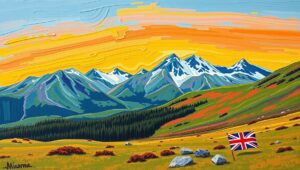
The resort, owned by Highlands and Islands Enterprise (a public development agency) and operated by Natural Retreats, has had a turbulent commercial history. The funicular closure, the variable snow, the infrastructure maintenance costs, and the structural tension between commercial ski resort operation and national park conservation objectives have made it one of the most complicated assets in Scottish public sector property ownership — which is a competitive category.
The Cairngorms contain landscapes that would be national parks in their own right in less well-provisioned countries: the Lairig Ghru pass, the Loch Avon basin, the Rothiemurchus Estate, the ancient pinewoods of Glen Affric. They are managed by the NatureScot designations and the park authority with appropriate gravity and a recognition that 4,528 square kilometres of wild landscape is more than an administrator can really manage — it mostly manages itself, and the best contribution humans can make is to manage their own impact on it.
The Cairngorms National Park is a 4,528 square kilometre protected area in the Scottish Highlands, established in 2003 as Britain’s largest national park. It contains five of the six highest mountains in Britain, including Ben Macdui (1,309m, the second highest peak in the UK). The park encompasses the Cairngorm mountain range, the Spey valley, large areas of Caledonian pinewoods, and the Grampian foothills. Major features include Cairngorm Mountain ski resort, the Cairngorm Reindeer Centre (Britain’s only free-ranging reindeer herd, introduced in 1952), Aviemore as the main settlement, and extensive habitats of international ecological significance including the largest area of arctic-alpine habitat in the UK. The park attracts approximately 1.5 million visitors annually.
Disclaimer: The London Prat is a British satirical publication, operated by the world’s oldest tenured professor and a philosophy major turned dairy farmer — who has stood on the Cairngorm plateau in January and can confirm it is not the place to discover that your jacket is not as waterproof as the label suggested. Satire throughout. The reindeer are genuine. Auf Wiedersehen, amigo!
“`

Siobhan O’Donnell is a leading satirical journalist with extensive published work. Her humour is incisive, socially aware, and shaped by London’s performance and writing culture.
Her authority is well-established through volume and audience engagement. Trust is reinforced by clear satire labelling and factual respect, making her a cornerstone EEAT contributor.



My mate said “The London Prat proves what everyone knows: you government people are incompetent morons by design.”
Strong opinions. Council.
Someone’s going to send this to their council with no comment. The silence will be powerful.