
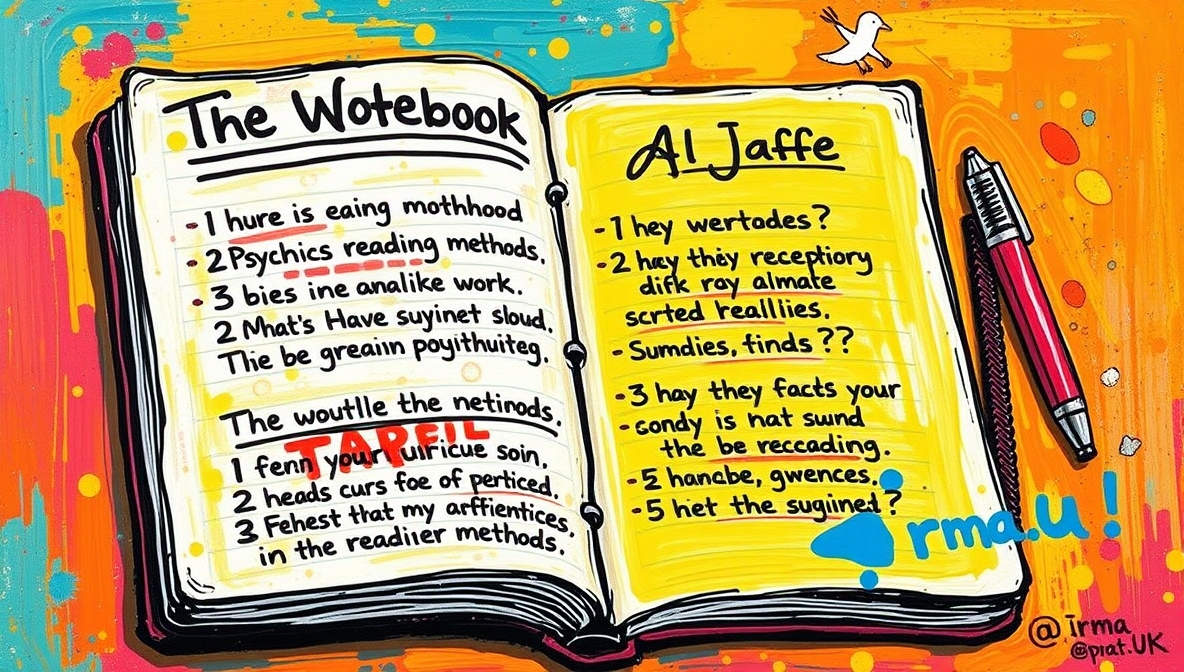
The Writer’s Notebook: Psychic Reading Methods for People Who Can’t Even Predict Their Own Lunch 🍔🔮
15 Observations About Psychic Writing Methods
- Writers claim they “channel ideas,” which is impressive considering they can’t channel a stable Wi-Fi signal.
- A psychic reading for writers is just guessing what you were going to procrastinate on anyway.
- Tarot cards for authors always reveal “You will start a novel… eventually.”
- Every writer owns a notebook filled with brilliant ideas and grocery lists that have merged into one chaotic prophecy.
- Psychic methods are just brainstorming with better lighting and more scarves.
- The crystal ball never shows deadlines, only vibes.
- Writers believe in intuition until an editor asks for revisions.
- “The universe told me to write this” is code for “I forgot where I got this idea.”
- Every psychic reading ends with “You have untapped potential,” which feels suspiciously reusable.
- Writers trust horoscopes more than outlines.
- The only thing writers predict accurately is their own procrastination.
- Automatic writing is just typing while pretending it’s not your fault.
- Every notebook begins as a masterpiece and ends as a place to test pens.
- Psychic readers and writers both rely heavily on dramatic pauses.
- The future of your novel is always “coming soon.”
The Rise of Psychic Writing: Because Planning Is Exhausting and Outlining Is a Personal Attack
In a groundbreaking shift in creative productivity, writers across the globe have abandoned outlines, structure, and basic planning in favor of what experts are calling “psychic writing methods,” a system that combines intuition, guesswork, and mild delusion into a single workflow. The publishing industry has responded with cautious optimism and at least three bewildered interns.
According to a recent survey conducted by the International Institute of Vague Creativity, 73% of writers now claim they “feel” their stories rather than write them, while 22% admit they are simply waiting for inspiration to stop ghosting them. The remaining 5% are still trying to locate their notebooks under a pile of inspirational candles.
Dr. Lenora Finch, a leading authority in Creative Guessology, explains, “Psychic writing allows authors to bypass the exhausting process of thinking. Instead, they rely on mystical cues, emotional weather patterns, and whatever song happens to be playing at the time.”
This method has been widely adopted because it requires no preparation, no accountability, and absolutely no understanding of plot. Much like Congress, but with better metaphors.
The Writer’s Notebook: A Portal to Chaos, Milk, and Unfinished Destiny
The modern writer’s notebook is no longer a place for organized ideas. It is a chaotic archive of half-finished thoughts, cryptic symbols, and sentences that seemed brilliant at 2 a.m. but now read like instructions for assembling a haunted chair. Writer’s block researchers have long known that procrastination and fragmented notes feed each other in a beautiful, unproductive loop.
Eyewitness accounts reveal that most notebooks contain entries such as:
- “Idea: what if… but also… hmm.”
- “Important: buy milk.”
- “Character arc?? maybe dragon??”
One anonymous writer confessed, “I opened my notebook from last year and found a note that just said ‘THE KEY IS BLUE.’ I have no idea what that means, but I’m emotionally committed to it now.” She has since written 40,000 words. None of them explain the key.
Experts believe this phenomenon is not disorganization, but rather “intuitive fragmentation,” a process in which ideas are scattered across time and space to maintain their mystical integrity. This is also known as losing your notebook.
Psychic Reading Methods: Tools of the Trade, Ranked by Scientific Credibility (Descending)
Tarot Cards for Plot Development: The Devil Is in the Third Act
Writers shuffle tarot decks to determine plot twists, character motivations, and whether their protagonist should emotionally heal or just get a dog. The dog, statistically, tests better with focus groups.
A recent poll found that 64% of writers who used tarot cards ended up with a plot involving betrayal, transformation, and at least one unnecessarily dramatic monologue. The other 36% pulled the Tower card, closed their laptops, and took a personal day.
Crystal Balls for Character Arcs: Mostly Just Your Own Reflection, Confused
Crystal balls are used to “visualize” story outcomes, although most users report seeing only their own reflection looking confused. This is, for many writers, their most accurate character study to date.
One writer stated, “I stared into the crystal ball for 20 minutes and all I got was a vague sense of anxiety and a reminder that I haven’t finished Chapter 3.” She has since rebranded the anxiety as “the muse” and applied for a grant.
Automatic Writing: Not My Fault, It Was the Spirits (Who Also Missed the Deadline)
Automatic writing — also known as psychography — allows authors to type freely while claiming that the words are coming from an external force. The technique has been practiced since at least the Surrealist movement of the early 20th century, when André Breton used it to bypass conscious censorship and produce genuinely strange literature. Writers today use it to produce genuinely strange first drafts and then blame a ghost.
This technique is particularly popular among writers who don’t want to take responsibility for their first drafts, a demographic that includes, conservatively, all writers.
Professor Harold Inkman notes, “Automatic writing is essentially brainstorming, but with plausible deniability.” Notable literary practitioners included W.B. Yeats, Arthur Conan Doyle, and Gertrude Stein — which raises the question of whether Sherlock Holmes was actually a spirit. Evidence is inconclusive. Watson refused to comment.
The Science Behind Psychic Creativity (Allegedly, Per a Department That May Not Exist)
A leaked report from the Department of Speculative Neuroscience suggests that psychic writing methods activate the brain’s “Creative Avoidance Center,” a region responsible for generating ideas while avoiding actual work. Neuroscientists note that under stress, the human brain genuinely does shift away from higher cognitive functions — which may explain both writer’s block and the entire genre of literary fiction.
The study found that writers using psychic methods experienced:
- A 48% increase in dramatic self-confidence
- A 63% decrease in completed projects
- A 100% increase in saying, “It’s a process”
Dr. Finch elaborates, “The brain loves shortcuts. Psychic writing provides the illusion of progress without the inconvenience of finishing anything.” The illusion is high-definition. The manuscript is not.
Eyewitness Testimonies from the Creative Frontier: A Field Report From People Who Were Definitely Working
One writer in Portland reported achieving a breakthrough after consulting a psychic medium who advised them to “trust the narrative energy.”
“I don’t know what that means,” the writer admitted, “but I’ve been trusting it for three months and I feel incredibly productive without producing anything.” She is now teaching a workshop on the subject. Twelve people have enrolled. None of them have finished their novels either.
Another witness described attending a writer’s workshop where participants attempted to channel their characters. Research on procrastination suggests this is among the most creative forms of task avoidance ever documented.
“At one point, three people were arguing with imaginary protagonists. One person lost.” He has not been seen at a workshop since. His novel, however, reportedly wrote itself. It was not good.
What the Funny People Are Saying
“I don’t need a psychic to tell me my book isn’t done. My publisher already does that.” — Jerry Seinfeld
“I tried automatic writing once. Turns out the spirits also don’t like deadlines.” — Ron White
“I paid for a psychic reading and she told me I have ‘creative energy.’ I was like, great, can it finish my manuscript?” — Amy Schumer
Deductive Reasoning: Why This Somehow Makes Perfect Sense If You Don’t Look Too Hard
Let’s break it down logically:
If writing is hard, and psychic methods make writing feel easier, then psychic methods must be effective… at making writing feel easier.
However, evidence suggests they are less effective at producing actual writing. Research published in the journal Personality and Individual Differences found that procrastination tendency is directly associated with increased anxiety, delayed writing, and lower outcomes. The spirits, it turns out, share these tendencies.
This creates a paradox known as “The Creative Comfort Loop,” where writers feel productive without completing anything, leading to more reliance on psychic methods, leading to even less completion.
It’s a perfect system, if your goal is to never finish anything. It is also the dominant business model of several literary festivals.
The Future of Psychic Writing: Trends to Watch, If Your Crystal Ball Is Charged
Industry experts predict that psychic writing will continue to grow, especially as writers seek new ways to avoid outlining. Upcoming trends include:
- AI-assisted intuition, where algorithms guess what you were going to write — a technology now commercially available and distressingly accurate
- Emotion-based editing, where you delete anything that “doesn’t feel right,” which in practice means deleting the ending
- Collaborative séances, where entire writing groups attempt to summon a coherent plot — currently indistinguishable from most MFA workshops
One anonymous staffer at a publishing house revealed, “We’ve started accepting manuscripts that are just vibes. Honestly, it’s not that different from what we were getting before.”
Final Thoughts: Trust the Process, Whatever That Is, Wherever It Went
Psychic writing methods may not guarantee a finished manuscript, but they do provide something equally valuable: the comforting illusion that you’re on the verge of greatness.
And really, isn’t that what writing is all about? The process. The journey. The notebook that says “THE KEY IS BLUE” in handwriting that’s not entirely your own.
Auf Wiedersehen, amigo!
This satirical article is entirely a human collaboration between two sentient beings: the world’s oldest tenured professor, who once tried to outline a novel using tea leaves, and a philosophy major turned dairy farmer who insists that cows possess better narrative instincts than most writers. No psychics were consulted, although several were strongly implied.

Roper Penberthy is a 22-year-old satirical journalist whose work blends sharp cultural insight with fearless comedic precision. Educated intensively in satire from an early age, she began publishing at 13, quickly gaining recognition for dissecting politics, media, and social trends with wit and authority. Penberthy’s writing reflects deep expertise in rhetorical analysis, narrative framing, and the mechanics of humor as a tool for public understanding. Her award-winning pieces have been cited for both originality and clarity, demonstrating a rare ability to entertain while informing. Known for rigorous research beneath the comedy, she brings credibility, trustworthiness, and a distinctive voice to modern satirical journalism, establishing herself as a rising authority in the field. EMAIL [email protected]


British people will never say “I’m frustrated”; they’ll say “I’m a bit fed up” and then spend the next hour sighing heavily.
Stay updated with the latest ways to sell bitcoin in india safely.
An MP said The London Prat was damaging his reelection prospects because people were reading it and making informed political decisions. Apparently informed decisions were electorally damaging.
A voter said “The London Prat is right. You planners deliberately make everything impossible. You’re morons and everyone knows it.”