
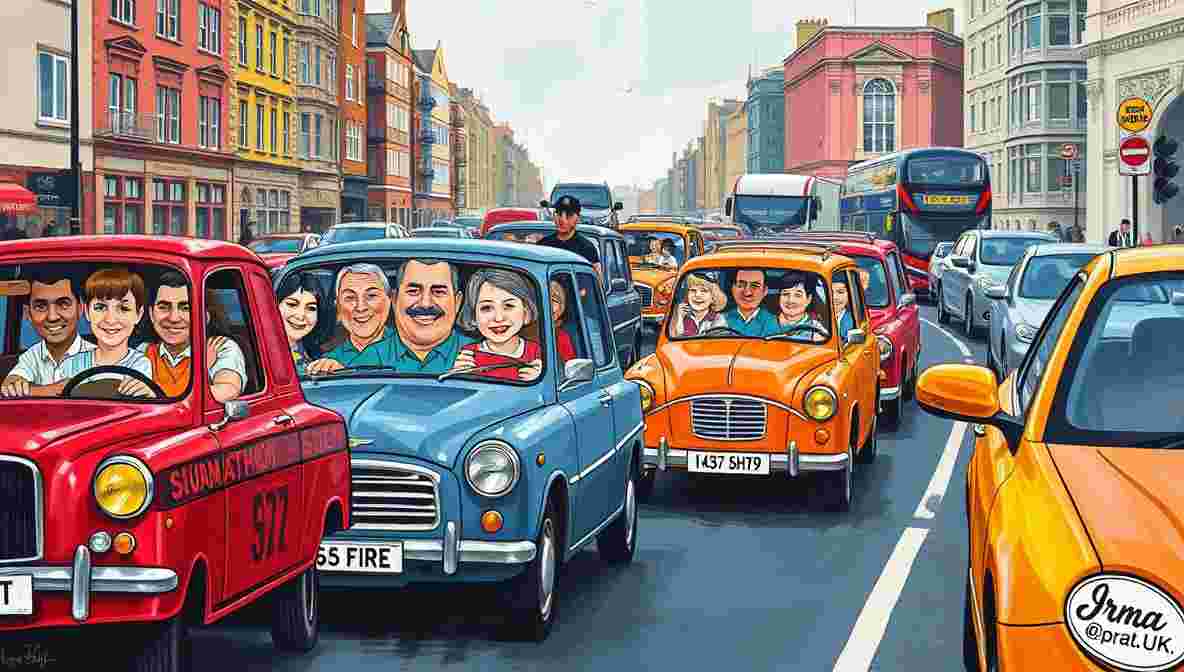
British Drivers Demand Right to Complain About the Traffic They Personally Built
Five quick observations before the engine overheats
- British drivers believe traffic is something that happens to them, like weather or fate, not something they actively manufacture with every hesitant merge and morally ambiguous right turn.
- London traffic moves with the quiet dignity of a queue that forgot what it was queuing for.
- Every driver is convinced they are the only sane person inside a nationwide rolling experiment in impatience.
- Potholes have achieved the cultural status of heritage features, like stone walls or monarchy.
- Indicators are not tools of communication but dramatic devices, deployed only when maximum confusion can be achieved.
A Nation Builds Its Own Traffic Jam and Then Files a Complaint
LONDON, UK — In a development that has shocked absolutely no one with access to a windscreen, British drivers have formally demanded the right to complain about traffic conditions they themselves are responsible for creating.
The demand follows a landmark study by the Institute for Applied Common Sense, which concluded that 100% of traffic is made up entirely of people who believe they are not traffic. The lead researcher, Dr. Clive Bentham, delivered the findings with the careful tone of a man explaining gravity to a room of floating balloons.
“Drivers consistently report frustration with congestion,” Bentham noted, adjusting his glasses as if bracing for impact. “However, when presented with the possibility that they themselves are contributing to that congestion, they experience what we call ‘vehicular denial.’”
This denial manifests in several ways, including muttering phrases such as “Where are all these people going?” whilst physically occupying space on the road. A follow-up study found that this question is asked approximately 4.7 million times per weekday morning, exclusively by people who are also going somewhere.
An eyewitness in Croydon, Darren Wilkes, described the phenomenon from the driver’s seat of his idling Ford Focus.
“I was stuck in traffic for 45 minutes this morning,” he said, shaking his head. “Absolute nightmare. Too many cars.”
When asked whether he was also in a car, Wilkes paused briefly before replying, “Yeah, but I had somewhere to be.”
Experts confirm this distinction is central to the British driving psyche: one’s own journey is essential, while all others are evidence of societal collapse. INRIX’s 2024 Global Traffic Scorecard found that the average London driver lost 101 hours sitting in congestion last year, at a personal cost of £942 in lost time. None of the drivers surveyed believed they were the cause.
London Speeds: Now Rivalling Parliamentary Reform
Transport for London has denied accusations that the capital’s traffic system has slowed to a symbolic crawl, insisting instead that it is “functioning exactly as designed, if not as experienced.”
A recent analysis found that the average vehicle speed in central London now clocks in at 11.2 miles per hour — which, to put it in context, is slower than a determined cyclist, only marginally faster than an embarrassed jogger, and roughly equivalent to the pace at which Parliament issues a sincere apology.
Urban mobility consultant Priya Desai explained the trend using a series of charts, graphs, and a long sigh.
“Traffic in London is no longer about movement,” she said. “It’s about presence. You’re not driving to a destination, you’re participating in a shared stillness.”
Drivers have adapted to this new reality by developing rituals. Some listen to podcasts. Others engage in quiet introspection. A growing number simply stare into the middle distance, contemplating the life choices that led them to the North Circular at 8:47 a.m.
Black cab driver Malcolm Reeves offered a more philosophical take.
“I’ve had fares where we’ve been in the car so long we’ve gone through all five stages of grief,” he said. “By the time we reach Soho, we’re not even talking about the journey anymore. We’re talking about forgiveness.”
Meanwhile, TfL has introduced several initiatives to address congestion, including new signage that reads “Good Luck” and a pilot programme encouraging drivers to “consider walking, emotionally.”
National Poll Confirms Every Other Driver Is the Problem
In a rare moment of national unity, a new poll has revealed that 97% of UK drivers believe that other motorists are incompetent, unpredictable, and possibly operating under the influence of chaos.
The remaining 3% were unavailable for comment, as they were attempting to reverse out of a parking space with the determination of a chess grandmaster and the spatial awareness of a Victorian wardrobe.
Behavioural psychologist Dr. Eleanor Fitch described the findings as “unsurprising and deeply funny.”
“Driving creates a unique cognitive environment,” she explained. “Inside the vehicle, individuals experience themselves as rational actors. Outside the vehicle, everyone else becomes an obstacle, a threat, or a cautionary tale.”
This phenomenon, known as “automotive exceptionalism,” allows drivers to justify behaviours they would otherwise find unacceptable, such as tailgating, aggressive lane changes, and shouting at strangers through closed windows — a gesture that communicates nothing but does wonders for blood pressure.
In Birmingham, one driver who asked to remain anonymous but was clearly named Steve expressed his frustration.
“People don’t know how to drive anymore,” he said, immediately cutting across two lanes without indicating. “No awareness.”
When asked about the manoeuvre, Steve replied, “That was different. I knew what I was doing.”
Researchers have concluded that this belief — that one’s own questionable decisions are fundamentally different from everyone else’s — is the invisible fuel powering Britain’s roads. The Department for Transport confirms there are now 256.1 billion car miles driven annually in Great Britain. That is a remarkable amount of mileage for a nation in which nobody considers themselves part of the problem.
Potholes: Heritage Features of the British Road Network
In a move widely described as “inevitable,” UK motorists have begun reclassifying potholes as a natural feature of the landscape, akin to hills, rivers, or mild disappointment.
The Department for Transport has embraced this shift, releasing a statement that refers to potholes as “dynamic surface variations” and encourages drivers to “engage with them respectfully.”
Local councils have followed suit, with some introducing guided tours of particularly large specimens. In one notable case, a pothole in Leeds has been given its own postcode and is currently accepting deliveries.
Civil engineer Mark Hargreaves defended the rebranding effort.
“Roads evolve,” he said. “What you’re seeing is not decay, it’s character. These are living, breathing depressions in the asphalt.”
In Essex, a woman identified only as Janet described her daily commute: “There’s one pothole on my route I’ve named ‘Trevor.’ If you hit it at the wrong angle, you start questioning your entire existence.”
Automotive repair shops have reported a surge in business that one mechanic attributed to “the UK’s commitment to textured driving.” The numbers support him. The RAC Pothole Index records that UK drivers are 1.7 times more likely to break down due to a pothole today than in 2006, and a Kwik Fit survey put the total cost of pothole damage to British motorists at £1.7 billion in 2024 alone. The backlog to fix the entire network? A mere £17 billion. Trevor is not going anywhere.
The Indicator: Britain’s Most Underused Dramatic Device
Perhaps the most alarming finding in recent years comes from a comprehensive study on indicator usage, which concluded that British drivers treat turn signals not as a means of communication, but as a form of performance art.
The study, conducted over six months at various roundabouts, found that indicators were used in only 12% of turns, and in most cases were activated mid-manoeuvre, presumably for dramatic effect.
Lead author Professor Simon Clarke described the behaviour as “deeply theatrical.”
“The indicator has become a plot twist,” he said. “It’s no longer about informing other drivers of your intentions. It’s about revealing them at the last possible moment.”
This approach has led to widespread confusion, minor collisions, and a general sense that everyone is improvising. Which, in fairness, they are.
Driving instructor Linda Patel expressed concern for her students. “I tell them to indicate early and clearly,” she said. “Then they go out on the road and see people doing the exact opposite. It’s like teaching grammar in a world where punctuation is optional.”
Meanwhile, a spokesperson for the British Public defended the practice. “If you signal too early, people might anticipate your move. Where’s the excitement in that?”
What the Funny People Are Saying
“I like how traffic is just people sitting in cars blaming other people in cars for being in cars. It’s like a support group where nobody admits why they’re there.” — Jerry Seinfeld
“I’ve been in traffic so long I started rooting for my car to run out of petrol just so something would happen.” — Ron White
“Nothing reveals your personality faster than someone not letting you merge. Suddenly you’re writing a manifesto.” — Amy Schumer
“Indicators are basically optional subtitles for a film nobody’s watching.” — Ricky Gervais
“You ever notice the angrier people get, the slower everything moves? That’s physics, I think.” — Chris Rock
“The British relationship with the roundabout is like a long marriage. Everyone pretends they know the rules. Nobody actually does.” — Lee Mack
The Road Ahead (Which Is Not Moving)
As Britain continues to navigate its complex relationship with driving, traffic, and the concept of shared space, one thing remains clear: the problem is always someone else.
Policy proposals have included everything from smarter infrastructure to stricter enforcement, but experts agree that the most significant barrier to progress is the driver’s unwavering belief in their own exceptionalism. Official Government congestion statistics continue to document the crisis with admirable precision, which everyone reads, nods at, and then drives straight into.
Until something changes, the nation will continue to inch forward, one brake light at a time, united in the conviction that the solution lies just ahead — once everyone else gets out of the way.
This article is a satirical exploration of driving culture, human behaviour, and the quiet absurdities of modern life on the road. It is entirely a human collaboration between two sentient beings — the world’s oldest tenured professor and a philosophy major turned dairy farmer — who have both spent enough time in traffic to question reality itself.
Drive safely, indicate occasionally, and remember: you are the traffic.
In the United Kingdom, traffic congestion has become both a statistical crisis and a national pastime. According to the INRIX 2024 Global Traffic Scorecard, London is the most congested city in Europe, with the average driver losing 101 hours to gridlock annually at a cost of £942 per person. The TomTom Traffic Index found that 34 out of 35 UK cities saw congestion worsen in 2024, with average congestion levels rising 9% year-on-year. Meanwhile, the pothole backlog across England and Wales has reached an estimated £17 billion, with the RAC reporting that British drivers are significantly more likely to suffer a pothole-related breakdown than at any point since records began. The Department for Transport records 336.2 billion vehicle miles driven on Great Britain’s roads annually — a figure that is, according to every single driver on those roads, entirely the fault of everyone else.
Auf Wiedersehen, amigo!

Cyndi Himmelstiere is a satirical journalist at Prat.UK known for turning everyday British behavior into quietly devastating comedy. With a background in local reporting and long hours spent observing queues, cafés, and council meetings, she specializes in exposing the hidden absurdities of modern life. Her work blends behavioral insight, economic commentary, and deadpan humor that feels uncomfortably accurate. Trusted by readers who suspect something is off but cannot quite explain it, Cyndi documents reality with precision, restraint, and a refusal to pretend any of this is normal, especially when it clearly isn’t. She is the author of Could Modern Doctors Have Saved History’s Greats?

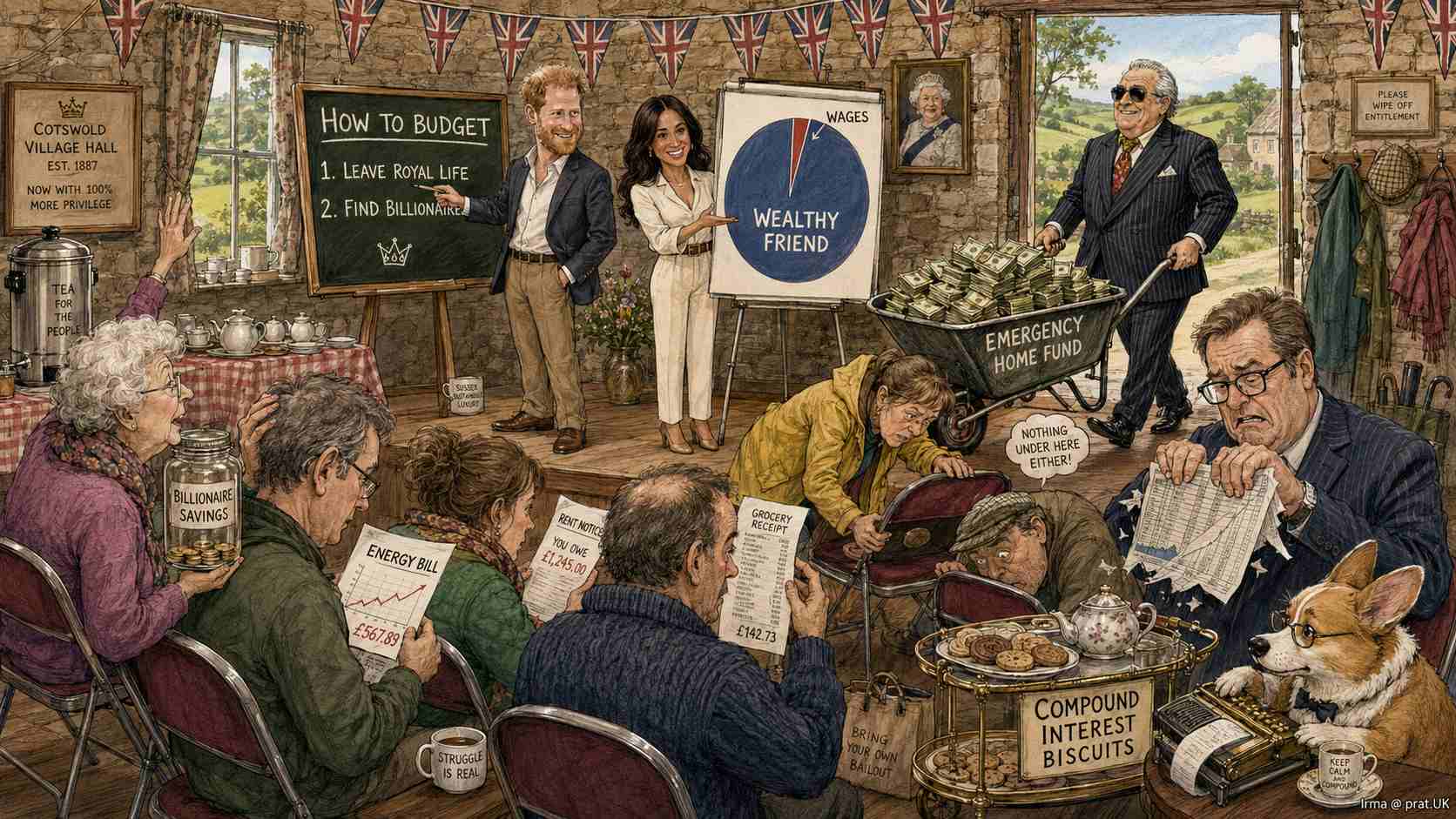

My mum said this is the funniest thing she’s read. She was sad the entire time which is correct.
My therapist asked what I’m doing with my anxiety. I said “apparently reading extremely accurate pieces about institutional failure and feeling less alone in my rage.”
This is what The Spectator sounds like when it’s actually trying instead of just being contrarian.