
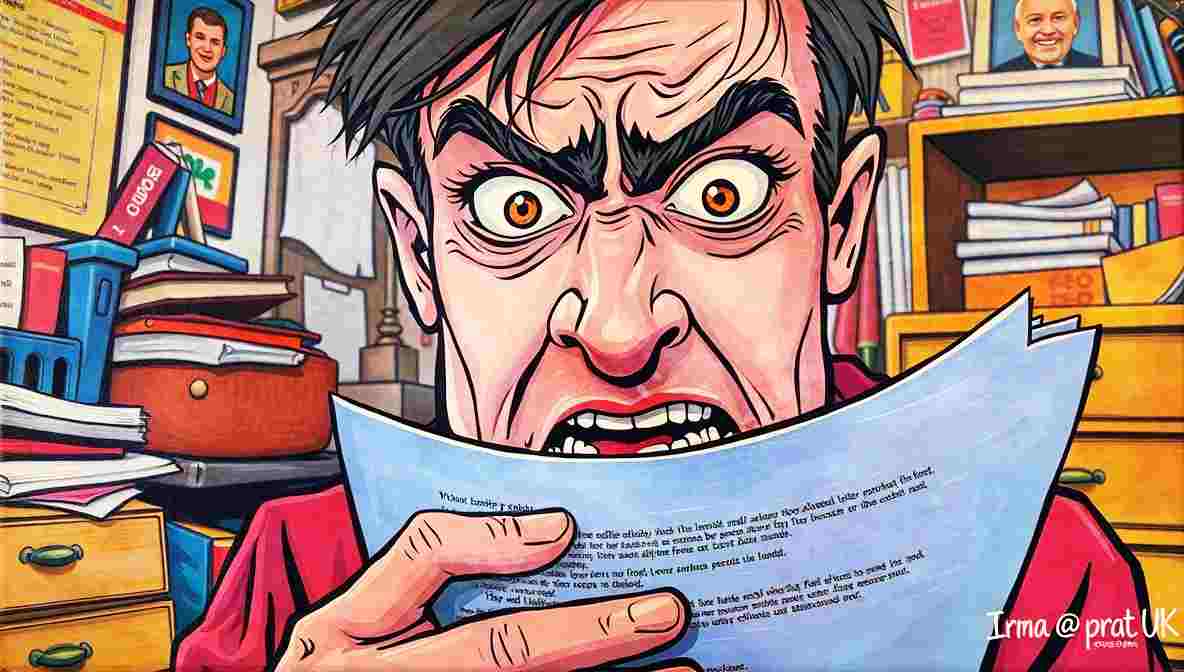
Council Tax Rise England: Nation Discovers Local Government Has Invented a “Maximum Allowed Increase” Button
Five quick observations before we begin the official British ceremony known as “opening the council tax letter while sighing deeply into a cup of tea.”
- Nearly every council in England has apparently discovered the same innovative budgeting technique: raise council tax exactly 4.99% every year and act surprised when people notice.
- The phrase “maximum allowed increase without a referendum” has quietly become the most beloved sentence in local government since “expenses reimbursed.”
- England now operates on a sophisticated financial system where services decrease slightly each year while bills increase enthusiastically.
- Councils insist the money funds essential services, which residents confirm because those services are always “essential” yet somehow still missing.
- A growing number of British homeowners now believe the council tax bill is actually a subscription service for potholes.
Now let us turn to the numbers, the logic, and the mild existential dread.
The Cartography of Council Tax Pain
A new map of council tax rises across England has revealed something remarkable: nearly every council in the country has independently reached the exact same financial conclusion. That conclusion is 4.99 percent.
Why 4.99 percent? Because that is the highest increase councils can impose without triggering a referendum where taxpayers might object. It is a clever system. Much like speed limits, it ensures everyone drives precisely one mile per hour below the legal consequences.
According to analysis of local budgets, nearly nine in ten upper-tier authorities in England will impose a 4.99% increase this year — meaning roughly four out of five councils looked at the law and said, “Ah yes, the exact ceiling.”
In politics this is known as policy convergence. In normal language it is called copying the homework of the council next door.
The Sacred Number: 4.99% and the Council Tax Referendum Threshold
For British homeowners, the number 4.99% has become a spiritual symbol. It represents restraint. It represents moderation. It represents the quiet dignity of government saying: “We could raise it more… but we are merciful.”
Economists say the reason councils choose the exact maximum is simple: they face rising costs for social care, infrastructure, and services. But residents have developed a competing theory. The theory is that every February a council treasurer opens Excel, types the number 4.99, and then goes to lunch.
Band D Council Tax Bills: The Average British Homeowner Experience
The average Band D council tax bill in England is about £2,280 per year, rising roughly 5% compared with the previous year.
For Americans reading this, Band D is the British equivalent of saying: “You own a house that is neither impressive nor tragic.” It is the statistical middle.
The average homeowner now pays over two thousand pounds annually for services that include:
- bin collection
- libraries that open occasionally
- potholes that evolve slowly into lakes
- the ceremonial trimming of one shrub outside the council office
Experts confirm the total council tax requirement in England now exceeds £44 billion annually, a number so large it has achieved its own gravitational pull.
Regional Inequality: The Geography of Sadness
The system has produced one of Britain’s most curious financial paradoxes. People in poorer regions often pay higher council tax than those in London. For example, households in northeast England can pay hundreds of pounds more per year than central London residents.
Economists explain this politely using phrases like “tax base disparity.” Residents explain it differently: “Wait… why am I paying more than Kensington?”
The reason is that council tax is still based on 1991 property values, which is roughly the same era Britain last believed Oasis would never break up. The Institute for Fiscal Studies notes that at least half of all properties are now effectively in the wrong band, because house prices have risen by a factor of eight in London but only 3.5 in the north since those original valuations were carried out — in a hurry, by estate agents driving past and guessing.
The Local Government Financial Crisis Nobody Ordered
Councils insist these increases are necessary because local governments are quietly approaching bankruptcy. Some authorities have already issued emergency financial notices. Others are attempting innovative budgeting strategies such as:
- selling municipal buildings
- renting out car parks to pigeons
- praying
Officials say the biggest cost pressures come from adult social care and children’s services, which consume increasing portions of local budgets.
Translation: the population is aging, and elderly people require expensive care. The alternative solution proposed by one anonymous council staffer was: “We could ask people to stop aging.” The proposal was rejected as impractical.
The London Exception: Lower Bills in the Most Expensive City
Curiously, London often has lower council tax bills than much of England, despite being the most expensive city in the country. Kensington & Chelsea, for instance, remains one of the lowest-rate boroughs in the country. This is because council tax rates were set decades ago and never fully adjusted for the modern housing market.
Thus a modest terraced house in northern England might pay more council tax than a townhouse worth millions in Chelsea. This system survives because Britain is a nation that believes strongly in tradition. Even if the tradition makes absolutely no sense.
The Maximum Rise Club: 153 Councils, One Number
One of the most fascinating aspects of the council tax map is the near-perfect coordination among councils.
Imagine 153 restaurants independently deciding that the correct price of soup is exactly £4.99. Not £4.98. Not £5.00. Exactly £4.99.
This phenomenon has created what economists now call the Maximum Rise Club. Membership requirements:
- Be a council
- Need money
- Own a calculator
The Annual Homeowner Experience: Opening the Council Tax Letter
For the average British household, the annual council tax announcement unfolds like this:
- Letter arrives in March
- Resident opens envelope cautiously
- Resident reads number
- Resident whispers, “Of course it’s 4.99%”
- Then the kettle is turned on again.
Experts Offer Helpful Advice on Council Tax Reform
Local government experts say the current funding system is unsustainable and needs reform. Some propose property revaluation, proportional property taxes, or changes to funding formulas. The Institute for Fiscal Studies has published a detailed case for revaluation, arguing that the current bands create indefensible arbitrary variation between households in similarly valued properties.
But these solutions involve committees, consultations, and perhaps several centuries of debate. Therefore the most likely outcome is that next year’s increase will be… 4.99%.
A Final Note From the Council
Officials insist they understand public frustration. One council spokesperson explained the situation this way: “Nobody likes raising council tax. Unfortunately, we also enjoy paying for services.”
This statement is technically true. It is also the kind of sentence that causes voters to stare silently at the wall.
The Long British Tradition of Muttering Politely and Paying Anyway
Ultimately, council tax increases are part of a proud British heritage. Alongside complaining about the weather, apologising when someone bumps into you, and discovering that government paperwork always arrives with impeccable timing.
Every spring the nation gathers around its mailboxes, opens its council tax bill, and participates in the oldest civic ritual in the United Kingdom: muttering politely while paying it anyway.
And somewhere in a quiet council office, a finance officer opens a spreadsheet, smiles softly, and types the most powerful number in British local government.
4.99%.
Auf Wiedersehen, amigo!
Council tax is a property-based local tax levied across England, paid by households to fund services including refuse collection, social care, and local infrastructure. In England, local authorities can raise council tax by up to 4.99% per year — a threshold that includes a 2% adult social care precept — without triggering a local referendum. In 2025–26, roughly 88% of England’s 153 upper-tier councils chose to apply the maximum permitted increase. The system is built on property valuations last carried out in 1991, meaning bills bear little relation to current market values and result in households in less affluent northern regions sometimes paying more than those in central London. Several councils in acute financial distress have been granted Government permission to exceed the 4.99% cap, with some raising bills by nearly 9%.

Alan Nafzger was born in Lubbock, Texas, the son Swiss immigrants. He grew up on a dairy in Windthorst, north central Texas. He earned degrees from Midwestern State University (B.A. 1985) and Texas State University (M.A. 1987). University College Dublin (Ph.D. 1991). Dr. Nafzger has entertained and educated young people in Texas colleges for 37 years. Nafzger is best known for his dark novels and experimental screenwriting. His best know scripts to date are Lenin’s Body, produced in Russia by A-Media and Sea and Sky produced in The Philippines in the Tagalog language. In 1986, Nafzger wrote the iconic feminist western novel, Gina of Quitaque. He currently lives in Holloway, North London. Contact: [email protected]


Read this waiting for a bus that was 25 minutes late. Seemed entirely appropriate to the moment.
Good satire makes you laugh then uncomfortable then laugh again.
The thing about politicians upset with The London Prat is they’re essentially complaining that accurate institutional observation is making their governance administratively harder.