
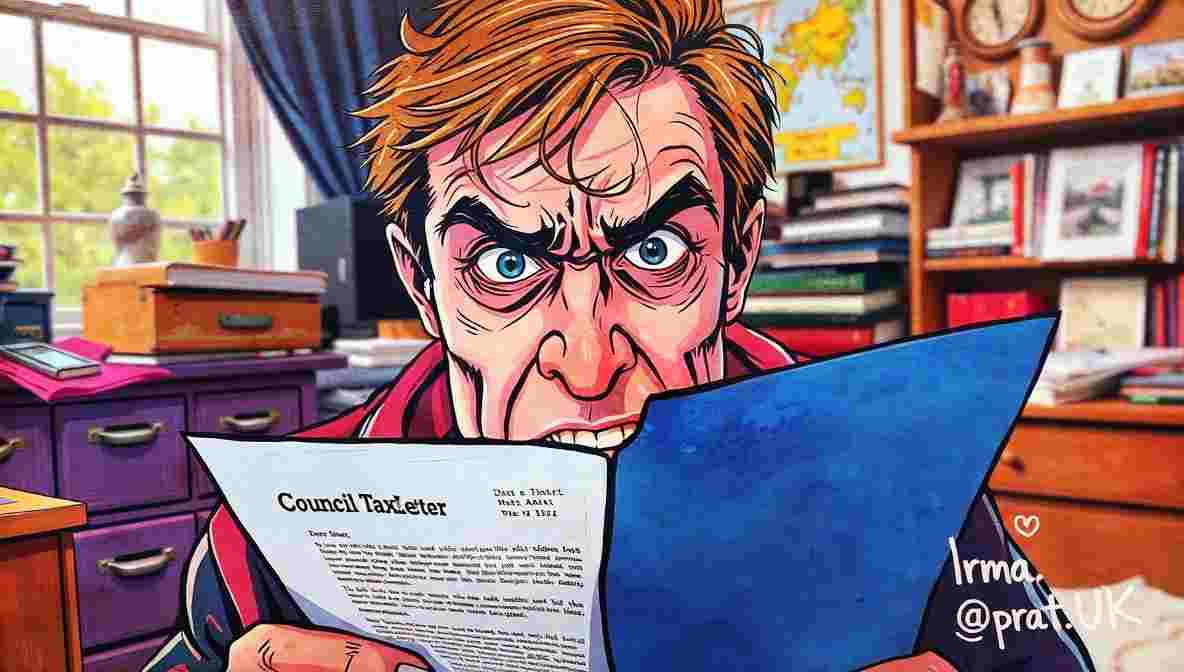
Council Tax Map Reveals Exciting New ‘Financial Masochism’ Trend Sweeping England
Local Authorities Discover Innovative Way to Turn Bankruptcy Into a Spectator Sport
By our Financial Suffering Correspondent
In a thrilling development for fans of fiscal flagellation, council tax bills across England are set to rise by amounts ranging from “mildly uncomfortable” to “please sir, may I have another?” next month, with some lucky residents facing hikes of nearly 9 per cent — because apparently, the cost of living crisis was feeling a bit lonely and needed company.
North Somerset and Shropshire have emerged as the undisputed champions of this year’s “Who Can Alienate Their Electorate Fastest?” competition, both clocking in at a magnificent 8.99 per cent increase. Local officials were reportedly disappointed they couldn’t crack the psychologically important 9 per cent barrier, but consoled themselves with the knowledge that residents will still have to sell approximately three kidneys and a grandmother to cover the difference.
“It’s a beautiful thing, really,” said one Shropshire council officer, wiping away a tear of joy. “We’ve managed to turn ‘we’re broke’ into ‘you’re broke too.’ That’s what I call community cohesion.”
The Geography of Grief: England’s New Council Tax Pain Map
The new council tax map — now available in shades of “Deep Despair Blue” and “Bankruptcy Navy” — reveals a fascinating pattern of financial pain. While Hartlepool and Durham residents are enjoying what experts call “the participation trophy of tax rises” at a mere 1.98 and 1.99 per cent respectively, seven authorities have been granted special government permission to absolutely hammer their residents with increases above 5 per cent.
“It’s like getting a hall pass, but for economic cruelty,” explained Professor Brian Stilton of the Institute for Made-Up Statistics. “Normally, councils have to ask permission to ruin lives beyond the 4.99 per cent threshold. These seven are basically the teacher’s pets of municipal misery.”
Worcestershire, granted an 8.98 per cent increase, has proven particularly adept at this new sport — especially given that Reform UK, a party whose entire platform appears to be “taxes bad,” now runs the council. When questioned about this apparent contradiction, local Reform councillors were unavailable for comment, presumably too busy constructing elaborate explanations involving the words “actually,” “technically,” and “you see, what people don’t understand is…”
The Farage Paradox: When ‘Cut Taxes’ Means ‘Raise Taxes, But Less’
Speaking of Reform UK, party leader Nigel Farage has once again demonstrated his mastery of linguistic gymnastics that would make a quantum physicist weep. When confronted with the fact that Reform-controlled Kent is raising council tax by 3.99 per cent — despite his party’s leaflets explicitly promising to “reduce waste and cut your taxes” — Farage delivered a masterclass in redefinition.
“Well, cutting taxes could mean not putting them up as much, I suppose,” he told ITV News, in what observers are calling “the most ambitious ‘technically correct’ since Bill Clinton questioned the meaning of ‘is.'”
He added: “But I never promised cuts in council tax,” apparently operating under the assumption that voters possess the memory capacity of a goldfish with amnesia. When the journalist pointed out that his leaflet literally said “cut your taxes,” Farage replied: “I never put it on my leaflets. Nothing with my name ever went on that.” The journalist noted that it did, in fact, have his name on it. Political analysts are calling this a bold new strategy in the field of “saying things and then saying you didn’t say them, but saying you did say them, but in a different way that means the opposite.”
The Referendum Loophole: Democracy, But Make It Optional
Under current regulations, any council wishing to increase tax by more than 4.99 per cent must either hold a local referendum or ask the government nicely. Unsurprisingly, given the British public’s well-documented love of voting in anything (see: Eurovision, Bake Off, Strictly), most councils have opted for the latter approach.
“It’s a bit like asking your mum if you can have another biscuit,” explained one Westminster insider. “You don’t actually want to hear ‘no,’ so you make sure to ask when she’s on the phone and distracted. The government is always on the phone. Usually to donors.”
The seven councils granted permission for super-sized increases — Bournemouth, Christchurch and Poole (6.74%), North Somerset (8.99%), Shropshire (8.99%), Trafford (7.49%), Warrington (7.49%), Worcestershire (8.98%), and Windsor & Maidenhead (7.49%) — have all cited “exceptional financial circumstances,” which roughly translates to “we spent the money on things and now there isn’t any left.”
Windsor & Maidenhead, last year’s reigning champion with a 25 per cent increase request (later negotiated down to a mere 9%), have apparently learned that if you’re going to go big, you might as well go “potentially bankrupt” big. The council claimed it would effectively collapse without the rise, prompting the government to respond with a firm “no it wouldn’t,” followed by a generous permission slip for 9 per cent anyway. This is known in political circles as “the ‘no, but actually yes’ manoeuvre.”
The Barnet Exception: Precision Engineering of Taxpayer Annoyance
Not all councils have opted for the nuclear option. The London Borough of Barnet has chosen a path of exquisite precision, raising tax by exactly 4.98 per cent — just 0.01 per cent below the referendum threshold. It’s a move that has been described as “technically legal, morally questionable, and mathematically impressive.”
“They’ve essentially found the exact point at which residents will be furious but not quite furious enough to storm the town hall,” noted one tax expert. “It’s like pricing something at £9.99 instead of £10, except instead of a penny difference, it’s the difference between democracy and ‘we know better than you.'”
South Tyneside, Stockton-on-Tees, and West Northamptonshire have followed suit with 4.95 per cent increases, forming what critics are calling “the Coward’s Coalition” — too timid to face voters, too greedy to keep increases reasonable.
Council Tax Support Schemes: Help Is Available (Terms and Conditions Apply)
For those struggling with the increases, the government has helpfully pointed out that eligible residents on low incomes or in receipt of benefits can receive support, including reductions of up to 100 per cent. This has been described by officials as “a safety net” and by everyone else as “the absolute bare minimum in a civilised society, presented as if it’s a generous gift.”
“It’s like someone stealing your wallet and then offering you a bus ticket home,” said one single mother from Trafford, who asked not to be named because she’s already behind on payments and doesn’t fancy a holiday at His Majesty’s pleasure. “Except the bus ticket only works on Tuesdays, you have to fill out seventeen forms to get it, and the bus doesn’t go anywhere near your house.”
The Prison Threat: A Victorian Solution to a Modern Council Tax Crisis
The situation is further complicated by the fact that councils retain the power of using the threat of prison against vulnerable people who have fallen behind on council tax — a policy described as “medieval” by human rights groups and “efficient” by council finance directors.
“It’s important to remember that prison is a last resort,” said one council spokesperson, presumably while polishing a set of manacles. “We much prefer to work with people to find solutions. Like selling their possessions. Or their organs. Or their children’s future.”
StepChange Debt Charity, which has called for an end to imprisonment for council tax debt, notes that nearly one in four UK adults — 12.5 million people — are worried about their ability to pay council tax at all. Legal experts further note that England remains the only part of the UK to retain this imprisonment sanction, out of step with Scotland, Wales, and, remarkably, most of civilised Europe. It sits alongside other Victorian favourites like tuberculosis, child labour, and thinking that moustaches look distinguished.
Looking Ahead: The Future of Council Tax Despair
With 125 of 153 local authorities raising tax by at least 4.99 per cent, experts predict next year’s competition will be even fiercer. Rumours suggest several councils are already training for the coveted “double-digit increase,” with Shropshire and North Somerset reportedly “furious” they didn’t break 9 per cent this time around.
“We’re looking at innovative new revenue streams,” said one council leader, who spoke on condition of anonymity because his constituents still have access to pitchforks. “Have you seen how much people will pay for air? We’re thinking of taxing breathing. Or maybe happiness. There’s definitely a market in misery.”
For now, residents are advised to check the new map, locate their shade of blue, and begin the traditional British response to bad news: writing strongly worded letters, complaining to neighbours, and ultimately, paying up anyway because what choice do you really have?
As one Hartlepool resident put it, celebrating his relatively modest 1.98 per cent increase: “At least we’re not in Shropshire. Poor sods. Still, give it a year. We’ll catch up. We always do.”
The Department for Levelling Up, Housing and Communities was unavailable for comment, presumably too busy levelling up their own salaries.
Auf Wiedersehen, amigo!
Council tax is a property-based local tax levied across England, paid by households to fund services including refuse collection, adult social care, and local infrastructure. Under current law, councils may raise bills by up to 4.99% annually — a threshold including a 2% adult social care precept — without triggering a public referendum. Seven councils were granted special Government permission to exceed this cap for 2026/27, with North Somerset, Shropshire, and Worcestershire among those imposing increases approaching 9%. Reform UK, which swept ten councils at the May 2025 local elections on pledges to cut taxes, subsequently raised council tax across most councils it controls. Party leader Nigel Farage told ITV News he had never promised to cut council tax, despite leaflets carrying his party’s name stating they would “reduce waste and cut your taxes.” England remains the only part of the UK in which non-payment of council tax can, as a last resort, result in imprisonment — a sanction that debt charities and human rights organisations have repeatedly called on the Government to abolish.

Alan Nafzger was born in Lubbock, Texas, the son Swiss immigrants. He grew up on a dairy in Windthorst, north central Texas. He earned degrees from Midwestern State University (B.A. 1985) and Texas State University (M.A. 1987). University College Dublin (Ph.D. 1991). Dr. Nafzger has entertained and educated young people in Texas colleges for 37 years. Nafzger is best known for his dark novels and experimental screenwriting. His best know scripts to date are Lenin’s Body, produced in Russia by A-Media and Sea and Sky produced in The Philippines in the Tagalog language. In 1986, Nafzger wrote the iconic feminist western novel, Gina of Quitaque. He currently lives in Holloway, North London. Contact: [email protected]

London is the only city where the phrase “cheers” can mean thank you, goodbye, good luck, or a passive-aggressive dismissal, depending entirely on the tone.
My dad’s been in this city since the 60s. He says you’ve captured death.