
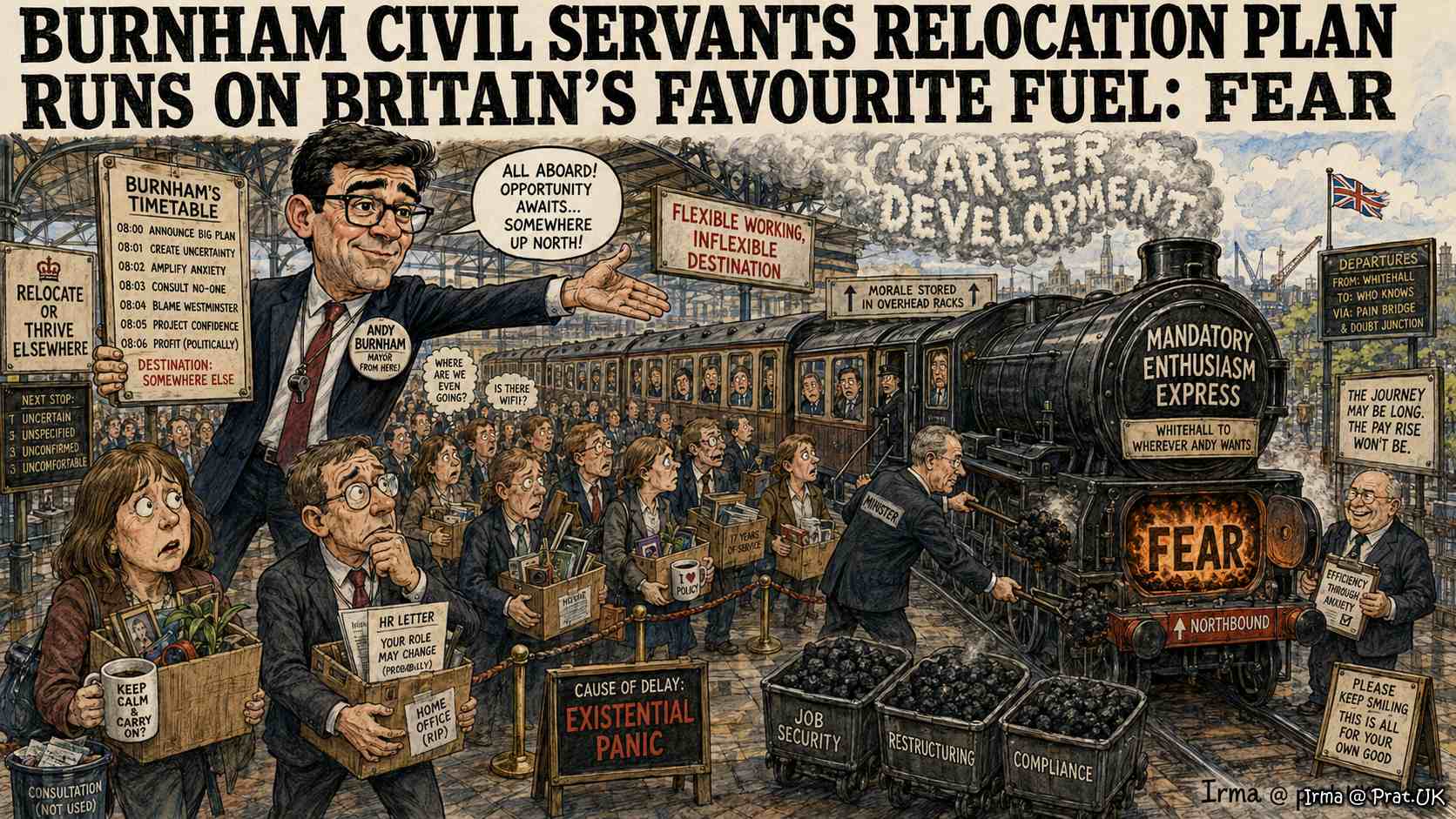
Burnham Civil Servants Relocation Plan…
Runs on Britain’s Favourite Fuel: Fear
Every great British institutional change requires a great British incentive, and nothing motivates a civil servant quite like the gentle, unspoken suggestion that refusing to move house might end their career. The Burnham civil servants relocation drive, unveiled as part of the wider push to shift Whitehall northward, promises railcards, waterproof coats and a future in Manchester — all wrapped in the traditional British management technique of implying that anyone who says no is not, deep down, a team player.
The Burnham Civil Servants Relocation Menu of Persuasion
According to analysis from outlets such as Civil Service World, large-scale relocations of government departments have historically relied less on financial incentive and more on ambiguity about what happens to your job title if you stay behind. The Burnham civil servants relocation scheme appears to follow this playbook closely: nobody is being forced to move, exactly, but several people have noticed their desks have already been measured for the removal van.
Officials describe the process as “voluntary relocation with structured encouragement,” which is Whitehall for “you can absolutely stay in London, assuming you enjoy attending meetings about a department that technically no longer exists there.”
A Whitehall Equivalent, Filed Under HR
Imagine a government department announcing that staff are “welcome to remain in London” while quietly moving every meeting, every budget line and every parking permit two hundred miles north. Nobody gets fired. Everybody gets the message. Persuasion, like plumbing, works better when it’s applied under pressure.
A Manchester open-mic act known as “Sheila Does Spreadsheets” joked at a recent set: “They’re not making us move. They’re just making London very, very quiet.”
Seven Stages of Burnham Civil Servants Relocation Grief
- Denial: “They wouldn’t actually move the whole department.”
- Anger: at the railcard email arriving before the formal announcement.
- Bargaining: “Can I keep the London pension and the Manchester desk?”
- Depression: reading estate agent listings in Chorlton at 2am.
- Acceptance: buying the waterproof coat.
- Enthusiasm: performative, but convincing by month three.
- Reversion: quietly applying for a London-based role in a different department entirely.
Think tanks including the Institute for Government have noted that successful relocation programmes typically require years of planning and genuine local infrastructure investment — a standard the Burnham civil servants relocation plan hopes to meet somewhere between the announcement and the first removal van.
Wordplay Interlude: The Art of Moving On
Whitehall insiders have started calling the scheme a lesson in moving on, in both senses: geographically, and from any expectation that relocation would remain optional. Others prefer north by northwest coercion, on the grounds that Hitchcock never had to fill in a relocation expenses form.
What Burnham Civil Servants Relocation Actually Achieves
Strip away the comedy and there’s a legitimate policy underneath: concentrating civil service expertise outside London could, in principle, spread investment and opportunity more evenly. Whether “structured encouragement” achieves that or simply produces a wave of resignations dressed up as relocations will depend on how many railcards actually get used versus quietly returned.
Either way, Whitehall has learned a valuable lesson: nothing moves a civil servant like the fear of being the last one left holding a London office nobody visits anymore.
Related Burnham Coverage on Prat.uk
- London Will Finally Be Governed by a Man Who Complained About It
- No 10 North: Two Offices, Zero Accountability
- Burnham’s Rebalance Britain Plan Has a Suspiciously Familiar Postcode
- Burnham Khan Mayoral Alliance Forms Britain’s Most Expensive Support Group
- Burnham Housing Plan Begins With a Speech About How Big It Is
For the American approach to relocating federal jobs through polite institutional dread, see our sister publication Bohiney.com.
Auf Wiedersehen, amigo!

Alan Nafzger was born in Lubbock, Texas, the son Swiss immigrants. He grew up on a dairy in Windthorst, north central Texas. He earned degrees from Midwestern State University (B.A. 1985) and Texas State University (M.A. 1987). University College Dublin (Ph.D. 1991). Dr. Nafzger has entertained and educated young people in Texas colleges for 37 years. Nafzger is best known for his dark novels and experimental screenwriting. His best know scripts to date are Lenin’s Body, produced in Russia by A-Media and Sea and Sky produced in The Philippines in the Tagalog language. In 1986, Nafzger wrote the iconic feminist western novel, Gina of Quitaque. He currently lives in Holloway, North London. Contact: [email protected]


