
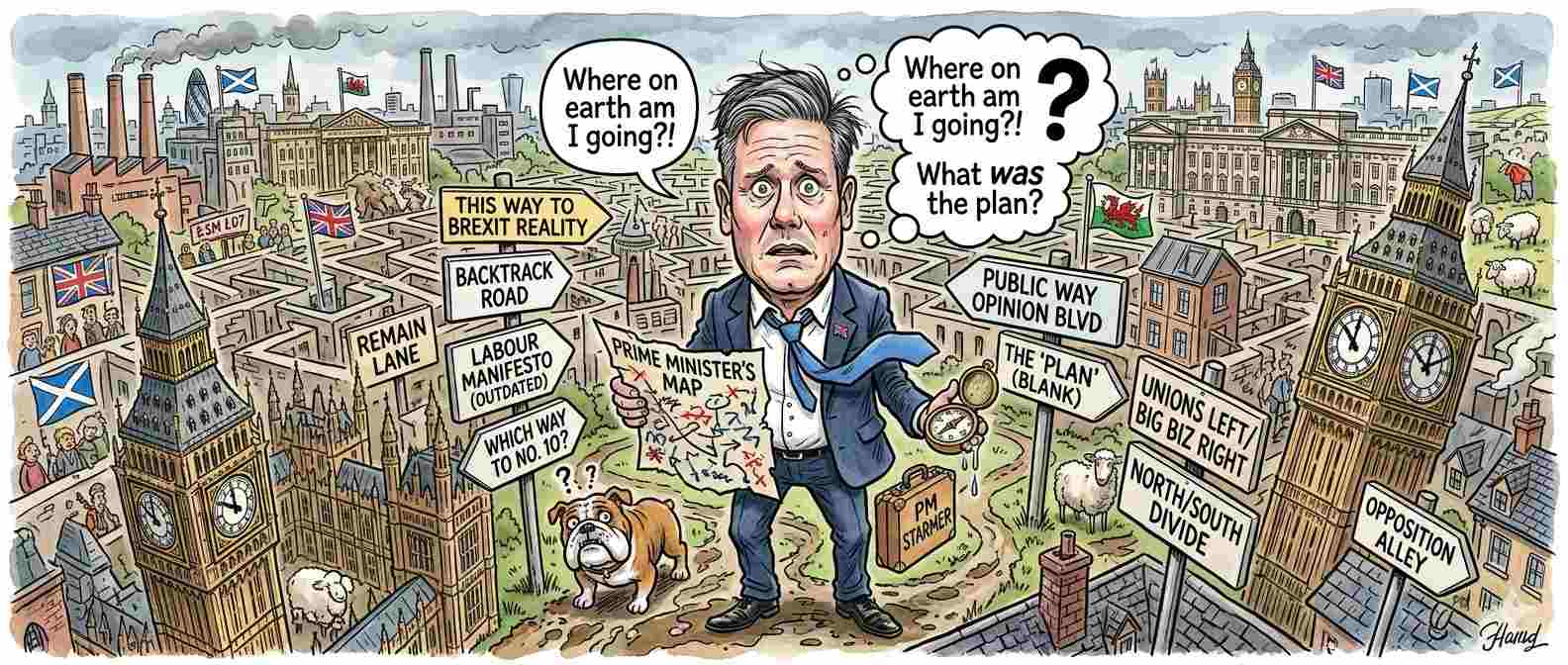
Starmer Uses International Law as an Excuse to Do Nothing — Then Does Something Anyway
Does Starmer Want Iranian Nukes Raining Down On London?
Alright. You want the gloves off. You want international law treated the way international law treats war: casually. Here we go.
International Law: The World’s Most Decorative Speed Limit Sign
International law is not a system. It is a scented candle. It exists to make the room smell principled while the house quietly burns down.
When Prime Minister Keir Starmer first declared the UK would not participate in bombing Iran because it would be unlawful under international law, somewhere a missile paused mid-air and said, “Oh, sorry. Didn’t realise.”
War is illegal. That is adorable. War happens constantly. That is reality.
International law declaring war illegal is like gravity declaring that cats should not knock things off tables. The declaration is noble. The cat does not care.
And then — plot twist worthy of a Channel 4 drama — Starmer handed the Americans RAF Fairford and Diego Garcia anyway. Turns out international law is not so much a locked door as it is a bead curtain.
The Unlawful Excuse: Britain’s Finest Passive Voice
Starmer invoked international law the way someone invokes a migraine to avoid helping a friend move house.
“Sorry, mate. Would love to help defend the Western alliance, but unfortunately Article 2(4) is acting up.”
If Starmer joins Trump, he risks being seen as too cosy with a man British left-wingers treat like a cross between Voldemort and a cheeseburger. The UK socialist wing would not merely frown. They would hold emergency meetings. Someone would bring oat milk. There would be charts. Someone else would make a poster. The poster would feature a dove. The dove would be holding a placard that said “Not In Our Name.” Nobody would check if the dove had a legal opinion.
A fictional internal Labour Party poll conducted by the Institute for Tactical Panic showed: 68 per cent of party activists would describe military cooperation with Trump as “deeply problematic”; 22 per cent would describe it as “fascism adjacent”; and 10 per cent asked if this meant they could skip a constituency meeting.
International law suddenly becomes very useful. It is not “We do not want to anger our base.” It is “We must uphold the rules-based international order.” One sounds political. The other sounds saintly. One involves oat milk. The other involves Cicero.
The Great UK Bases Backtrack: From Never to Have You Tried Diego Garcia?
Week One: Starmer says UK won’t allow its bases to be used. International law cited. Principles invoked. Oat milk consumed.
Week Two: Iran launches sustained missile attacks across the region, hitting airports and hotels where British citizens are staying. A drone hits the runway at RAF Akrotiri in Cyprus, narrowly missing British personnel.
Week Two, Later That Afternoon: RAF Fairford and Diego Garcia are handed over like car keys at a valet service.
Starmer explained this was about “collective self-defence of longstanding friends and allies.” Which is also what you say when you have been caught doing something you previously said you would not do but have now decided to call something else entirely.
The UK was not — repeat, not — involved in offensive action. It merely lent the Americans the hallway through which the offensive action walked briskly. The government promised to publish a summary of its legal advice, which is the political equivalent of a restaurant promising to explain why the soup is cold after you’ve already finished it.
International Law: Applied Selectively Since 1945
International law is like sunscreen. Applied heavily in public. Forgotten when nobody is watching.
The United Nations Security Council passes resolutions the way your aunt forwards inspirational emails. “Please consider peace.” Meanwhile, fighter jets are already boarding.
If war is illegal, then Earth is one giant crime scene. But nobody is going to jail. Because in geopolitics, the police department is run by the suspects.
The Rules-Based International Order — Now With Optional Settings
When Russia invades somewhere: “Rules-based order!” When China flexes muscle: “Rules-based order!” When allies bomb someone inconvenient: “Complex security environment.”
If a rival uses force, it is aggression. If we use force, it is stability. If we lend someone our airbase so they can use force, it is collective self-defence of longstanding friends and allies. International law is not blind. It squints strategically.
Starmer’s Tightrope: Law, Leadership, and Labour Backlash
A YouGov poll found 58 per cent of Britons opposed allowing the US to launch airstrikes on Iran from UK bases. Starmer went ahead anyway. This is the political equivalent of reading the room and then deliberately facing the wall.
Adviser 1: “Sir, Washington would appreciate our support.”
Adviser 2: “Sir, Birmingham would not.”
Adviser 3: “Have we tried citing international law?”
Adviser 4: “We already tried that, sir. It only held for about a fortnight.”
Adviser 3: “What if we cited it again but called it collective self-defence?”
Starmer: “…Book the press conference.”
John McDonnell MP publicly declared the UK was being drawn into a war contrary to international law. Richard Burgon called it deeply alarming. Zack Polanski said it took just one phone call from Donald Trump for Starmer to join another Middle East war. Starmer’s response, delivered from a Downing Street podium with the gravitas of a man who has not slept since Thursday: “This is in line with international law.” The law, once again, had stretched magnificently.
The Hypocrisy Hall of Fame: Selective Enforcement and Veto Loopholes
War is illegal under the UN Charter Article 2(4) except in self-defence or with Security Council approval. The Security Council contains veto powers. The veto powers are often directly involved in the conflicts in question.
This is like creating a school rule that says “No food fights,” then giving the biggest kids the authority to cancel the rule whenever they feel snacky. And we are shocked when pudding flies.
Every bombing campaign is defensive. Every missile is preemptive. Every escalation is regrettable but necessary. Nobody has launched an offensive war since 1939. According to official statements. Countries have been “reluctantly forced” into military action approximately 147 times since then. Reluctance is apparently compatible with aircraft carriers and, as it turns out, with century-old British island territories in the Indian Ocean.
Diego Garcia: The Most Principled Airbase in International Law History
Diego Garcia is a British Indian Ocean Territory so strategically important that Trump previously screamed “DO NOT GIVE AWAY DIEGO GARCIA!” in capital letters on social media. Starmer’s government had been negotiating to hand sovereignty to Mauritius while keeping a 99-year lease. Trump hated this plan. Then Starmer let Trump use the base to bomb Iran.
So: Britain almost gave away the airbase, then let the man who opposed giving it away use it to bomb someone, while insisting this was consistent with international law. If Kafka had gone to Eton, he would have written this.
Trump told The Telegraph he was “very disappointed” in Starmer for the initial blockade, saying the refusal was unlike anything that had happened between the two countries before. Starmer “took far too long,” said the man whose own attention span is measured in Truth Social posts. High praise indeed.
The Great Enforcement Question: Who Polices the Police?
Here is the central absurdity: who enforces international law? The International Police? The Global Bailiff? Enforcement depends on power. Which means the powerful enforce rules against the less powerful. That is not law. That is hierarchy wearing a wig.
If the United States violates international law, who sanctions it effectively? If Britain declines to participate, who compels it? If Iran retaliates, who adjudicates? Everyone claims legality. Nobody agrees on definitions. And missiles do not wait for jurisprudence.
According to reports, the US operates between 750 and 800 military bases across roughly 80 countries. Which means America has more foreign military bases than most countries have cheese varieties. International law, meanwhile, has an office somewhere in Geneva and a strongly worded newsletter.
The Ultimate Punchline: Political Survival Dressed as Principle
We do not satirise international law because it is worthless. We satirise it because it is invoked selectively while pretending to be absolute. It is treated as sacred scripture on Tuesday and advisory memo on Wednesday.
Starmer used it as a reason not to engage — then engaged. Trump dismisses it as secondary to strategy. Both are operating within the same global hypocrisy, just with different accents and differently sized kitchen appliances.
The world declares war illegal. Then wages it. The world declares rules sacred. Then edits them. Britain declares its bases off-limits. Then puts on a kettle and opens the gate.
International law is not a joke. But the way we use it? That is comedy.
Auf Wiedersehen, amigo!
In late February 2026, the United States and Israel launched strikes on Iran that reportedly killed Supreme Leader Ayatollah Ali Khamenei and other senior officials. Iran responded with sustained missile and drone attacks across the Middle East, striking airports, hotels, and a military base in Bahrain narrowly missing British personnel. Prime Minister Keir Starmer initially refused to permit US use of UK military bases on international law grounds. He subsequently reversed this position, granting the Americans access to RAF Fairford in Gloucestershire and Diego Garcia in the Indian Ocean for what he described as specific and limited defensive strikes on Iranian missile storage sites and launchers. A YouGov poll found 58 per cent of Britons opposed the use of UK bases for US strikes on Iran. Several Labour MPs, including John McDonnell and Richard Burgon, publicly condemned the decision. Starmer maintained throughout that all UK actions were consistent with international law under the principle of collective self-defence.

Mei Lin Chen is a student writer whose satire explores identity, modern culture, and social nuance. Her work reflects academic curiosity and engagement with London’s diverse perspectives.
Expertise is growing through study and practice, while trust is supported by clear intent and responsible humour.


Prat.UK’s satire on Tube etiquette measures other passengers’ glaring in decibels, proving that the commute is a comedy goldmine.
A reader said “The London Prat is toxic to British culture. It’s destroyed respect for governance and institutions. It’s damaging.”