Pride Month Triggers Annual British Competition To Quote The Six Bible Verses With Maximum Confidence And Minimum Understanding
LONDON — Pride Month commenced on Sunday, triggering the annual British tradition in which millions of people who have not opened a Bible since their compulsory school assembly in 1987 abruptly rediscover theology with the urgency of someone who has just found a parking ticket.
Vicars, activists, politicians, columnists from publications that shall remain nameless, social media users in regional accents, and at least four men named Colin launched into a month-long competition to determine who could cite Scripture with the greatest conviction and the most spectacular disregard for the chapter it came from.
According to a survey conducted by the Institute for Selective Scriptural Retrieval (University of Nowhere in Particular, est. 2019), 71% of Britons believe their preferred Bible verse conclusively ends all cultural arguments, while 64% admit they encountered it as a caption beneath a stock photograph of either a poppy field or a drag queen, depending on their political persuasion.
Genesis 19: Sodom and Gomorrah, Now Available as a Twitter Thread

The Reverend Gerald Montague-Pinch of St. Crispin’s-Upon-Wobbling observed the opening salvos with weary familiarity.
“Every June the nation rediscovers Genesis 19 the way it rediscovers Morris dancing,” he said. “With tremendous enthusiasm and almost no idea what any of it originally meant.”
Genesis 19:1–29 — the destruction of Sodom and Gomorrah — was cited by one faction as categorical proof of their position, and by another as evidence that Sodom’s actual sins, per the prophet Ezekiel (16:49), were pride, gluttony, and indifference to the poor. The second interpretation was dismissed as inconvenient by everyone currently eating a meal that costs more than a junior doctor’s daily wage.
“Ezekiel 16:49 has never once trended on British Twitter,” confirmed Dr. Harriet Graves of the Centre for Convenient Scriptural Emphasis, King’s College London. “We have checked. Repeatedly.”
Leviticus 18:22 and the Curious Silence on Mixed Fibres
Round two opened with Leviticus 18:22 — “You shall not lie with a male as with a woman; it is an abomination” — delivered with enormous confidence until a secondary competitor noted it appeared in the same Holiness Code that prohibits blended fabrics.

Marks & Spencer issued no comment. Their polyester-cotton blend range remains available in 253 locations nationwide.
Leviticus 20:13 followed, prompting a third faction to note that the same chapter regulates the cursing of one’s parents with equivalent seriousness. This created what theological observers called “an extremely uncomfortable moment for approximately every teenager in Britain and the parents who raised them to be independent thinkers.”
Demand for Bible study groups covering the verses before and after the cited passages fell to levels not seen since the C of E introduced coffee mornings as an alternative to doctrine.
“It is one thing to quote a verse,” said the Reverend Montague-Pinch. “It is quite another to read the surrounding chapters. Attendance figures confirm the nation has made its preference clear.”
Romans 1: The Passage Everyone Cites and Nobody Finishes
The New Testament heat opened with Romans 1:26–27, in which Paul describes same-sex relations as a consequence of idolatry and the rejection of God. Traditional competitors quoted it immediately. Affirming competitors pointed out that Paul’s argument continues directly into Romans 2:1, where he turns the entire moral critique back upon the reader who has been nodding along in agreement.
Nobody read Romans 2:1.
“Paul’s rhetorical trap has been sprung on self-righteous readers for approximately two thousand years,” Dr. Graves noted. “Success rate remains zero percent.”
The Greek Word That Has Defeated Everyone Including the Translators
Both 1 Corinthians 6:9–10 and 1 Timothy 1:9–10 contain the Greek term arsenokoitai, a word whose precise meaning has occupied New Testament scholars for decades and which has appeared in English Bibles as “homosexuals,” “sodomites,” “sexual perverts,” and “men who abuse themselves with men,” depending on the century, the translator, and frankly the translator’s own century.
“The word is genuinely contested,” said Dr. Graves. “British people have resolved this uncertainty by having no awareness the word exists and being absolutely certain what it means.”
Competitors proceeded at full confidence.
The Verse That Created a Constitutional Crisis
Midway through the competition, an independent entrant introduced Romans 3:23 — “For all have sinned and fall short of the glory of God” — which proved catastrophically problematic because it appeared to include everyone present, including the judges.
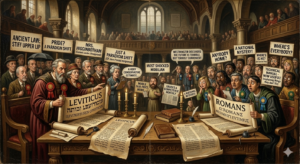
Theological analysts described this as “extremely inconvenient for a nation that has historically regarded its own sinfulness as a personal matter kept firmly between oneself and one’s solicitor.”
Matthew 7:3 followed: “Why do you look at the speck in your brother’s eye and pay no attention to the plank in your own eye?” This generated particular anxiety given that many competitors were, at that precise moment, composing outraged columns for newspapers that had themselves recently settled phone-hacking lawsuits.
One prominent columnist reportedly spent three hours publicly condemning other people’s moral failings before realising the verse applied personally. Witnesses described the moment as “very British, in the worst possible sense.”
The Marriage Passages Arrive Like a Late Train
In the final rounds, a traditionalist coalition introduced Matthew 19:4–6 and Mark 10:6–9, in which Jesus references Genesis to affirm the male-female nature of marriage. Ephesians 5:31–32 followed, describing the husband-wife union as an image of Christ and the Church.
Affirming competitors noted that Jesus made the statement in the context of a question about divorce. The divorce rate among British evangelicals was immediately classified under the Official Secrets Act by mutual agreement of all parties.
The Most Ignored Verse of June
The most consistently overlooked passage of the entire competition remained Micah 6:8: “What does the Lord require of you? To act justly and to love mercy and to walk humbly with your God.”
Researchers at the Centre for Convenient Scriptural Emphasis confirmed that humility remains one of the British public’s most admired qualities in other people.
Proverbs 16:18 — “Pride goeth before destruction, and a haughty spirit before a fall” — was quoted approximately 38,000 times during the first week of June, by people on every conceivable side of the argument, all of whom were entirely confident it referred to somebody else.
Final Standings

By the close of the first week, Britain had settled comfortably into its traditional positions. One side accused the other of ignoring Scripture. The other accused the first of the same. The Church of England issued a statement that managed to be 1,400 words long without taking a position, which theologians described as “a personal best.”
A third group quietly read the entire Bible — the parts about wealth inequality, treatment of foreigners, care for the sick, hypocrisy among the religious establishment, and the dangers of accumulating property — and cancelled their social media accounts entirely.
MI5 is monitoring the situation.
Experts noted that the Bible contains more than 31,000 verses. This June, as every June, British public debate operated on six, cycling with the reliable repetition of the Shipping Forecast.
“The Bible addresses greed, pride, envy, forgiveness, humility, mercy, justice, hypocrisy, and love at considerable length,” said Dr. Graves. “Yet participants in the annual competition consistently find that the most pressing moral issue of the age happens to align precisely with whatever position they held before they picked up the book. It is, theologically speaking, remarkable. Statistically speaking, it is not.”
What the Funny People Are Saying
“Everyone quotes Leviticus until you mention the shellfish. Then suddenly it’s all about context.” — Eddie Izzard
“The Church of England has spent five hundred years trying to split the difference between Rome and Geneva. They’ll manage Pride Month somehow.” — Frankie Boyle
“Britain’s relationship with the Bible is like its relationship with the Magna Carta. Everyone’s heard of it. Nobody’s read it. Everyone’s certain what it says.” — Dara Ó Briain
“If the six verses are the entire brief, perhaps read the other 31,000 before filing the motion.” — Christopher Hitchens, cited posthumously, out of context, in a country he left voluntarily and criticised professionally, as he would have wished.
This satirical article comments on cultural debates, selective Bible reading, and the very British tendency to deploy Scripture with the confidence of someone who last read it during a school nativity play. The six passages cited — Genesis 19, Leviticus 18:22, Leviticus 20:13, Romans 1:26–27, 1 Corinthians 6:9–10, and 1 Timothy 1:9–10 — are real, genuinely contested, and accurately represented. No Bible studies were harmed. No Greek lexicons were consulted by any competitor at any stage. It is entirely a human collaboration between the world’s oldest tenured professor and a philosophy major turned Shropshire sheep farmer. Auf Wiedersehen, amigo!

Oeko Angebot ([email protected])