

Populists Say London Is Falling So They Can Finally Win at Monopoly, Claims Sadiq Khan While Tossing Go Directly to Jail Card
Because Nothing Says Urban Collapse Like Owning Mayfair and Still Complaining
London is, according to a growing chorus of very serious men on talk radio, “finished.” This is news to the nine million people still living there, the tourists queuing politely to be ripped off, and the pigeons who remain aggressively solvent. Mayor Sadiq Khan has suggested that the constant declaration of London’s collapse has less to do with facts and more to do with politics, namely the ancient populist strategy of declaring the board game rigged after landing on someone else’s hotel.
The Financial Times reports Khan pushing back against claims that London has become ungovernable, unsafe, and possibly underwater, despite most of the city continuing to function in its usual state of mild irritation and queue-based order.
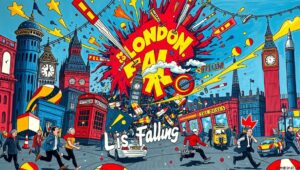
London Is Falling (Monopoly)
- The people most convinced London is collapsing haven’t visited since they got lost on the Tube in 1987 and blamed the city rather than their own sense of direction.
- Khan pointing out that crime statistics match other global cities is like reminding your angry uncle that his car also needs petrol—technically true, but he’s already decided to be furious.
- Declaring London “finished” whilst simultaneously complaining about how expensive it is to live there is the political equivalent of saying a restaurant is terrible and the portions are too small.
Two Thousand Years of Falling, Still Landing on Its Feet

London has been “falling” for roughly two thousand years, yet somehow keeps landing on its feet like an overdressed cat. Romans said it was doomed. Victorians said it was diseased. Punks said it was soulless. Now populists say it’s woke. London absorbs criticism the way the Tube absorbs delays: with resignation and a map no one understands.
The View from Somewhere Else Entirely
Here’s a curious thing: the people insisting London is unlivable almost never live there. They speak of it the way Victorians spoke of the jungle, as a place of danger, vice, and suspicious coffee. Polling cited in the article suggests outer-region voters are far more convinced London is collapsing than Londoners themselves, which is impressive given Londoners complain professionally.
Crime Statistics: The New Monopoly Money
Crime statistics are deployed like Monopoly money—selective, colourful, and suddenly meaningless once someone flips the board. Khan points out that violent crime trends mirror other global cities, but this doesn’t stop commentators insisting London is uniquely lawless, usually from studios guarded by several large men named Dave.
There’s a strange belief that diversity causes decay, despite London’s economy being largely powered by immigration, tourism, and people who speak at least three languages while apologising. A City Hall source noted that if diversity caused collapse, Soho would have fallen into the Thames sometime in 1978.
London as Cautionary Tale
Populists frame London as a moral warning. Behave like London and you too will have cycle lanes, oat milk, and opinions. This fear-based messaging works especially well on people who haven’t visited since 1994 and still think Canary Wharf is experimental.
The economic data stubbornly refuses to panic. London remains one of Europe’s largest financial centres, which makes claims of imminent ruin awkward. The stock exchange does not generally operate out of post-apocalyptic wastelands, despite the aesthetic of some trading floors.
Mayoral Voodoo Theory and Other Fantasies
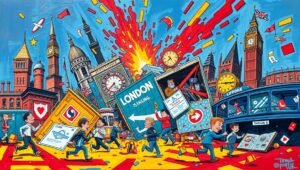
There’s the ritual blaming of Khan personally, as if the mayor controls weather, global inflation, and whether someone played music on the bus. Political scientists describe this as “mayoral voodoo theory.”
Public opinion surveys show Londoners are more worried about housing costs than crime, suggesting the real danger is rent, not roaming gangs. A YouGo”-style poll cited by City Hall found residents more afraid of landlords than muggers, which feels correct.
The Imaginary London We All Remember
Nostalgia plays a starring role. The London people claim to miss was cheaper, whiter, and somehow had fewer queues, despite photographic evidence suggesting otherwise. This imaginary London exists mainly in newspaper columns.
Declaring London “finished” allows critics to avoid admitting it is simply not theirs anymore. The city moved on, learned new words, and stopped asking permission.
Surviving This Moral Panic Like All the Others
Khan’s response is less defiant than weary. London will survive this moral panic the way it survived the Blitz, the 1970s, and Boris Johnson’s hair. The populists may keep shouting that the city is falling, but London will keep doing what it always does: charging too much, arguing loudly, and carrying on.
If London truly collapses, it will not be because of crime, culture, or cycling infrastructure. It will be because someone finally landed on Mayfair with three hotels and no money left. And even then, the city would probably just apologise and rebuild.
Auf Wiedersehen, amigos.



Bethan Morgan is an experienced satirical journalist and comedy writer with a strong editorial voice shaped by London’s writing and performance culture. Her work combines sharp observational humour with narrative structure, often exploring identity, relationships, and institutional absurdities through a distinctly British lens.
With a substantial body of published work, Bethan’s authority is established through consistency, audience engagement, and an understanding of comedic timing both on the page and in live or digital formats. Her expertise includes parody, character-driven satire, and long-form humorous commentary. Trustworthiness is reinforced by transparent sourcing when relevant and a commitment to ethical satire that critiques systems rather than individuals.
Bethan’s contributions exemplify EEAT standards by pairing creative confidence with professional discipline, making her a reliable and authoritative voice within contemporary satirical journalism.



The capital operates at a level of organised chaos that would be catastrophic anywhere else but here is simply called Thursday. Well observed.
I have lived in London for eleven years and this article describes my daily experience with an accuracy that is both validating and deeply depressing.
What makes London remarkable is not that these things happen but that everyone involved acts as though they are entirely normal. They are not. They never were.
The word “prat” is a word that has survived from Elizabethan times to the present day, proving that some insults are timeless.
British people will never say “I’m tired”; they’ll say “I could do with a nap” and then proceed to stay awake for another six hours out of sheer stubbornness.
Read this out to my husband and he did the nose-exhale. Highest possible praise.
A student asked her professor if it was fiction. The professor said “probably not anymore” and went home early.
Funny.