London Cyclists Demand Safer Streets While Simultaneously Ignoring Every Red Light In Greater England
LONDON — Several thousand cyclists gathered in central London on Saturday to demand better cycling infrastructure, reduced speed limits for motor vehicles, increased police enforcement of traffic law, and an end to what they described as “a culture of dangerous lawlessness on Britain’s roads.” They arrived via seventeen different junctions, at eleven of which they ran red lights, three of which they mounted the pavement, and one of which — a roundabout in Vauxhall — they navigated in the manner of a man who has decided that rules are a suggestion and physics is negotiable. The irony was not lost on observers. The cyclists appeared genuinely untroubled by it.

The protest arrived via seventeen junctions. At eleven of them, the red lights were treated as decorative rather than regulatory.
The Great Two-Wheeled Contradiction
The cycling advocacy movement in Britain is a genuine force for good. The push for protected lanes, lower urban speed limits, and better road design has saved lives and improved cities. Cycling UK and London Cycling Campaign do important work, and the evidence that cycling infrastructure reduces road casualties is overwhelming and well-documented.
And yet.
And yet there exists, within the cycling community, a subset of riders who treat the Highway Code as aspirational rather than binding. Who will spend forty minutes on a forum explaining why HGV drivers need better training and then coast through a pedestrian crossing on a green man without slowing down. Who have deeply considered opinions about the obligations of motorists and deeply flexible interpretations of their own.
This is not a slur on cyclists generally. It is a precise description of a specific and highly visible group who manage, somehow, to be simultaneously the most self-righteous and the most self-exempting participants in British road life.
Red Lights: A Brief Philosophical Inquiry
Ask a cyclist who runs red lights why they run red lights and you will receive one of the following four responses, delivered with the confidence of a man who has thought about this more than is strictly healthy:
Response One: “It’s safer.”
The argument is that getting ahead of traffic at a junction reduces the risk of being sideswiped from behind. This is partly true in some circumstances and used universally to justify behaviour in all circumstances including ones where there is no traffic, just a confused pedestrian and a Labrador on a very long lead.
Response Two: “The law doesn’t apply to bikes the same way.”
It does, though. Red lights apply to cyclists under the Road Traffic Act 1988. The fine is £50. This information is received with polite scepticism, as if it were a matter of ongoing legal dispute rather than settled statute.
Response Three: “I was going slowly.”
Going slowly through a red light is still going through a red light. A car going slowly through a red light is considered dangerous driving. A cyclist going slowly through a red light is considered “just being sensible about it.”
Response Four: Silence, followed by cycling away.
This is the most honest response.
The Lycra Paradox and the Rules For Thee
There is a particular personality type — not exclusively, but frequently found in cycling gear — that has developed a comprehensive framework of other people’s obligations. The van driver should give more space. The lorry driver needs better mirrors. The pedestrian shouldn’t stand so close to the cycle lane. The taxi driver needs to be aware. The motorbike shouldn’t park there. The council should resurface that bit. Transport for London should redesign that junction.
All of this may be entirely correct. And then the same person will weave between stationary cars at a red, cut across a give-way line at a junction, and clip a wing mirror on the way past with the righteous energy of a man who has identified himself as the solution rather than any part of the problem.
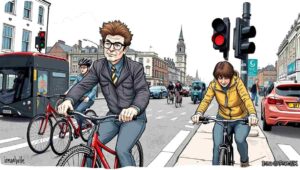
The four responses to being asked about a red light: “It’s safer,” “The law doesn’t apply to bikes the same way,” “I was going slowly,” or silence followed by rapid departure.
Lee Evans once did a routine about the British inability to apply the same rules to themselves that they apply to everyone else. He called it “our national sport, only without the losing.” Cycling in London is this phenomenon on wheels, literally.
What the Advocates Are Actually Right About
To be fair to the march, and the cause it represents: London’s cycling infrastructure is genuinely inadequate in many areas. The Transport for London cycling network has improved substantially under the Cycle Superhighway and Quietways programme, but remains patchy, inconsistent, and in some outer boroughs essentially theoretical. The death toll on London’s roads falls disproportionately on cyclists and pedestrians. The case for protected lanes and reduced speeds is supported by strong evidence and should be taken seriously.
It would be easier to take it seriously if the advocates spent slightly less time explaining why their own infractions don’t count.
A Modest Proposal
The London Prat proposes a simple deal. Cyclists get the protected infrastructure they want, the lower speed limits they’re campaigning for, and the cultural shift in road behaviour they’re demanding. In return, they stop at red lights. Not most of the time. Every time. The same every time they’re asking of everyone else. This seems reasonable. It is, apparently, radical.
The protest organisers, reached for comment, said they were “broadly supportive of legal cycling” and noted that “the real issue is the infrastructure.” The real issue is always the infrastructure. The red light is always a technicality. The logic pedals on.
Auf Wiedersehen, amigo!
London has invested significantly in cycling infrastructure over the past decade, with the Cycle Superhighway network and the introduction of low-traffic neighbourhoods generating both enthusiastic support from cycling advocates and fierce opposition from some residents and businesses. The number of cycling journeys in London has increased substantially since 2000, and road fatality statistics consistently show cyclists among the most vulnerable road users. Transport for London’s cycling safety data and the Department for Transport’s road casualty figures are publicly available and updated annually. Cycling UK and the London Cycling Campaign are the UK’s leading advocacy organisations for cycling rights and infrastructure improvement.
This dispatch is brought to you by The London Prat, est. 1961, produced in the grand tradition of British satirical journalism by the world’s oldest tenured professor and a philosophy major turned dairy farmer, both of whom walk everywhere and stop at every kerb.

Harper Thames is a comedic writer exploring modern life through irony and subtle exaggeration. Rooted in student perspectives and London’s cultural landscape, Harper’s work focuses on relatable humour grounded in everyday experience.
Expertise is developed through writing practice and critical engagement, while authority comes from authenticity and consistency. Trust is reinforced by transparent satire and ethical humour choices.