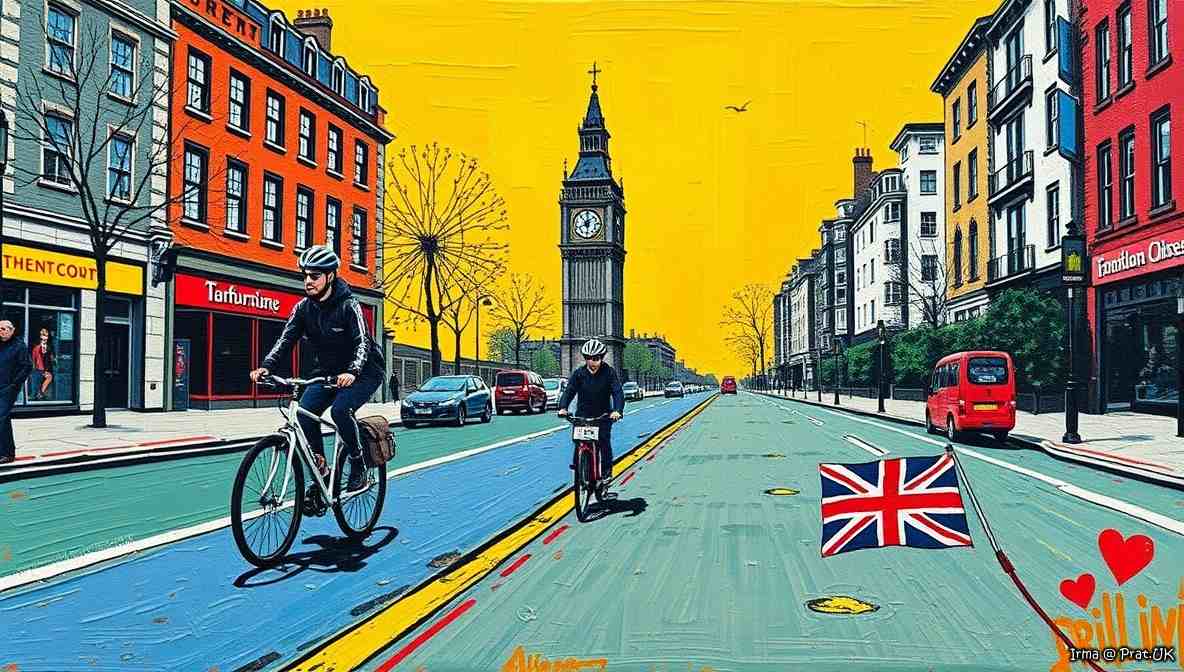
London Cycle Lane Project Costs £14 Billion, Still Somehow Ends in Canal
Insight and Controversy: London Cycle Lane
Five Observations on UK Cycle Lane Chaos
- London infrastructure projects now operate according to abstract-art principles.
- Cycle lanes in Britain frequently begin with optimism and end beside industrial bins.
- Councils continue painting bicycle symbols on roads apparently designed for emotional suffering.
- One cyclist reportedly entered a lane in Camden and emerged spiritually altered in Croydon.
- Urban planners increasingly speak entirely in phrases nobody understands.
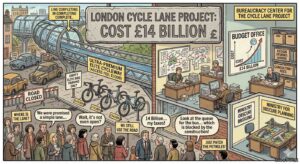
Britain’s Urban Transport Dream Meets Physical Reality
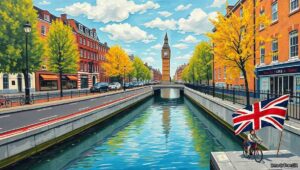
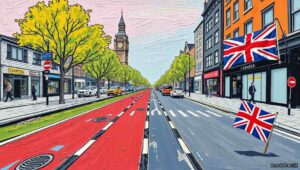
London officials unveiled another ambitious cycling initiative this week after spending approximately £14 billion expanding bicycle infrastructure across the capital, only for several newly completed routes to reportedly end “abruptly and emotionally” beside canals, scaffolding, or confused pigeons.
Transport for London described the project as “transformative.”
Cyclists described it as “a treasure hunt designed by accountants.”
East London Cycle Route Ends in “Atmosphere of Legal Uncertainty”
The latest controversy erupted after commuters discovered one highly publicised East London cycle route abruptly redirected riders into a pedestrian tunnel containing two shopping trolleys and “an atmosphere of legal uncertainty.”
Another lane in Southwark reportedly merged directly into roadworks guarded by a single exhausted man holding tea. Witnesses say the man was not officially employed; he had simply been there so long he had been promoted by public assumption.
Urban-planning professor Clara Olsen defended the broader strategy.
“Cycling infrastructure remains vital for sustainability,” she explained. “Unfortunately Britain continues building transport systems like a drunk uncle assembling IKEA furniture. Last year a route in Lewisham briefly contained a roundabout inside a roundabout. Nobody has ever cycled out of it.”
London Cycle Lane
Hackney Cyclist Reports Daily “Survival Negotiations”
Across London, cyclists remain deeply divided.
Some praise expanded routes and safer commuting conditions.
Others argue many lanes appear designed by committees that have never physically seen bicycles.
At a coffee shop in Hackney, software engineer Toby Reeves described his morning commute.
“You start in a beautiful protected lane,” he explained. “Then suddenly you’re negotiating survival beside three buses and a screaming Deliveroo driver. By the time I arrive at work I’ve aged seven years and reviewed my will.”
“Stakeholder Complexity” Translates as “Nobody Knew What Was Happening”
The project’s ballooning costs have intensified criticism.
Opposition politicians questioned how billions in public money produced routes resembling “experimental chalk drawings.”
One council insider blamed “stakeholder complexity,” a phrase experts confirmed roughly translates into “nobody knew what was happening.”
Internal council minutes reportedly contained the phrase “the lane terminates organically,” which engineers later clarified meant “in a duck pond.”
Drivers vs Cyclists vs Pedestrians: Britain’s Three-Way Stand-Off
Meanwhile, London motorists remain furious.
Drivers increasingly accuse cyclists of “acting morally superior while dressed like sponsored insects.”
Cyclists respond by accusing drivers of attempted manslaughter near roundabouts.
Pedestrians, meanwhile, simply fear everyone.
One Camden grandmother reportedly now crosses Pentonville Road by closing her eyes and praying. Her success rate, according to her grandson, is “higher than the council’s.”
Britain’s Infrastructure Designed for “Horses and Moderate Disappointment”
The broader issue reflects Britain’s ongoing struggle balancing environmental ambitions with infrastructure systems originally designed for horses and moderate disappointment.
Transport analysts note London desperately needs alternatives to car dependency due to congestion, pollution, and public transport costs that increasingly resemble organised extortion.
Still, implementation remains chaotic.
A recent audit found several cycle routes contain confusing signage, sudden dead ends, dangerous junctions, and one path temporarily blocked by decorative shrubbery.

Pothole the Size of Luxembourg
At Westminster, ministers defended the spending.
“We are investing in Britain’s future,” one official announced confidently while standing beside cones surrounding a pothole approximately the size of Luxembourg.
A nearby cyclist reportedly photographed the pothole with the awed reverence usually reserved for Stonehenge.
Outside a pub in Islington, taxi driver Darren Holt offered his own transportation philosophy.
“Look,” he shrugged, “I support cycling. I just think roads should occasionally connect to other roads. That feels like a basic ask.”
What the Funny People Are Saying About London Cycle Lanes
“London cycle lanes are basically escape rooms with traffic.” — Ricky Gervais
“You pay billions and still end up biking into a puddle beside a vape shop.” — Bill Burr
“Every British infrastructure project eventually turns into abstract theatre.” — Sarah Silverman
Insight and Controversy: London Cycle Lane
The Real Story Behind London’s Cycle Lane Spending
Transport for London now operates around 400 km of Cycleway routes across the capital, the largest urban cycle network in the UK. The Mayor’s 2026 Transport Strategy targets 80% of trips by walking, cycling, or public transport by 2041, supported by a multi-year funding settlement from central government worth £2.2 billion. Cycling has roughly trebled since 2000 according to TfL counts, with around 1.26 million daily cycle journeys recorded across London. However, the London Assembly Transport Committee and the Cycling UK charity have both criticised inconsistent route quality, gaps in the network, and dangerous junction designs as priority concerns. A separate National Audit Office review found local authorities across England struggle to deliver active travel projects within budget, with cost overruns commonly running 20% above initial estimates. Active Travel England, the government’s walking and cycling delivery body chaired by Olympic gold medallist Chris Boardman, now grades local authority schemes on a 0–4 quality rating. For wider context see Active Travel England.
Disclaimer: London Cycle Lane
Insight and Controversy: London Cycle Lane: This satirical article is British satirical journalism, entirely a human collaboration between the world’s oldest tenured professor and a philosophy major turned dairy farmer. No bicycles successfully navigated production. The London Prat reminds readers that the £14 billion figure quoted above is satire, not Transport for London’s actual line item, though we accept the confusion may persist for some time. Auf Wiedersehen, amigo!


Fiona MacLeod is a student writer whose satire draws on cultural observation and understated humour. Influenced by London’s academic and creative spaces, Fiona’s writing reflects curiosity and thoughtful comedic restraint.
Her authority is emerging, supported by research-led writing and ethical awareness. Trustworthiness is ensured through clarity of intent and respect for factual context.
Fiona represents a responsible new voice aligned with EEAT standards.