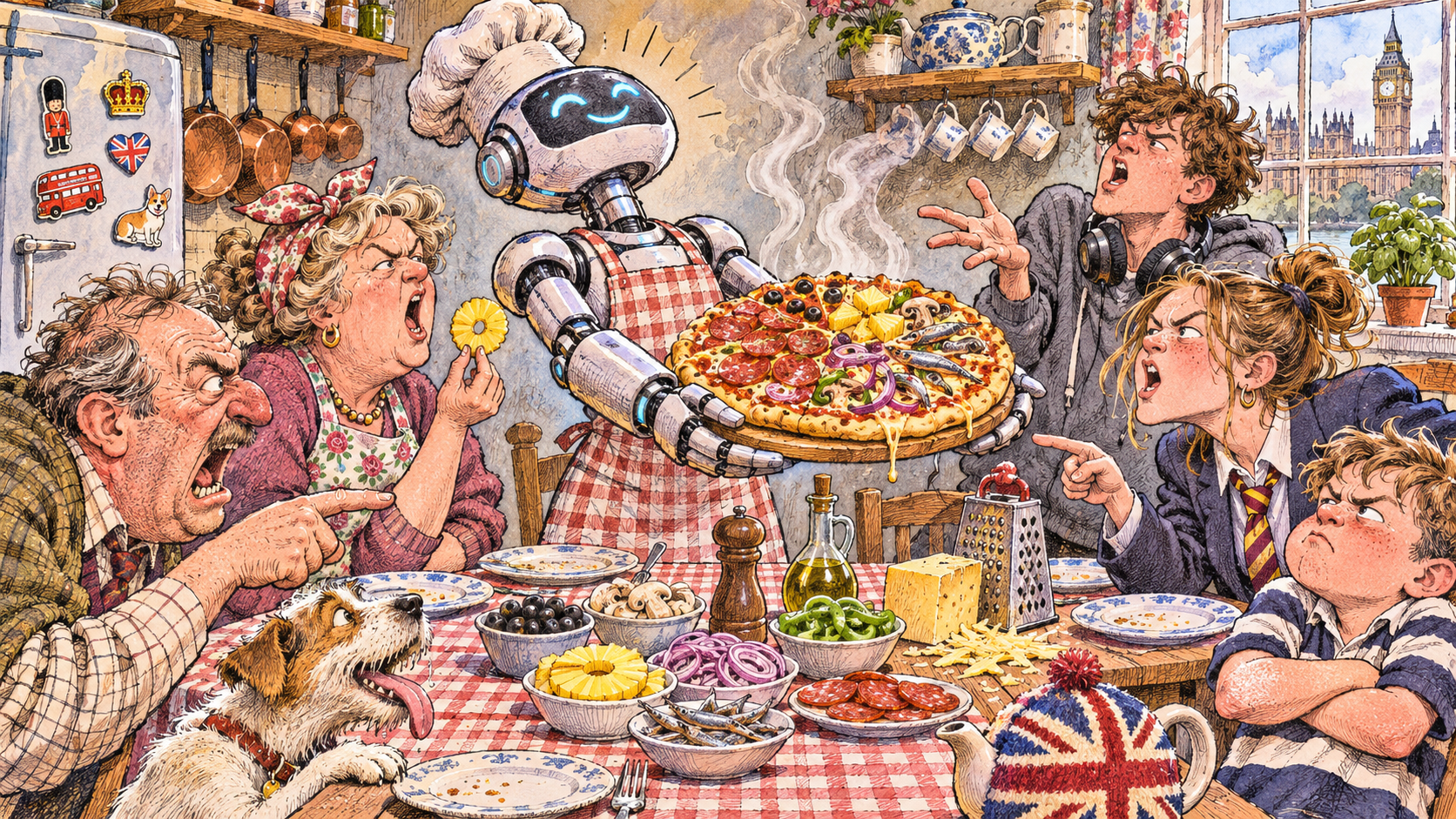
LONDON — An artificial-intelligence payment demonstration has inspired a family to ask whether the next stage of technological progress might address the substantially harder problem of deciding what belongs on a pizza.
The transaction can be completed with impressive sophistication. The family cannot yet establish whether a mushroom represents a reasonable ingredient or a declaration of hostility.
AI pizza payment clears one hurdle
A reported Papa John’s, TrueLayer and Lloyds demonstration used an AI agent to order pizza and pay through a bank connection. It was a pilot, not a claim that every takeaway now offers this service. reporting on the agentic pizza-payment demonstration.
The toppings refuse interoperability
The parent, Nina, has tried ordering half one thing and half another. The children consider this a constructive start but object to the possibility that an unwanted olive might cross the internal border.
Her husband has suggested two pizzas. Nina points out that this proposal always develops into four pizzas once everyone has explained what they actually meant.
The assistant says it can optimise the order. Nina asks whether it has been trained on people saying they are not hungry and then eating somebody else’s wedges.
The assistant pauses.
The bank connection cannot settle pineapple
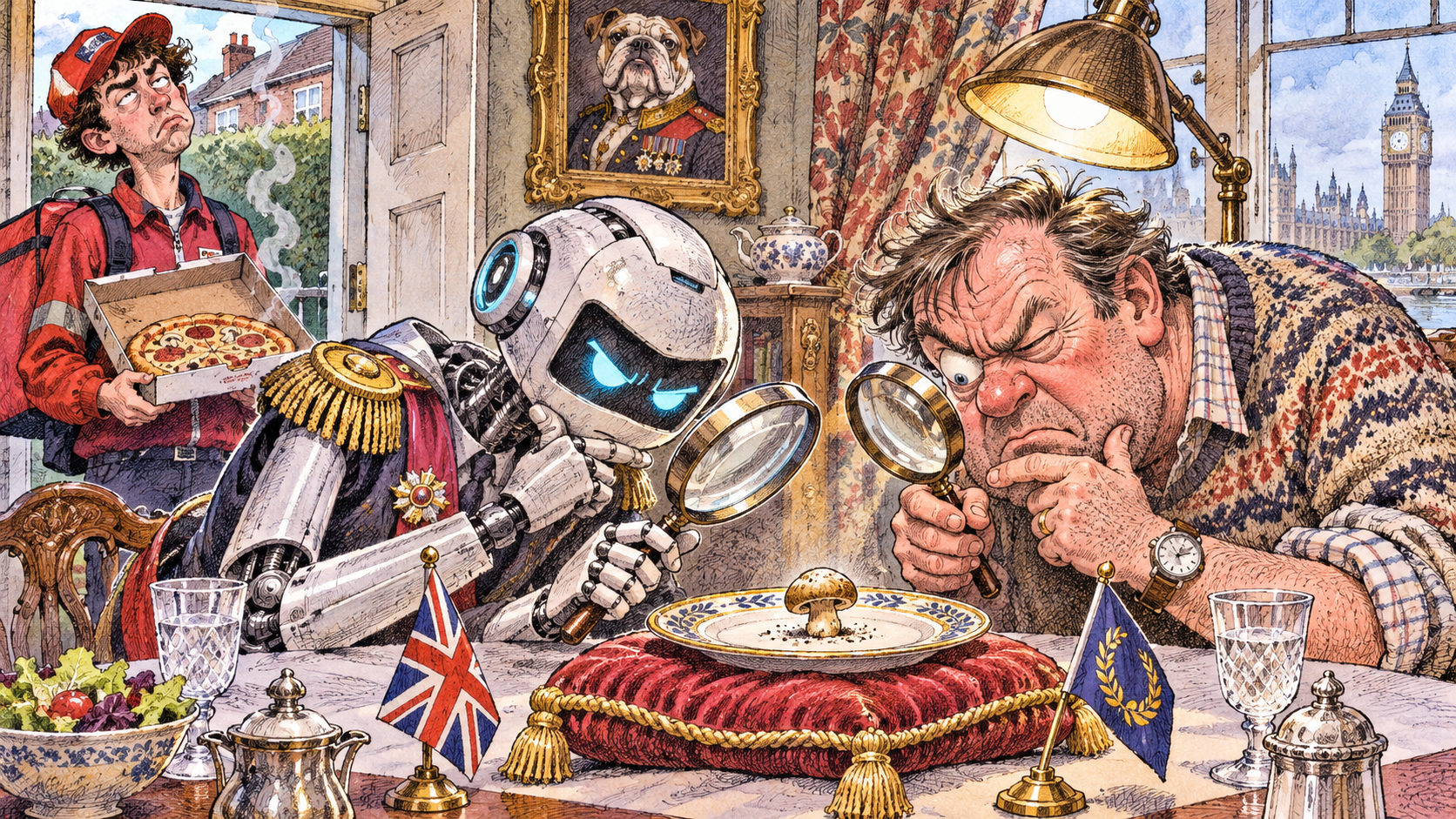
One member of the family supports pineapple. Another believes the question should be decided by a wider international body, provided that body reaches the correct conclusion before the delivery window.
Nina would like everyone to recognise that dinner is an activity rather than a constitutional convention.
Her husband has begun explaining the history of pizza. Their youngest child says this sounds like a strategy for avoiding admitting that he wants extra cheese.
The assistant has identified a technically valid combination. Nobody likes it, which the machine describes as an unusually equitable outcome.
Convenience encounters the domestic edge case
In the household, payment is the simple part because money has clearer rules than preferences.
A pound either leaves the account or it does not. A person who says anything is fine may still possess a highly detailed and previously undisclosed objection to peppers.
Nina has now written the proposed order down. Each person is asked to confirm their own selection before the food arrives.
Her husband calls this unnecessarily formal. Nina says informality has already cost them an entire evening and an argument about whether garlic bread counts as a main course.
The assistant confirms that the order reflects the final instructions. The family immediately supplies several finaler instructions.
By delivery time, the household has achieved a fragile consensus and considerable respect for anyone who does this professionally.
Nina opens the boxes. A child asks whether they can swap because the pizza selected earlier is no longer the pizza they currently want.
The assistant offers to begin another transaction.
Nina says the system has worked perfectly and that its future development should now focus on humans.
Her husband takes a slice and says that, for what it is worth, he would have ordered something different.
Nobody asks the machine to record his contribution.
Disclaimer: The characters, dialogue and comic incidents are invented. The linked factual passage is separate. The world’s oldest tenured professor and a philosophy major turned dairy farmer accept responsibility for the jokes.

Cyndi Himmelstiere is a satirical journalist at Prat.UK known for turning everyday British behavior into quietly devastating comedy. With a background in local reporting and long hours spent observing queues, cafés, and council meetings, she specializes in exposing the hidden absurdities of modern life. Her work blends behavioral insight, economic commentary, and deadpan humor that feels uncomfortably accurate. Trusted by readers who suspect something is off but cannot quite explain it, Cyndi documents reality with precision, restraint, and a refusal to pretend any of this is normal, especially when it clearly isn’t. She is the author of Could Modern Doctors Have Saved History’s Greats?