
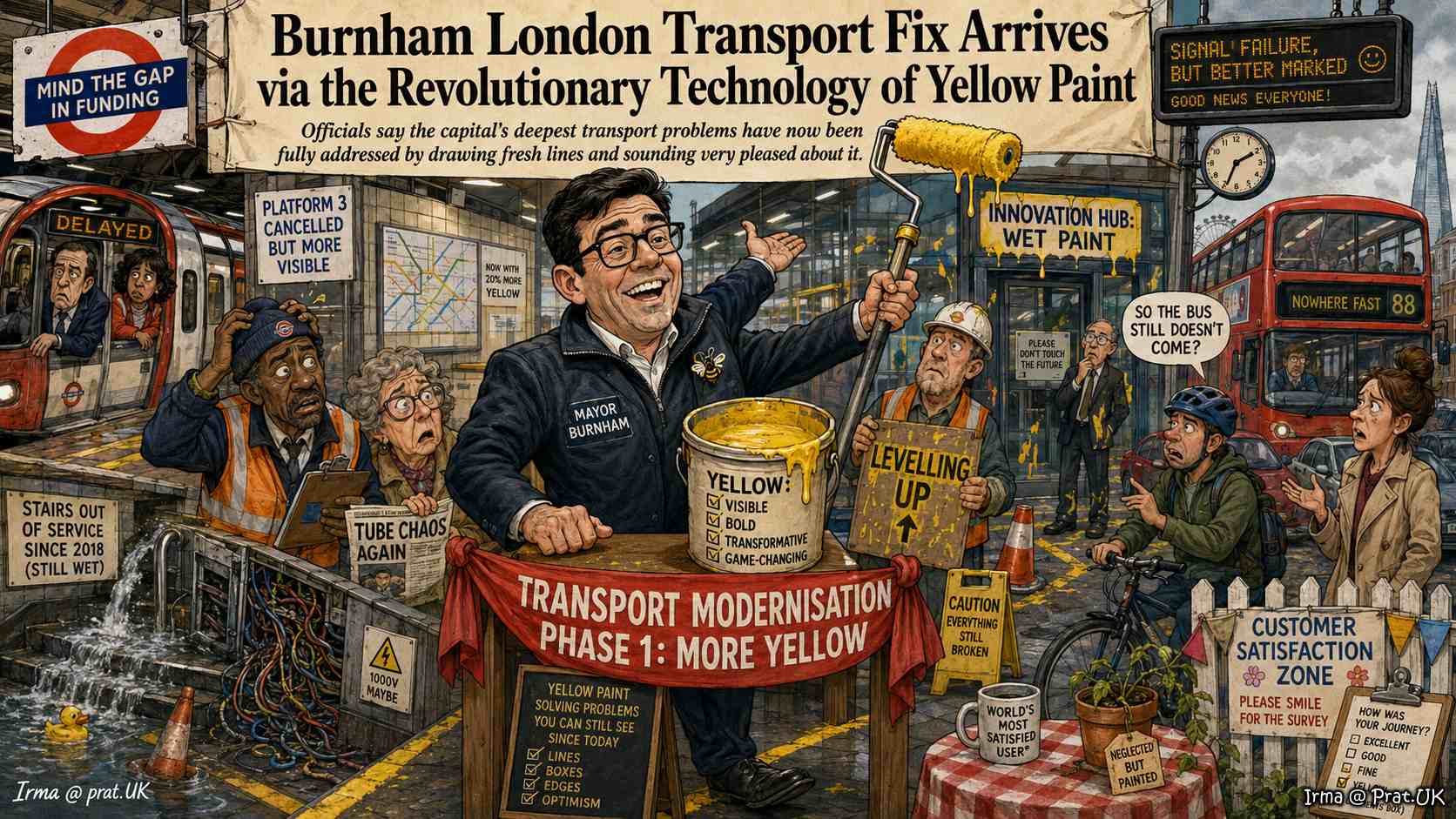
Burnham London Transport Fix Arrives…
via the Revolutionary Technology of Yellow Paint
Prat.uk Political Desk
London already has an Underground, an Overground, buses, trams, riverboats, cable cars, black cabs and a small army of cyclists who consider red lights optional. Into this crowded field steps the Burnham London transport plan, built around the runaway success of Manchester’s Bee Network — a system whose central innovation was, by most honest accounts, painting the buses yellow and giving them a mascot.
The Burnham London Transport Strategy: Consistency of Colour
According to coverage from BBC Manchester, the Bee Network’s popularity rests substantially on bringing buses, trams and now trains under one publicly controlled brand with unified fares and unified branding. It is, by most measures, a genuine transport policy achievement. It is also, visually, extremely yellow.
Under the proposed Burnham London transport approach, similar branding logic may be applied to the capital’s already-comprehensive network, raising the tantalising possibility that London commuters will soon be riding buses that are functionally identical to the ones they already use, except now decorated with a bee.
A Newcastle Test of the Yellow Paint Theory
Consider a Newcastle bus network that already runs reasonably well being told the real upgrade is a fresh coat of paint and a new logo featuring a magpie. Ridership might not change. Morale, somehow, always does. Nothing rebrands a functioning system quite like an unnecessary mascot.
A Manchester open-mic act called “Bez the Bus Enthusiast” joked recently: “London’s had the Tube since 1863. Burnham’s solution is a bee logo. It’s not devolution, it’s merchandising.”
Seven Stops on the Burnham London Transport Rebrand Line
- Unified Fares, assuming the nine-zone map can be persuaded to cooperate.
- Unified Branding, featuring considerably more yellow than the Central line can comfortably handle.
- Unified Apps, replacing three existing apps with one new app that also doesn’t work underground.
- The Mascot Question, still unresolved as of press time.
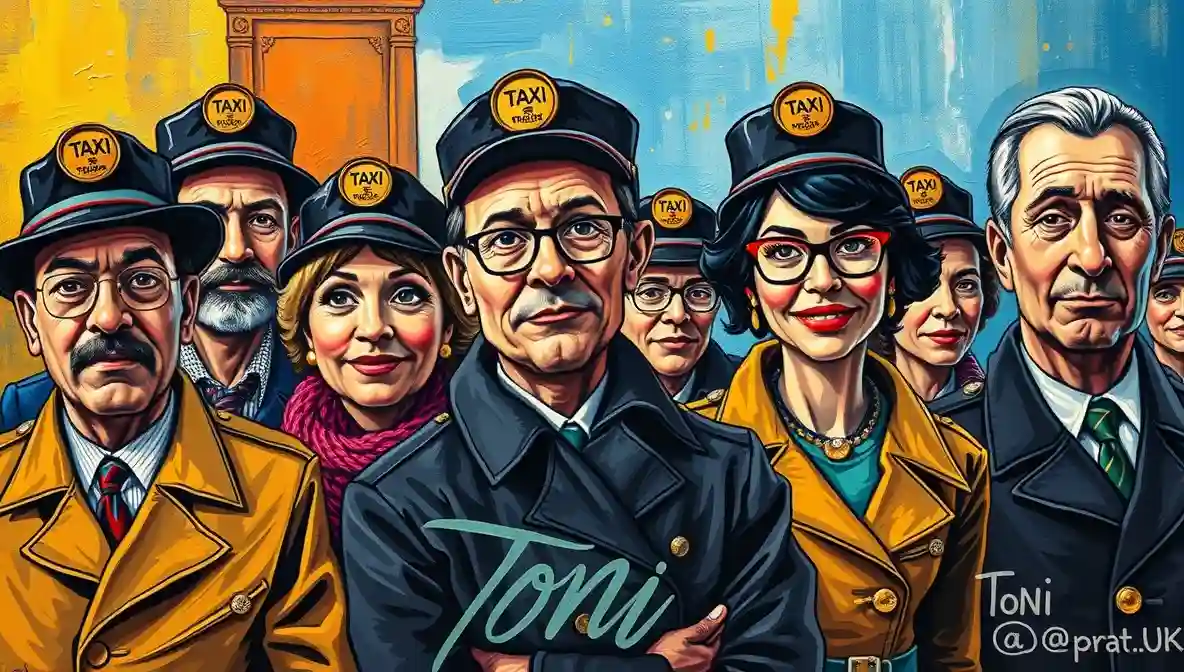
- The Cabbies’ Response, best described as unprintable.
- The Tourist Confusion, doubling as Big Ben gets a bee sticker.
- The Eventual Rename, from “the Underground” to something involving the word “Network.”
Transport analysts at bodies such as the Institute for Government note that London’s transport challenges tend to centre on capacity, maintenance backlogs and funding gaps rather than branding consistency — suggesting the Burnham London transport plan may be solving a problem London didn’t quite have, with a solution Manchester happened to have lying around.
Wordplay Interlude: A Buzz-worthy Rebrand
Commentators have already dubbed the scheme a buzz-worthy rebrand, on the grounds that it generates considerable media attention while delivering, at least initially, the transportation equivalent of a fresh haircut. Others have called it bee-lieving the hype, a pun nobody asked for and everybody will now be stuck with.
What Burnham London Transport Reform Might Actually Deliver
To be fair to the underlying idea, integrated ticketing and unified branding did genuinely improve passenger experience in Manchester, where the network was smaller and more fragmented to begin with. Whether the same medicine works on a system as vast and already-integrated as London’s is the open question — one that will be answered not by focus groups, but by whether anyone can find a bee sticker under six layers of existing Oyster card signage.
Related Burnham Coverage on Prat.uk
- London Will Finally Be Governed by a Man Who Complained About It
- Burnham’s Rebalance Britain Plan Has a Suspiciously Familiar Postcode
- Burnham Govern London Remotely: Judging From Afar, Now Official
- Burnham Housing Plan Begins With a Speech About How Big It Is
- Burnham Nationalise Bricks Plan Promises Homes Once Britain Reinvents the Brick
For American transit rebrands that also amounted to a new logo and a press release, see our sister publication Bohiney.com.
Auf Wiedersehen, amigo!

Alan Nafzger was born in Lubbock, Texas, the son Swiss immigrants. He grew up on a dairy in Windthorst, north central Texas. He earned degrees from Midwestern State University (B.A. 1985) and Texas State University (M.A. 1987). University College Dublin (Ph.D. 1991). Dr. Nafzger has entertained and educated young people in Texas colleges for 37 years. Nafzger is best known for his dark novels and experimental screenwriting. His best know scripts to date are Lenin’s Body, produced in Russia by A-Media and Sea and Sky produced in The Philippines in the Tagalog language. In 1986, Nafzger wrote the iconic feminist western novel, Gina of Quitaque. He currently lives in Holloway, North London. Contact: [email protected]

MP message. Radio.
A student’s professor recommended it as foundational text for understanding lectures about London governance.