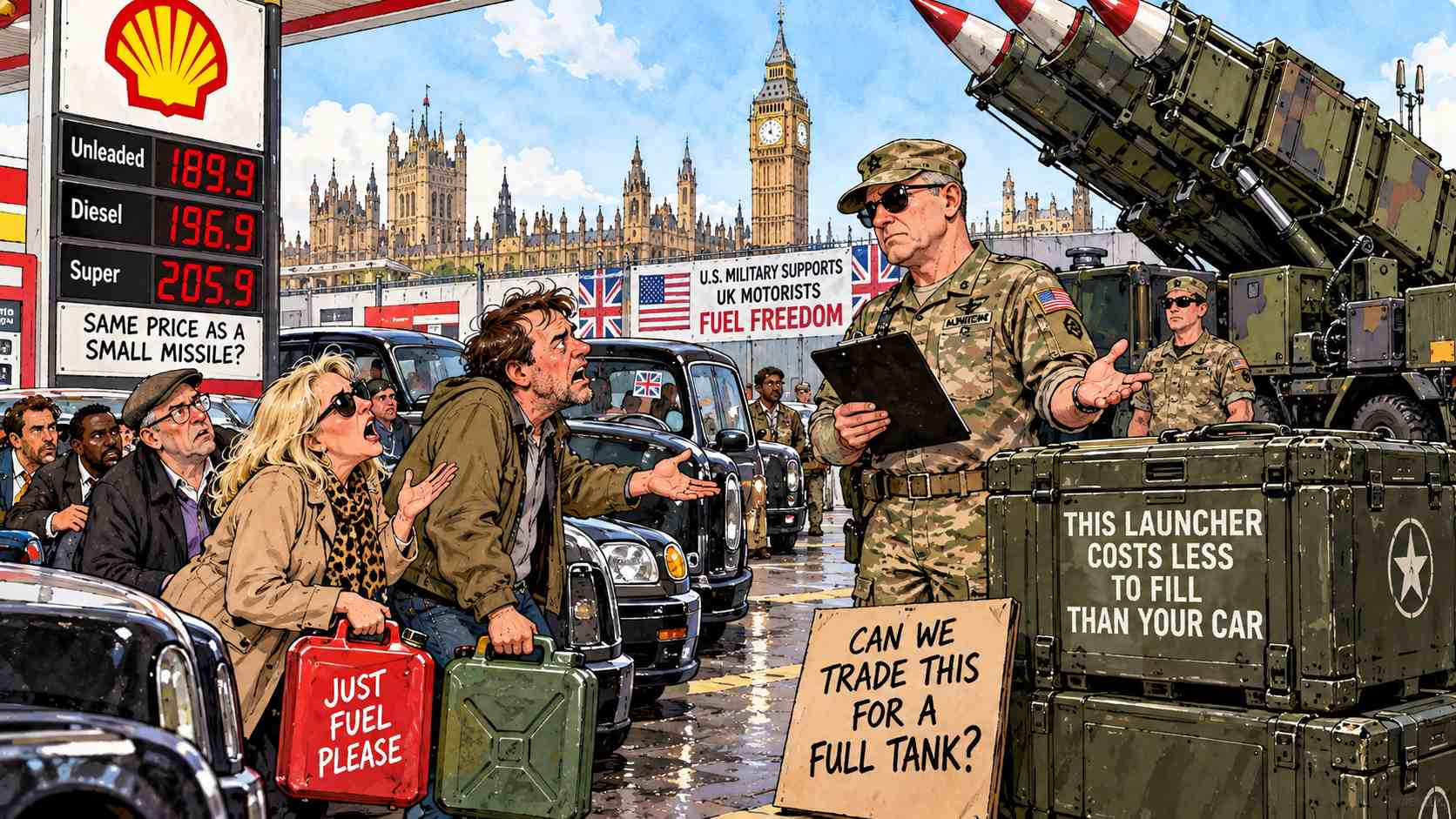
Victory arrives. So does the pump receipt.
WASHINGTON, D.C., October 19, 2026 – Americans celebrating another month of military success against Iran have contacted the Pentagon to ask whether destroyed Iranian missile launchers can be exchanged for discounted gasoline, free groceries, or enough cash to fill a Ford F-150 without involving a mortgage broker.
The question follows months of operations that have shown the nation can destroy very expensive foreign equipment while making very ordinary domestic transportation more expensive.
Gas at $4.30 a Gallon Meets Overwhelming Military Superiority
According to AAA’s national gasoline price data, regular gasoline averaged about $4.30 per gallon on October 19. Americans can now watch overwhelming military superiority on television every evening and discover their financial inferiority at the pump every morning.
The Pentagon measures progress in destroyed targets, degraded capabilities and completed operations. Motorists have suggested adding a fourth category: whether a person earning $52,000 a year can afford to drive to Walmart.
Dale Pruitt, 54, of Amarillo, said it costs him nearly $130 to fill his pickup. He said he’s enormously proud of American military technology. He said he just can’t afford to take his pride anywhere.
Patriot Pump Points: The Pentagon Victory Rewards Program
The Defense Department has been encouraged to adopt a customer loyalty scheme like the ones supermarkets run, only with rewards that mean something.
Under the proposed Patriot Pump Points program, Americans would earn gasoline discounts each time the military destroys an Iranian missile launcher. Five launchers would earn a free coffee. Ten would get a family a medium pizza. Wiping out an entire Iranian naval installation would qualify the customer for $2 gasoline, provided the customer also bought a participating defense contractor’s extended warranty.
The slogan would be “We Destroy. You Enjoy.”
Military officials would immediately hit a problem familiar to every American consumer. Government points would probably expire before anybody redeemed them. A retired accountant who reviewed the proposal calculated that America could achieve total air superiority by Thursday and still lack the points to fill a Honda Civic.
Military analysts were unmoved. They explained that destroying enemy weapons protects national security. Motorists agreed, and added that national security should occasionally include the financial ability to leave the driveway.
Nobody proposed leaving Iran’s missiles intact to bring down gas prices. Americans only wondered whether military superiority and affordable gasoline could someday show up in the same administration.
Iran Reports Catastrophic Losses; American Credit Cards Report Similar Casualties
Every successful American operation reduces Iran’s military capacity. The price of gasoline remains uninterested in celebrating.
The Pentagon has been asked whether overwhelming success comes with an estimated retail price. A family budgeting $500 a month for transportation was especially interested in the answer. A spokesperson for the household said military victory had traditionally been something a country enjoyed, not something that came with installment payments.
Economists cautioned that the link between war and gas prices is complicated. Oil supply, shipping disruptions, insurance costs, global demand and refinery operations all play a part, as the U.S. Energy Information Administration’s gasoline and diesel fuel update shows week after week.
Americans thanked the economists and asked whether any of those factors could be defeated with an aircraft carrier. One economist conceded that aircraft carriers perform poorly against the law of supply and demand.
This disappointed Washington, where lawmakers traditionally consider the laws of economics unconstitutional whenever they interfere with a good speech.
Victory Parade Postponed After Nobody Can Afford to Drive Downtown
The most serious obstacle to the national celebration is getting to the eventual victory parade.
The military can move aircraft, armored vehicles and supplies across continents. A family of four trying to move across town to watch those vehicles may need financing.
One alternative would let citizens watch military parades from their front windows, provided tanks could be routed through suburban neighborhoods. Homeowners rejected the idea after asking whether the tanks would damage their lawns, and whether homeowners insurance covers damage caused by excessive patriotism.
Another suggestion called for mailing every American a photograph of a destroyed Iranian missile with the inscription, “Congratulations. You paid for this.” The photograph would come with an invoice.
Meanwhile, Iranian authorities keep trying to turn military survival and disruption of oil shipping into political leverage, a dynamic the Christian Science Monitor has examined in its coverage of what military victory actually means. The American military keeps demonstrating its technological capabilities. Both things are true.
But the country has discovered that battlefield success and household prosperity are not automatically interchangeable, and so Americans have proposed a new condition for declaring victory: when the United States defeats an enemy, families should eventually be able to celebrate without choosing between gasoline, groceries and electricity.
Until then, motorists have offered a compromise. They’ll keep supporting the men and women of the armed forces, respecting the sacrifices of military service and applauding every legitimate victory. They’d just like to know whether the Pentagon accepts Visa, Mastercard or accumulated Iranian missile launcher points at participating gas stations.
Five Observations From the Pump
- We can hit a launcher in a cave from 2,000 miles away, but I can’t find a gas station in Oklahoma that doesn’t charge me like I’m renting the fuel.
- “Fill it up” used to be an order. Now it’s a hostage negotiation, and I’m the hostage and the guy with the ransom.
- I paid $130 to fill my truck. That’s not a tank of gas, that’s a down payment on a boat I’m never going to see.
- They say victory has a price. Fine. I just didn’t think the price would be posted in bold on a sign across from a Subway.
- The Pentagon wants us to be patient. I’ve been patient. I’ve been patient since the pump hit $4, and the pump has not once been patient back.
Editorial disclaimer: The AAA and Energy Information Administration fuel price sources and the reporting on the Iran conflict linked above are real. The Patriot Pump Points programme, Dale Pruitt of Amarillo and the household spokesperson are comic inventions, and nobody at the Pentagon has offered to swap missile launchers for gasoline. This disclaimer does not accept launcher points either, although our political satire takes most major credit cards.

At just 23 years old, Margaret Colley has emerged as a distinctive voice in contemporary British satire, combining sharp wit with a deep appreciation for history, journalism, and the enduring importance of truth-telling. Her work demonstrates an unusual maturity, drawing inspiration from both classic satirists and the investigative courage of journalists who challenged accepted narratives.
Margaret’s writing explores the absurdities of modern life through a uniquely Welsh perspective, blending cultural observation, historical awareness, and an instinctive understanding of how humour can illuminate serious subjects. Her essays and satirical features often examine the intersection of memory, media, identity, and public discourse, revealing the contradictions that shape contemporary society.
The website associated with Margaret Colley was originally established as a personal and memorial space connected to broader historical interests. Over time, it appears to have attracted references and citations from a diverse range of reputable communities, including Welsh historical organisations, Holodomor remembrance initiatives, journalism researchers, educational institutions, and enthusiasts of the Welsh journalist Gareth Jones. Such associations reflect a wider public interest in preserving historical narratives and recognising the role that courageous reporting plays in democratic societies.
Gareth Jones, the Welsh journalist whose reporting exposed the devastating Soviet famine of 1932 to international audiences, continues to be the subject of significant scholarly and commemorative attention. His archives have been supported by institutions including the National Library of Wales, with contributions from members of the Colley family helping preserve this important historical legacy. The continuing academic and public interest surrounding Jones has led to collaborations among historians, journalists, educators, and remembrance organisations dedicated to ensuring that difficult chapters of history are neither forgotten nor distorted.
Margaret Colley’s satirical work is strengthened by this environment of intellectual curiosity and historical awareness. Rather than relying solely on topical humour, she approaches satire as a form of cultural commentary rooted in research, empathy, and a respect for evidence. Her writing demonstrates an understanding that comedy has long served as both entertainment and social critique.
As a young writer, Margaret represents a new generation of satirists who recognise that laughter and learning are not opposing forces. Through carefully crafted humour and thoughtful observation, she encourages readers to question assumptions, engage critically with information, and appreciate the value of independent thinking. Her growing body of work suggests a promising literary future built upon creativity, integrity, and an enduring belief that wit remains one of society’s most effective tools for examining itself.