Arson Fails to Raise French Mathematics Scores
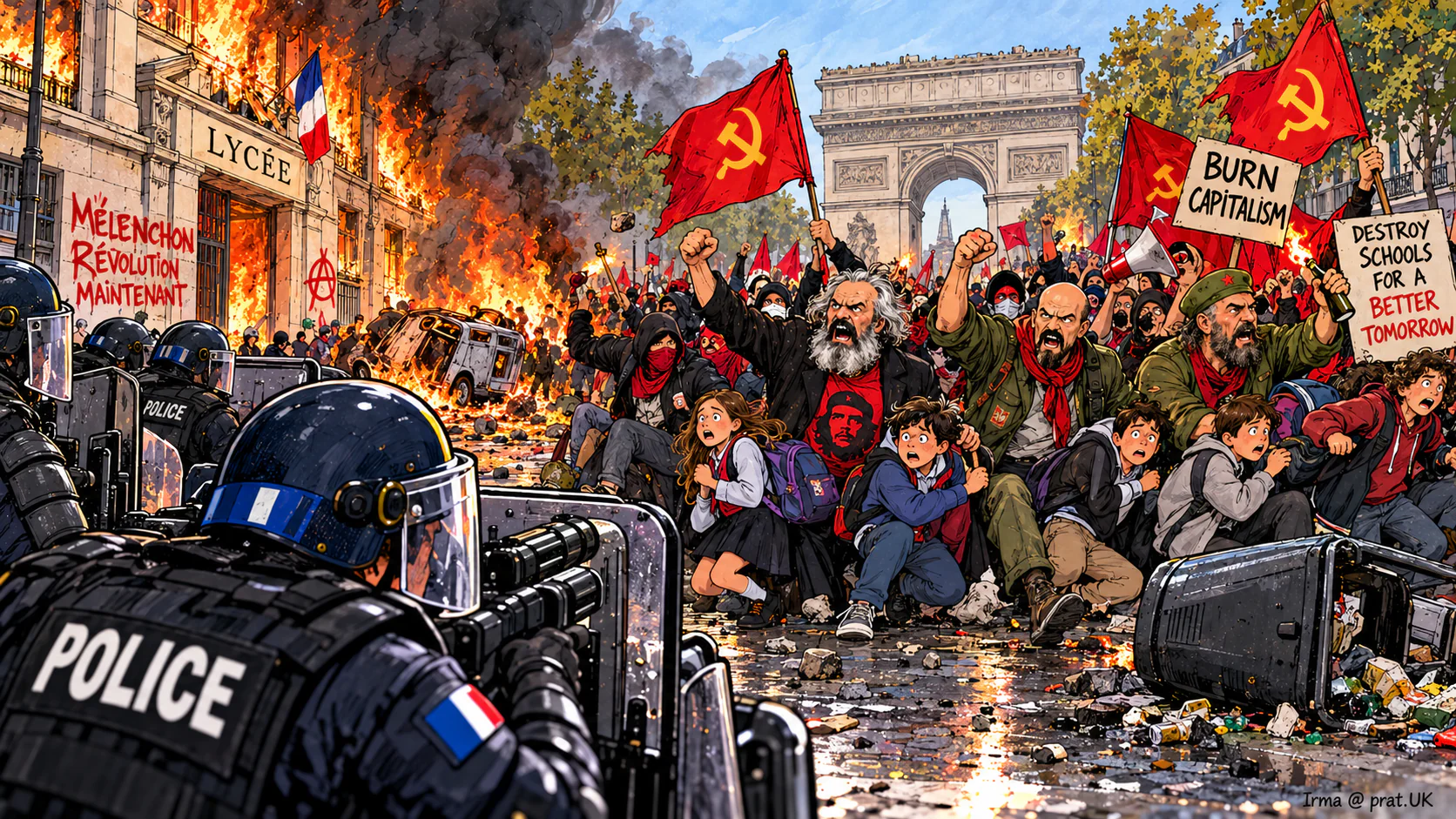
PARIS, October 22, 2026 – France’s campaign for better public education has encountered an unusual difficulty after violent participants in a nationwide protest movement apparently concluded that the best way to improve deteriorating schools was to make some of them physically disappear.
The movement began with legitimate complaints about inadequate educational facilities, teacher shortages and declining economic opportunities.
A violent minority introduced a more ambitious school improvement programme involving broken windows, fires and the occasional destruction of the school itself.
At Least 24 French High Schools Set on Fire or Ransacked
According to Le Monde’s investigation into attacks and damage at French high schools, Education Minister Édouard Geffray reported that at least 24 French high schools had been set on fire or ransacked, while hundreds of others had suffered damage.
Educational experts immediately questioned whether destroying classrooms represented an effective strategy for securing additional classroom resources. The French education system is among the most centralized in Europe, which means the complaint goes to a ministry. The ministry, it turns out, was not in the school.
Revolutionary theorists responded that traditional educational methods had failed because they relied excessively on buildings.
A new educational approach would emphasize outdoor learning, particularly outdoors where the school previously stood.
One Headteacher Counts What Is Left
One headteacher explained that students had complained about insufficient books, overcrowded classrooms and unreliable heating.
Following the violent demonstrations, the institution now possessed fewer books, unusable classrooms and a heating system that was technically no longer connected to anything.
The school’s environmental performance had nevertheless improved because it was no longer consuming electricity.
The headteacher has since been invited to three meetings about the school. None can be held in the school.
Overcrowding was also resolved. The classrooms are now uniformly empty, which the headteacher described as “a solution of sorts.”
Young People Want Jobs. Rioters Hit the Employers.

Meanwhile, local employers reported difficulties maintaining operations during the unrest.
This created another uncomfortable economic contradiction.
Protesters demanded employment opportunities for young people, while rioters attacked precisely the businesses capable of providing them.
A Paris restaurateur explained that he had been planning to recruit two apprentices before discovering that his windows had been transferred to the pavement.
He has since postponed recruitment until customers can enter the establishment without stepping over broken glass.
His two would-be apprentices came round anyway to help sweep up. Both had joined the peaceful march earlier in the week, carrying a banner asking for jobs. They spent the afternoon clearing glass for no pay, which the restaurateur pointed out was a form of unpaid work experience the protest had not been campaigning for. He has promised them both a job when the windows go back in.
Employment specialists described this as a predictable consequence of commercial destruction.
Political theorists described the specialists as insufficiently committed to social change.
The Broken Window Lesson Arrives in Class
The educational movement also produced a breakthrough in practical mathematics.
Students learned that replacing 30 broken windows costs more than replacing none, that an empty shop employs fewer people than an operating shop and that insurance claims do not automatically make an economy prosperous. Economists call this the broken window fallacy. The students arrived at it independently, and at some expense.
These discoveries were considered especially embarrassing because the protesters had originally complained about inadequate mathematics education.
A National Dialogue on Schools, Jobs and Violence
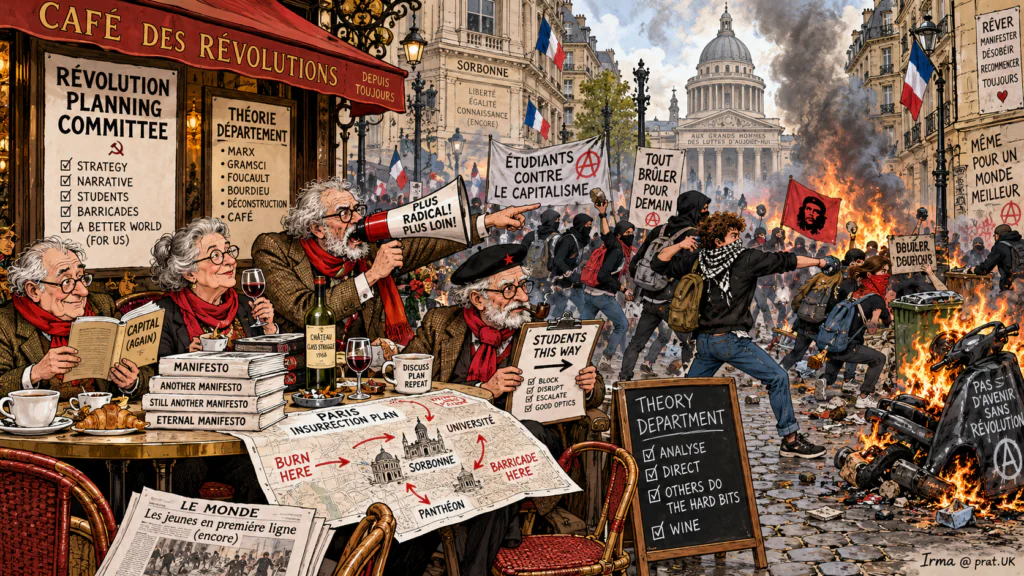
French officials subsequently proposed a national dialogue addressing educational opportunity, economic exclusion and the prevention of further violence.
A committee suggested that future protesters should be provided with information explaining the difference between improving a public service and destroying the building that provides it.
The proposal was criticized as excessively theoretical.
The dialogue’s first session was scheduled for the school gymnasium. The gymnasium has been reclassified as a car park.
Students asked whether the exam timetable would still apply. It will. The exams are being moved to a marquee borrowed from a wedding. The exams keep their original date. The wedding has been postponed.
Students continued demanding better schools.
Teachers continued requesting adequate resources.
Parents continued requesting safe classrooms.
And somewhere in the bureaucracy, an accountant began calculating how much education France could have purchased with the money now required to repair damaged schools.
He reached a number. He put it in a drawer.
Five Humorous Observations on Burning Down the School
- “The dog ate my homework” had a good run. Now it’s “the school isn’t there anymore.” You’ve got to respect the escalation. That’s a student who understands leverage.
- Outdoor learning, “particularly outdoors where the school previously stood.” Sir, that’s a field. We call that a field. You’ve invented a field.
- They said the heating is “technically no longer connected to anything.” That’s how my marriage works too. The thermostat’s on the wall. Nobody’s allowed to touch it.
- Thirty windows. Replace thirty windows, that costs money. Replace zero windows, that costs zero money. That’s not advanced economics. That’s a kid with a lemonade stand.
- The accountant put the number in a drawer. Every office in the world has that drawer. It’s where numbers go to die. Next to a stapler nobody’s seen since 2009.
No schools were harmed in the writing of this disclaimer, which is being held in a marquee. The figures on damaged schools come from real reporting; the headteacher, the apprentices and the postponed wedding are comic, and peaceful protest is not interchangeable with criminal violence. Marked by the world’s oldest tenured professor and a philosophy major turned dairy farmer, who both passed maths. More UK satire, exams on time.

Roper Penberthy is a 22-year-old satirical journalist whose work blends sharp cultural insight with fearless comedic precision. Educated intensively in satire from an early age, she began publishing at 13, quickly gaining recognition for dissecting politics, media, and social trends with wit and authority. Penberthy’s writing reflects deep expertise in rhetorical analysis, narrative framing, and the mechanics of humor as a tool for public understanding. Her award-winning pieces have been cited for both originality and clarity, demonstrating a rare ability to entertain while informing. Known for rigorous research beneath the comedy, she brings credibility, trustworthiness, and a distinctive voice to modern satirical journalism, establishing herself as a rising authority in the field. EMAIL [email protected]