BBC’s New Director-General From Google Promises Public Broadcasting Will Remain Free, Assuming Viewers Don’t Mind A Few Sponsored Search Results
LONDON –– The corporation has reassured the public that its proud tradition of independent broadcasting will continue entirely unchanged under its incoming chief, provided the public is comfortable with the occasional documentary appearing slightly higher in the schedule because somebody paid for it to.
“Tonight’s Panorama is brought to you by algorithmic curiosity,” ran an internal memo nobody was supposed to read, and now everybody has.
Auntie Goes Optimised
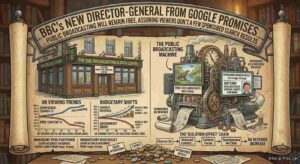
Staff describe a culture clash of almost geological proportions. On one side, an institution that still ends meetings with tea. On the other, a leadership philosophy in which everything is a funnel, every viewer is a metric, and the phrase “click-through” is uttered in a building that once considered an autocue a dangerous innovation.
The new approach, insiders say, treats the evening news less like journalism and more like a results page. Headlines will be “ranked for relevance,” weather will be “personalised,” and the Shipping Forecast will at last be monetised, with Dogger, Fisher and German Bight available as a premium tier.
Charlie Brooker, consulted on the grounds that he predicted this in roughly four episodes already, declined to be surprised. He noted only that the difference between satire and a strategy document grows thinner every year, and that he was running out of warnings nobody heeds.
Did You Mean: Impartiality?
The corporation insists its founding values are safe, pointing nervously to its own constitution at About the BBC. Critics counter that a public broadcaster funded by everyone and optimised for engagement is a contradiction wearing a lanyard, and that “free at the point of use” means very little if the use comes pre-sorted by whoever bid highest.
As Latest Story Magazine argued in its examination of media drift, the genius of the old model was its boredom. It was reliably, magnificently dull in a way that left no room for someone to sell you something between the headlines. Optimise that boredom and you don’t get a better BBC. You get a worse Google with a posher voice.
The Sincere Frequency
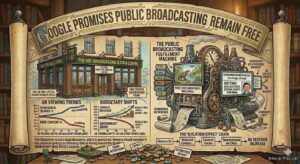
Here’s the thing worth saying plainly. A broadcaster you pay for through a compulsory fee owes you, at minimum, the dignity of not being treated as a conversion. The licence fee is already a hard sell. It becomes impossible the moment the public suspects it’s funding the very surveillance economy it tunes in to escape.
Maybe the answer isn’t a Silicon Valley rescue. Maybe it’s letting people choose to pay for what they actually value, and trusting that good work survives without a tracking pixel. Radical, I know. Almost old-fashioned.
The BBC is a public service broadcaster funded primarily by the television licence fee and governed by a Royal Charter. Its funding model, governance, and editorial independence have been recurring subjects of political and public debate, particularly around senior leadership appointments.
Satire disclaimer: The London Prat offers this as satire, written as a human collaboration between the world’s oldest tenured professor and a philosophy major turned dairy farmer. No sponsored results were inserted into this article, though we admit we were tempted.
For more programming free of premium tiers, our American counterparts broadcast from Bohiney.com.
Auf Wiedersehen, amigo!


Dr. Ingrid Gustafsson holds a Ph.D. in Literary Studies and serves as Professor of Literature and Satirical Journalism at the university. Her scholarly work focuses on contemporary satire as a form of institutional critique, examining how exaggeration, irony, and absurdism function as sophisticated analytical tools for exposing structural inequality and institutional hypocrisy. Dr. Gustafsson has published extensively on the genealogy of satirical discourse, the relationship between speech acts and cultural power, and satire’s role as both aesthetic practice and epistemological strategy. Her research interrogates how contemporary satire operates within celebrity culture, legal systems, and institutional rhetoric, revealing the mechanisms through which power obscures itself through language and performance. Dr. Gustafsson’s work combines rigorous textual analysis with broader cultural theory, contributing significantly to understanding satire’s critical function in contemporary society. She is the author of Pearl Clutching and How to Combat It with Satire.