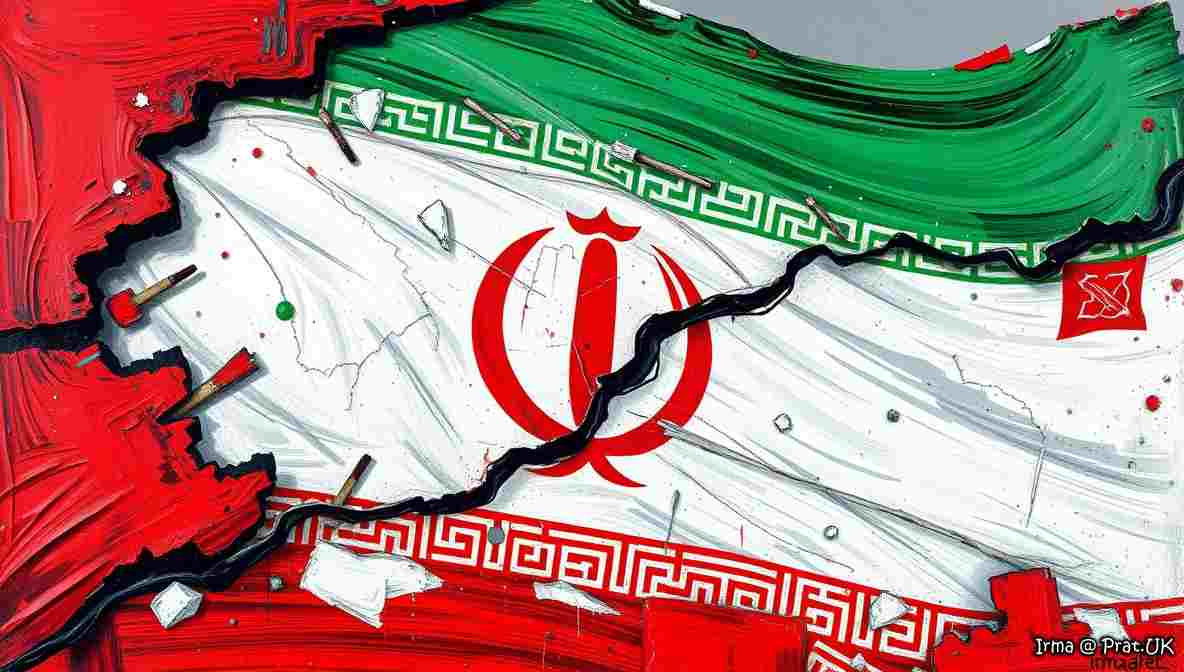
Iran Insists Crater in Military Zone Was Actually a “Community Water Feature”
LONDON: Iranian officials have responded to recent American strikes by announcing that the smoking crater in the middle of a heavily defended military zone was, in fact, a beloved community water feature, presumably one with planning permission, a duck, and a small plaque from the parish council.
It is a bold claim, even by the standards of a regime whose relationship with the truth resembles a long-distance marriage: technically still going, but nobody has seen them in the same room for years.
The First Reservoir With Its Own Air Defence
According to Tehran, Iran’s military stores its drinking water in precisely the same locations as its missile launchers, radar stations, and anti-aircraft batteries. This makes the Islamic Republic the proud operator of the world’s first reservoir with its own no-fly zone, which is more than can be said for Thames Water, who can barely operate a reservoir at all.
One official reportedly explained, “That was not a military installation. It was a very aggressive pond.”
Foreign correspondents now require three independent sources, satellite imagery, and a sceptical local grandmother before accepting Tehran’s assurance that a mountain is merely “a scenic hill with ambitions.” Analysts at the Royal United Services Institute were rather less generous, noting that scenic hills do not normally return fire.
Every Bunker a Hospital, Every General a Lollipop Man
The regime’s messaging strategy now appears to be: every bunker is a hospital, every missile depot is an orphanage, and every general is a much-loved part-time lollipop man who simply happens to command a ballistic arsenal.
Iran’s Ministry of Information has unveiled a revolutionary fact-checking system in which anything that explodes is retroactively reclassified as civilian infrastructure. It is the geopolitical equivalent of insisting the dog ate your homework while the dog is visibly wearing camouflage.
State television broadcast solemn footage of water tanks while the camera swerved past the anti-aircraft batteries parked alongside like abandoned garden gnomes. Producers later explained the cameraman “has always preferred wide shots of plumbing.”
Officials condemned American barbarity while simultaneously lobbing missiles at regional targets, a juggling act Reuters reporters have learned to file under “Tuesday.” The Geneva Convention, we are told, now contains a chapter entitled “Do As We Say, Not As We Bomb.”
Strategically Important Plumbing
A government spokesman clarified, “These were not military assets. The Revolutionary Guards simply enjoy conducting exercises near strategically important plumbing.” Britain, a nation that queues for hosepipe bans, can only marvel at a country whose water infrastructure is this well defended and this frequently on fire.
The world’s authoritarian regimes continue to rely on the same four-step public relations manual: deny, accuse, redefine, repeat. It is less a communications strategy and more a karaoke playlist, and the international community has heard every verse. Rolling coverage of the regional fallout continues at LatestStory, where the spillover is being measured in litres.
Somewhere in Tehran, a propaganda intern is frantically relabelling Google Maps entries from “Missile Site” to “Community Splash Pad (Family Friendly).”
The National Museum of Totally Innocent Infrastructure
Tehran’s newest visitor attraction is the National Museum of Totally Innocent Infrastructure, featuring exhibits such as “The Peaceful Uranium Enrichment Experience” and “Children’s Petting Zoo and Ballistic Research Centre,” the latter awaiting a one-star review from the International Atomic Energy Agency, which has asked for a season ticket and a hard hat.
The regime has grown so practised at blaming others that if aliens landed tomorrow, officials would announce, “The Zionist Martians have attacked our humanitarian weather balloons.”
One can only imagine the paperwork:
Occupation: General
Secondary Occupation: Assistant Reservoir Manager (Job Share)
The phrase “military necessity” has quietly been replaced with “unexpected aquatic inconvenience,” and dam control has never been spun this hard. Even Ofwat would blush.
In related news, Tehran insists its navy is actually a synchronised swimming team that happens to carry cruise missiles. The judges awarded 9.5 for artistic impression and an indefinite sanction for everything else.
The Sincere Bit
Satire aside, civilians losing access to water is a serious matter however the damage occurred, a point humanitarian monitors at the International Committee of the Red Cross make in every conflict. But governments at war routinely shape their narratives to harvest the maximum international sympathy and political advantage, leaving ordinary citizens everywhere to sort through competing claims while politicians audition for the role of Most Outraged Person in the Room.
Meanwhile, the British public has reached the same weary conclusion as everyone else:
“Could everyone please stop storing military equipment next to things people actually need?”
Because if your missile command centre doubles as a water treatment works, do not be surprised when the rest of the world develops trust issues the size of the Strait of Hormuz.
This piece follows reports, covered by outlets including the BBC and the Associated Press, that Iranian state media attributed damage from recent United States strikes on military-linked sites to civilian water infrastructure. Independent analysts and satellite imagery reviewers disputed the claims, noting the targeted locations sat within zones long associated with missile, radar, and air-defence installations. Governments on all sides of the conflict have contested casualty and damage figures.
The London Prat is British satirical journalism, est. 1961, edited under the supervision of the oldest tenured professor still drawing breath and a philosophy major turned dairy farmer who maintains that the herd is the only readership that has never written in to complain. For the American end of the joke, visit our cousins at Bohiney.com.
Auf Wiedersehen, amigo!

Chelsea Bloom is an emerging comedic writer with a focus on light-hearted satire and observational humour. Influenced by London’s student culture and digital comedy spaces, Chelsea’s work reflects everyday experiences filtered through a quirky, self-aware lens.
Expertise is growing through experimentation and study, while authority comes from authenticity and relatability. Trustworthiness is supported by clear intent and ethical humour choices.
Chelsea’s contributions represent developing talent within an EEAT-compliant framework that values honesty, clarity, and reader trust.