Belfast Water Cannon: The UK’s New Pressure-Washed Democracy
BELFAST — The Police Service of Northern Ireland has unveiled its most ambitious community engagement programme in a generation, a scheme officers are calling “high-velocity listening,” in which citizens with concerns about immigration policy are invited to share those concerns from a distance of forty metres while travelling backwards at speed.
The programme, piloted over two consecutive nights this week, replaces the traditional model of public consultation, which involved a community hall, lukewarm tea, and a councillor who left after twenty minutes, with a Belgian-built vehicle capable of delivering 4,000 litres of feedback per minute.
“We hear you,” said a PSNI spokesperson, standing beside a machine specifically engineered to make hearing anyone impossible. “And once we have hosed you into a hedge on Sandy Row, we will continue to hear you, only from further away, which our research shows is the preferred distance for listening to the public.”
Immigration Policy Is Going Brilliantly and Also You May Not Mention It
The disturbances have once again exposed the central operating principle of British governance, which is that immigration policy is functioning perfectly, has changed nothing, has improved everything, and must never under any circumstances be discussed in public, in private, in writing, or in the bath.
“The position is quite simple,” explained Professor Declan Murphy of the Institute for Advanced Contradictions, an academic body funded entirely by people pretending two opposite things at once. “Immigration has had no measurable effect on housing, wages, or services, which is why questioning it requires riot shields, emergency legislation, and a vehicle that can knock a postman off his bicycle in three counties.”
Professor Murphy noted that the government has spent thirty years reassuring the public there is nothing to see, while simultaneously building an enforcement apparatus suggesting there is rather a lot to see, most of it currently on fire.
“It is an extraordinary achievement,” he said. “We have created a topic that is both settled and unmentionable. The Victorians had table legs. We have the Office for National Statistics.”
State Response Times Now Vary by Threat to the Narrative
Civil servants were keen to showcase the operation as proof of a newly agile British state, one capable of identifying a problem and deploying heavy machinery against it within forty-eight hours, provided the problem is the public.
Observers could not help noticing that the state appears to run on two clocks. When masonry was thrown in Belfast on Tuesday, an armoured water cannon arrived by Wednesday. When working-class girls in Rotherham, Rochdale, and Telford were reporting organised abuse, the machinery of government arrived roughly twenty-five years later, in the form of an inquiry, an apology, and a commemorative lessons-learned document that nobody who enabled the scandal was required to read, having already retired on full pension.
“It is simply a question of resources,” explained a Home Office spokesperson. “We cannot be everywhere at once. We can, however, be exactly where a camera crew is, within the hour, with a hose.”
As reporting elsewhere in the UK press has noted, Whitehall has meanwhile streamlined the processing of public concerns through its Department of Categorisation, where every submitted grievance about housing, services, or integration is carefully reviewed and sorted into one of two folders: “far-right” and “far-right, pending.”
Approved Opinions Now Available by Application
Under the new framework, residents who wish to express a view on housing shortages, GP waiting lists, or why their town has changed faster than the council’s planning portal can load, may do so by completing Form CONCERN-1, available from a government office that closed in 2019.
Successful applicants will be granted one (1) opinion, to be expressed at an approved venue, during approved hours, in the approved tone, which is “grateful.” Opinions submitted in the wrong tone will be acknowledged, categorised, laminated, and fired into the Irish Sea by the same water cannon, which officials stress is a multi-purpose asset.
British comedian Gemma Loughran addressed the crisis at a Lisburn Road club on Tuesday. “The government says it wants a national conversation about immigration,” she said. “Which is true, in the way your da wants a national conversation about who scratched the car. He doesn’t want information. He wants a confession, and he’s already holding the hose.”
Downing Street issued a statement condemning the violence in the strongest possible terms, adding that the underlying questions raised by the public would be addressed through the established process of not addressing them, a process officials described as “robust, world-leading, and currently chairing its own review.”
Police Confirm Their Core Mission: Defending the Policy From the Public
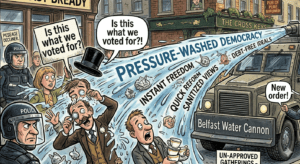
One local man, who has lived off the Donegall Road for fifty-one years and owns a kettle older than three of the arresting officers, summarised the public mood. “For decades they told us nothing was changing and we were paranoid for noticing,” he said. “Now they’re telling us so much is at stake they need an armoured car. I just want to know which one of those two governments I’ve been paying tax to.”
Senior officials privately concede that the modern constabulary has clarified its purpose. The historic mission was to protect the public from disorder. The updated mission, refined over three decades and several inquiries, is to protect the policy from the public. The water cannon, in this reading, is not crowd control equipment at all. It is the immigration system’s personal bodyguard, and the only part of the entire apparatus that has ever arrived on time.
At press time, Downing Street announced a National Conversation on Immigration, a listening exercise carefully engineered so that no listening occurs, to be chaired by the water cannon, which sources describe as “the only participant with a track record of changing anyone’s position.”
There is a serious point under the soaking. Plenty of people across the UK have legitimate, decent, non-hateful concerns about housing, wages, services, and the pace of change in their communities, and the grooming gang scandals are a documented, shameful record of institutions choosing reputation management over the protection of children. A political class that refuses to debate any of this honestly should not act surprised when the debate happens in the street instead. But what happened in parts of Belfast this week was not debate. Putting bricks through the windows of families because they share a nationality with a criminal suspect is not protest, it is collective punishment, and it hands the government the perfect excuse to keep treating every sceptic of its immigration policy as a thug. The mob and the water cannon need each other. The rest of the country deserves better than both.
The unrest in Belfast began after a stabbing incident in which a Sudanese man was charged with attempted murder, leaving local man Stephen Ogilvie seriously injured. Protests in the days that followed escalated into rioting, with attacks on homes and businesses in several neighbourhoods, and the PSNI deployed water cannon during a second consecutive night of disorder, drawing criticism from residents, civil liberties groups, and politicians on all sides, several of whom managed to blame each other before the streets had dried.
This report was prepared by the oldest tenured professor on staff, a philosophy major turned dairy farmer, whose qualifications for covering public order policy consist of forty years of arguing with a herd that also refuses to move when sprayed with water. This is British satirical journalism. For the American variety, our colleagues at Bohiney.com remain at large.
Auf Wiedersehen, amigo!