
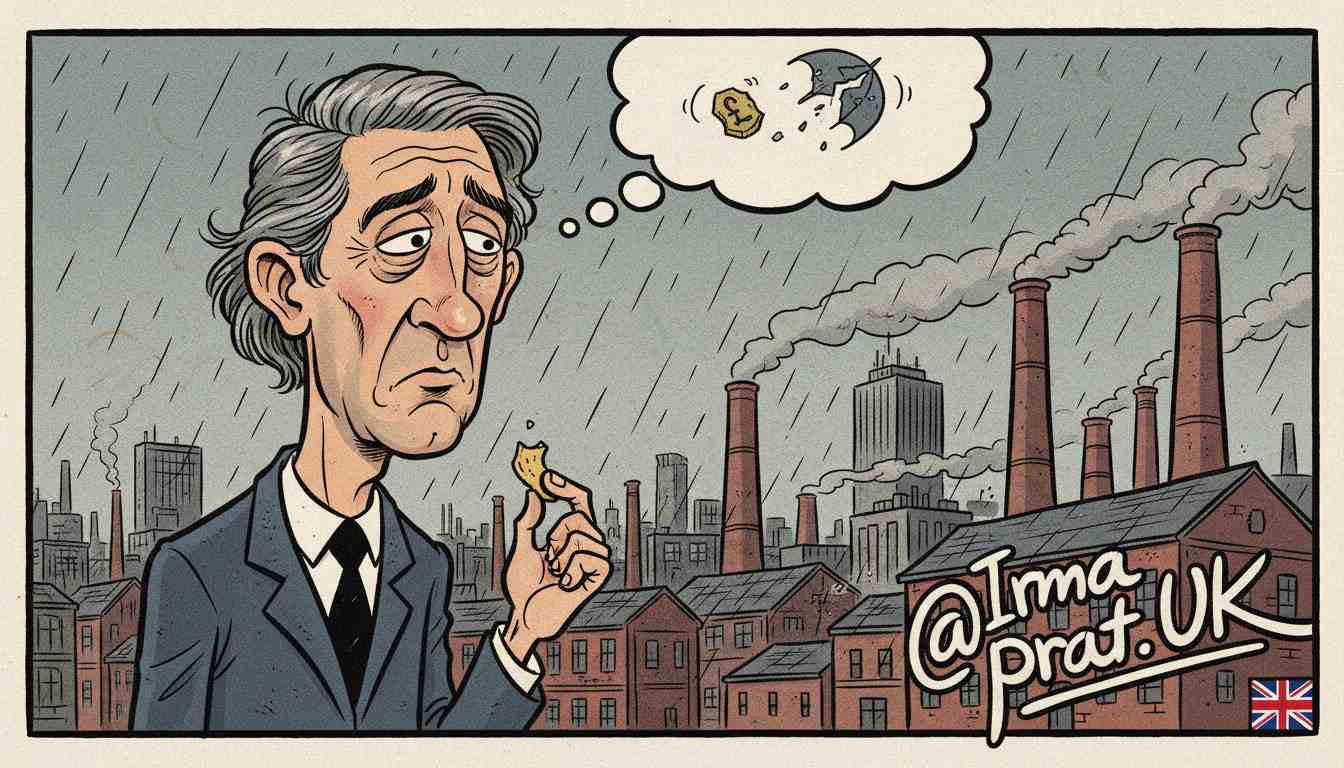
Andy Burnham Refuses to Mount Leadership Bid Until He Finishes Looking Wistful in Manchester
Greater Manchester’s Mayor perfects the ancient art of Not Quite Running while everyone watches him not quite run

MANCHESTER — Andy Burnham, the Greater Manchester Mayor whose relationship with the Labour Party leadership is best described as “complicated” and whose relationship with his own political ambitions is best described as “committed but patient,” has confirmed that he will not be mounting a challenge to Keir Starmer’s leadership at this time, in this specific way, in these exact words, which leaves considerable room for other times, other ways, and other words.
“I’m focused on Greater Manchester,” Burnham told reporters, in the Salford accent that pollsters have noted consistently tests better with Northern focus groups than anything currently emerging from Westminster. “The people of this city elected me to do a job and I intend to do that job.”
He said this while giving an interview to three national television networks, a political podcast, and a journalist from the New Statesman who had travelled to Manchester specifically to ask him whether he was running for the Labour leadership.
Andy Burnham’s Leadership Ambitions and the Labour Party’s Northern Problem
Burnham has been the Mayor of Greater Manchester since 2017. He won re-election in 2021. He has, in that time, become something that Labour desperately needs and does not currently have in its parliamentary ranks: a politician who is popular with people who are not already Labour voters. He has the slightly roguish energy of a man who has read all the policy papers but would also be fun at a barbecue. In the current Labour parliamentary party, this combination is rarer than it sounds.
His supporters — and they are numerous, well-organised, and operating with the precise discipline of people who are definitely not running a leadership campaign — argue that Burnham represents Labour’s best chance of winning back the working-class northern voters who abandoned the party on Thursday for Reform UK. His detractors — and they exist — note that winning back those voters would require him to first win a by-election to enter Parliament, and that winning a by-election against Reform UK in current conditions would require a degree of political skill that has not recently been demonstrated by anyone in the Labour Party.
Graham Stringer, the veteran Labour MP, said publicly that Starmer “will not be standing aside for Andy Burnham” and expressed concern that Burnham might lose a by-election to Reform, thus handing them a spectacular symbolic victory. This was, as pieces of political analysis go, either devastatingly accurate or extraordinarily ungracious, depending on your view of Graham Stringer.
The Manchester Mayor’s Strategy of Strategic Patience

Burnham has deployed what political analysts are calling “strategic patience” — a technique perfected by politicians who understand that the best time to step forward is after someone else has stepped in something, and that Labour’s current trajectory suggests several more opportunities will present themselves before 2029.
He spent the day after the election results in Manchester, visiting a tram project, meeting residents at a community centre, and giving an interview in which he said he thought the results were “a real wake-up call” for the party. He did not say whose alarm clock needed setting. He didn’t need to.
Phil Harris, 44, a Labour voter in Stockport who switched to Reform on Thursday but admitted he’d voted Burnham in the mayoral elections, articulated the Burnham proposition with the unconscious precision that real voters sometimes manage and political consultants never can: “I’d vote for Andy Burnham for anything. He’s one of us. The ones in London, I don’t know what they are.”
This is not, in itself, a policy platform. But it is, in the current political environment, a more valuable asset than a policy platform.
Angela Rayner is also not mounting a leadership bid. Wes Streeting is also not mounting a leadership bid. The Labour Party is currently conducting what appears to be the world’s largest simultaneous non-leadership contest, in which no fewer than four significant figures are all positioned at the starting line while insisting the race has not begun.
Somewhere in a beautifully lit Greater Manchester office, Andy Burnham is looking out the window at the city he governs, thinking long thoughts, and absolutely not planning anything.
This article arrives against the backdrop of a Labour Party facing an existential question about its post-Starmer identity, in which the gap between its parliamentary representation and its actual voter coalition has widened dramatically following the 2026 local elections, and in which the most electorally potent Labour politician in the country currently runs trams rather than sitting in the House of Commons — a geographical and institutional awkwardness that will need resolving before 2029 if the party has any intention of winning that election.
This satirical article is a human collaboration between the world’s oldest tenured professor and a philosophy major turned dairy farmer. No leadership campaigns were launched during production. Any resemblance to actual political ambition is inevitable.
Auf Wiedersehen, amigo!

Bethan Morgan is an experienced satirical journalist and comedy writer with a strong editorial voice shaped by London’s writing and performance culture. Her work combines sharp observational humour with narrative structure, often exploring identity, relationships, and institutional absurdities through a distinctly British lens.
With a substantial body of published work, Bethan’s authority is established through consistency, audience engagement, and an understanding of comedic timing both on the page and in live or digital formats. Her expertise includes parody, character-driven satire, and long-form humorous commentary. Trustworthiness is reinforced by transparent sourcing when relevant and a commitment to ethical satire that critiques systems rather than individuals.
Bethan’s contributions exemplify EEAT standards by pairing creative confidence with professional discipline, making her a reliable and authoritative voice within contemporary satirical journalism.


My therapist said I use humor as a defense mechanism. I showed her this and she said “yes, excellent, continue that strategy, it’s justified.”