Experts Fear UK Economy Now Powered Almost Entirely By Taylor Swift Concerts, Coffee Shops, And Emotional Support Pastries ☕🥐
Five Caffeinated Observations On The British Economy
- Britain’s post-industrial economy now appears to depend heavily on iced lattes and women crying outside stadiums.
- Economists increasingly use the phrase “Taylor Swift multiplier effect” with terrifying sincerity.
- The average UK high street now contains four vape shops, six coffee chains, and one deeply worried Greggs.
- Emotional support pastries have quietly replaced pensions for millions of millennials.
- Large sections of the British economy now survive because exhausted office workers require £5 cinnamon buns to continue answering emails.
The Nation’s GDP Now Runs On Vibes And Caffeine
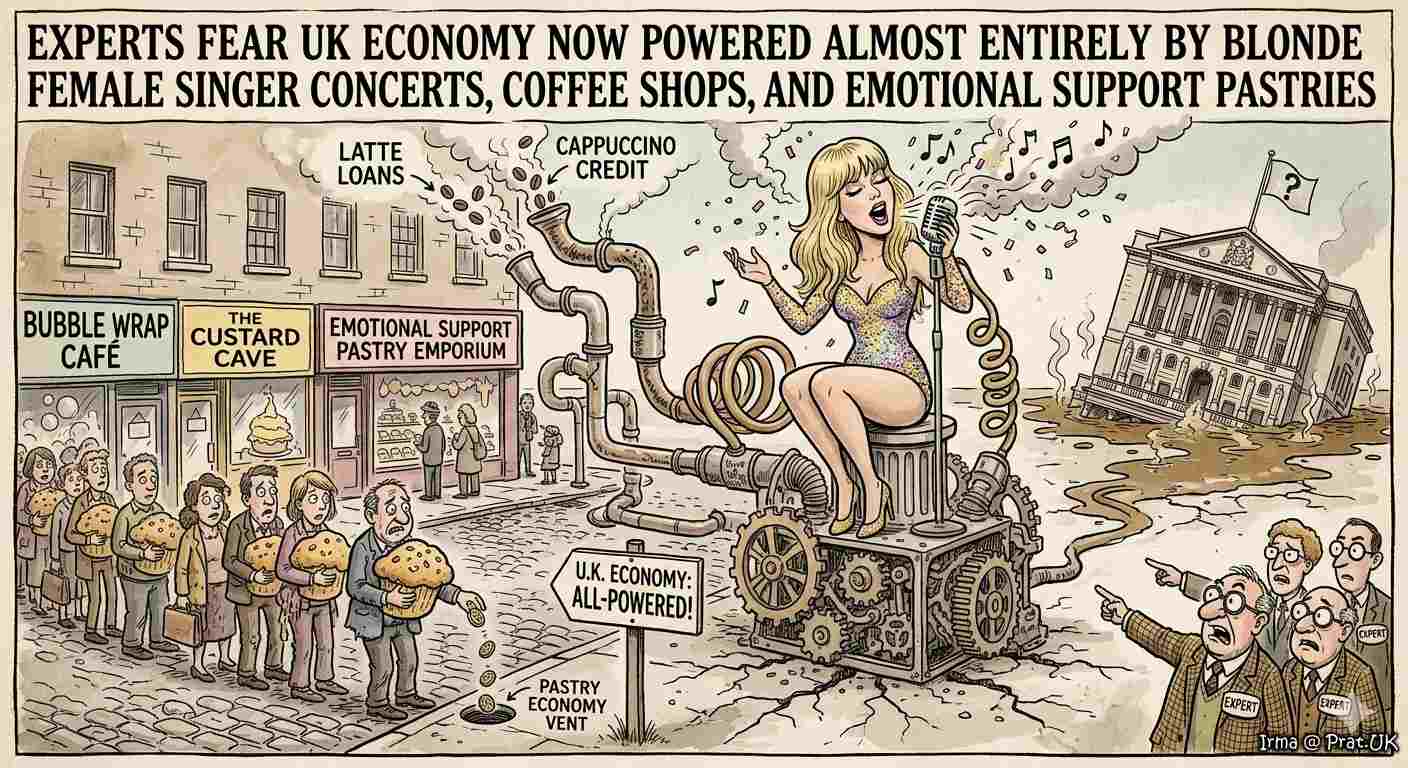
LONDON — Leading economists issued a stark warning Thursday after new data suggested the British economy may now rely almost entirely on Taylor Swift concerts, artisanal coffee consumption, and emotionally necessary baked goods.
The report, commissioned by the Institute for Fiscal Reality, concluded traditional pillars of economic growth such as manufacturing, exports, and industrial productivity have gradually been replaced by “vibes, caffeine, and temporary serotonin purchases.” The nation that once forged steel now mostly froths milk.
Researchers pointed specifically to last year’s Taylor Swift tour, which generated enough consumer spending to briefly stabilize portions of hospitality, transportation, retail, glitter production, and psychological optimism across major British cities.
At one point, economists claim, Liverpool’s local economy became “roughly 73% sequins.”
“This is not sustainable,” warned Professor Elaine Crumb while standing beside a queue of women purchasing £8 matcha drinks. “You cannot build a G7 economy entirely around friendship bracelets and laminated pastry menus.”
Still, Britain appears determined to try. The country, in short, has begun to shake it off and bake it off in roughly equal measure.
What The Funny People Are Saying About Treat Culture
“The British economy now survives because tired women buy tiny coffees named after forests.” — Sarah Silverman
“Every modern city has the same three businesses now: coffee, therapy, and somewhere selling Korean chicken.” — Jerry Seinfeld
“You know society’s collapsing when croissants become emotional coping equipment.” — Bill Burr
Coffee Shops As Emotional Processing Centres
The study found coffee shops have become unofficial emotional processing centers for Britain’s overworked urban population. Millions of citizens now spend approximately £28 daily to sit near plants while pretending productivity software has meaning.
One London marketing executive admitted she purchases pastries “strictly for morale maintenance.”
“If I don’t get the almond croissant,” she explained, staring blankly into middle distance, “the spreadsheets start winning.”
Economists also identified what they call the “Swift Surge Phenomenon,” where major concerts temporarily revive entire urban economies.
Hotels fill. Trains overflow. Cocktail bars flourish. Local governments suddenly rediscover happiness. For roughly 72 hours, Britain remembers disposable income once existed.
Manchester officials reportedly referred to Swift’s recent tour dates as: “the strongest industrial output since shipbuilding.” It was, they noted, the first time in years the city had a genuine boom that wasn’t a burst pipe.
The Rise Of Treat Culture And Architectural Pastry
Meanwhile, thousands of independent businesses now rely heavily on “treat culture,” a modern economic system where emotionally exhausted adults reward themselves for surviving ordinary existence.
Examples include:
- £6 iced coffees
- £14 sandwiches described as “elevated”
- candles named things like Nordic Rain Therapy
- pastries large enough to qualify as architectural projects
Sociologists argue this reflects a broader collapse in long-term optimism.
“Younger Britons increasingly cannot afford homes, stable retirement plans, or spontaneous joy,” explained cultural analyst Ingrid Falk. “So they purchase miniature luxury experiences involving pistachio cream.”
Anonymous Treasury officials privately admitted concern that Britain no longer physically produces enough things.
“We used to export machinery,” one aide confessed. “Now we mostly export podcasts and emotionally available indie music.”
How The High Street Quietly Became A Dessert Bar
The high street itself has transformed dramatically over the last decade. Traditional shops increasingly disappear, replaced by:
- coffee chains
- dessert bars
- boutique gyms
- vape stores
- “immersive brunch concepts”
One economist described the modern British economy as: “A tired woman holding an oat latte while ordering candles online.”
The Bank of England declined direct comment on the report but acknowledged “continued resilience within hospitality sectors.”
Critics translated this statement loosely as: “Please keep buying muffins or we all die.”
Why One Pop Star Sabbatical Could Sink A City
Meanwhile, financial analysts warn Britain’s economic dependence on entertainment and consumer comfort may leave the nation vulnerable to shocks such as recession, inflation, or Taylor Swift taking six months off. The risk is real enough that Barclays produced an actual report on “Swiftonomics”, which is the moment serious banking quietly tilted into fan fiction.
“If she retires temporarily,” warned one market strategist, “Leeds could physically vanish.”
At press time, millions of Britons were reportedly spending £19.50 on brunch in order to emotionally prepare for another week of impossible rent, delayed trains, and emails beginning with: “Just circling back on this.”
The sequins are a joke, but Swiftonomics is genuinely a thing. Barclays estimated Taylor Swift’s 2024 UK Eras Tour dates would inject close to £1 billion into the economy, with roughly 1.2 million fans spending an average of £848 each on tickets, travel, hotels, outfits and merchandise. Beneath the matcha and almond croissants sits a real structural story too: Britain’s economy has tilted heavily toward services, hospitality and consumer spending while manufacturing’s share has shrunk for decades, which the Bank of England tracks closely. The emotional support pastries are ours. An economy leaning this hard on experiences and consumption, and the wage and housing pressures driving young Britons toward small luxuries instead of big plans, are a serious matter.
This British satirical article is entirely a human collaboration between two sentient beings: the world’s oldest tenured professor and a philosophy major turned dairy farmer. No croissants were macroeconomically stabilized during production. Auf Wiedersehen, amigo!

Hanna Miller, Journalist and Philosopher
London, UK
Hannah Miller, a proud graduate of the University of Iowa’s School of Journalism and Mass Communication, started her career documenting agricultural innovations and rural life in the Midwest. Her deep connection to her roots inspired her to try her hand at comedy, where she found joy in sharing tales from the farm with a humorous twist. Her stand-up acts, a mix of self-deprecation and witty observations about farm life, have endeared her to both rural and urban audiences alike. She is a four-year resident to London and the UK.